


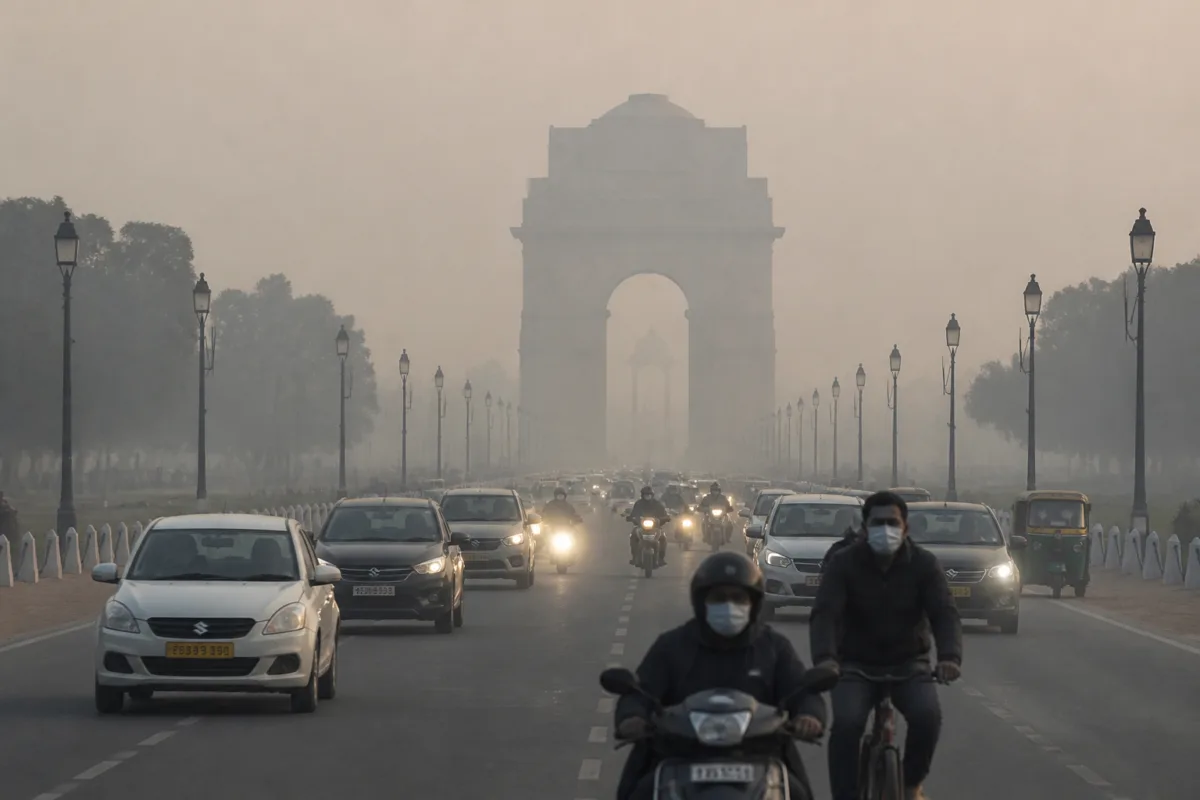
Delhi’s air quality deteriorated sharply to an AQI of 377 on Wednesday, with several monitoring stations recording readings above 400 and authorities warning that the capital could enter the severe category by Friday. The deterioration has coincided with a rise in the estimated contribution of stubble burning and stagnant weather conditions that are trapping pollutants close to the ground.
According to the report citing news agency ANI, local sources accounted for 31% of Delhi’s pollution on Wednesday, while sources outside the capital contributed 69%. The estimated contribution from stubble burning rose from 8.2% on Tuesday to 16.2% on Wednesday. IITM projections cited in the report indicate that the share could reach 20% by Friday, potentially exceeding the contribution from vehicular emissions.
The worsening conditions have prompted the Commission for Air Quality Management (CAQM) to issue show-cause notices to the deputy commissioners and senior superintendents of police in five Punjab districts. The districts named in the notices are Barnala, Bathinda, Fazilka, Jalandhar and Faridkot. CAQM had previously issued notices to officials in Gurdaspur and Kapurthala.
The notices place responsibility for crop-residue burning within the administrative focus of the neighbouring state as the seasonal pollution episode intensifies. The supplied report does not specify the response deadline or the action proposed by the district administrations.
Several Delhi monitoring stations recorded air quality in the severe range even as the city’s overall AQI remained in the very poor category. IIT Delhi recorded an AQI of 455, followed by Jahangirpuri at 449, Punjabi Bagh at 446, Mundka at 439, Vivek Vihar at 436, Rohini at 432, Narela and Alipur at 429 each, Sonia Vihar at 427 and ITO at 411. An update attributed to the Central Pollution Control Board placed the AQI around India Gate at 399 at 6:40 am, also in the very poor category.
Delhi’s winter pollution-control plan came into effect on 1 November, according to the report. The plan restricts private construction activity from 1 November to 31 January, while a complete ban is scheduled from 10 December to 20 January. Under measures linked to GRAP-II, the entry of BS-IV or older vehicles registered outside Delhi has also been restricted.
The escalation comes despite these restrictions and highlights the operational difficulty of controlling pollution across a region where emissions move across administrative boundaries. The report also identifies vehicles as the largest local pollution source, while noting that smoke from crop-residue burning has worsened conditions in recent days.
Environmental expert Anumita Roychowdhury said vehicles remain the biggest local pollutant source, but added that stubble-burning smoke had further aggravated the situation. She attributed the near-ground accumulation of pollution to high moisture and low wind speeds.
Delhi experienced a visibly hazy sky on Wednesday, followed by light haze and fog on Thursday morning. The maximum temperature was recorded at 29.8 degrees Celsius and the minimum at 16.1 degrees Celsius. Agencies cited in the report expect the severe conditions to persist for about six days, with Friday identified as the point at which the capital’s overall air quality could deteriorate further.

