


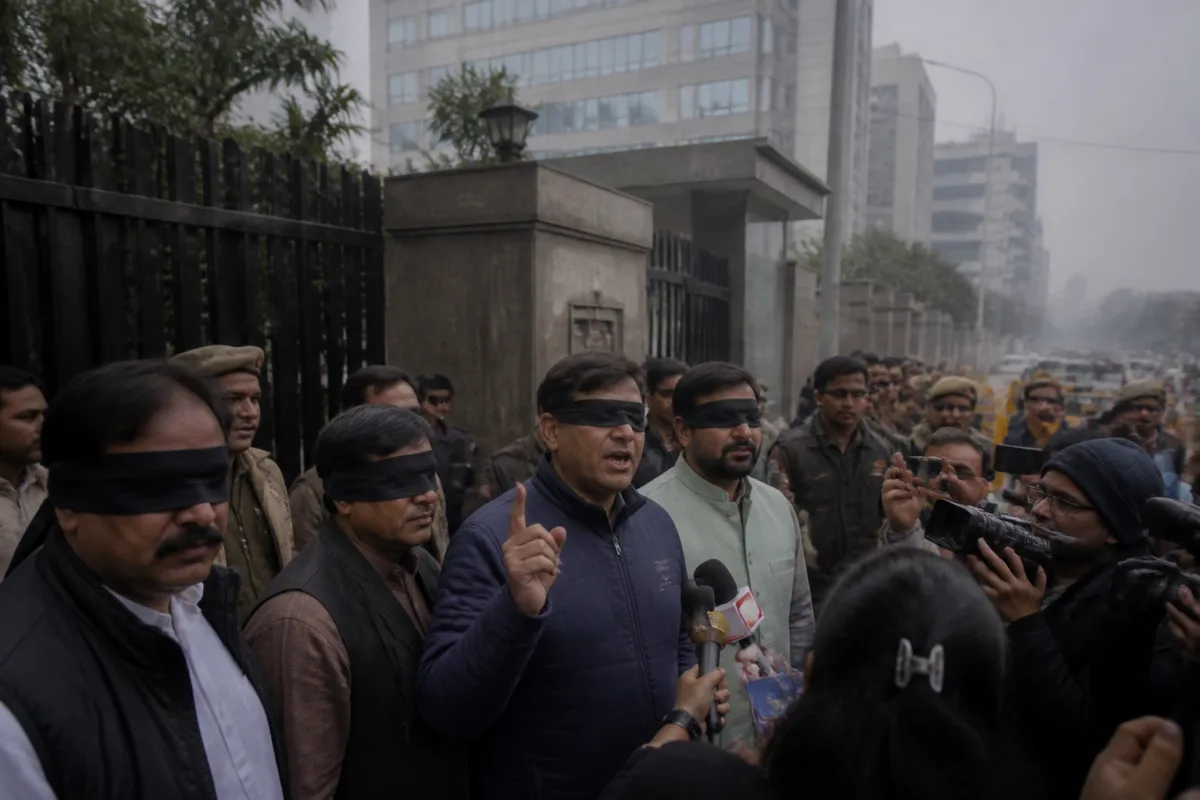
Aam Aadmi Party Delhi president Saurabh Bhardwaj led a demonstration outside the Commission for Air Quality Management (CAQM) office on Wednesday, alleging that air-quality monitoring data in the capital was being manipulated and accusing the commission of failing to act on complaints.
Bhardwaj and other AAP workers arrived at the office wearing black blindfolds. Speaking to the media outside the premises, he alleged that monitoring stations were switched off during Diwali night and that water was sprayed over stations in pollution hotspots to influence readings. The claims were reported by Live Hindustan – NCR and were not independently established in the supplied report.
Bhardwaj said the alleged interruption of monitoring during Diwali prevented residents from knowing the extent of pollution caused by firecrackers. He also claimed that the issue had been raised before the Supreme Court last year and that the court had directed CAQM to file a status report. The supplied report does not include the text of that direction or any response from CAQM on the matter.
The AAP leader further alleged that monitoring stations had been placed in green areas to produce lower AQI figures and described this as an attempt to mislead the public. He said the party had submitted a written complaint to the CAQM chairperson around 10 days earlier, but had not received a response. According to Bhardwaj, a subsequent request for a meeting also went unanswered.
Bhardwaj said the delegation had gone to meet CAQM officials rather than stage a protest, but alleged that the office gate was closed and that police were sent to detain party workers. The supplied report does not provide an independent account from CAQM, the Delhi government or the police regarding the claims about access, detention or the alleged monitoring practices.
AQI monitoring is central to how residents, regulators and courts assess the severity of air pollution and determine the need for restrictions or emergency measures. Monitoring stations collect readings from specific locations, meaning disputes over station placement, operational continuity or local interference can affect public confidence in the data. The report, however, does not provide technical evidence, station records, inspection findings or an official audit confirming the allegations.
The demonstration has placed CAQM’s role in the centre of a fresh political dispute over the transparency of Delhi’s pollution data. CAQM is responsible for coordinating air-quality management across the National Capital Region, but the supplied report does not state whether the commission has opened an inquiry, issued a clarification or scheduled a meeting with the AAP delegation. Any official response or status report would determine the next stage of the dispute.

