


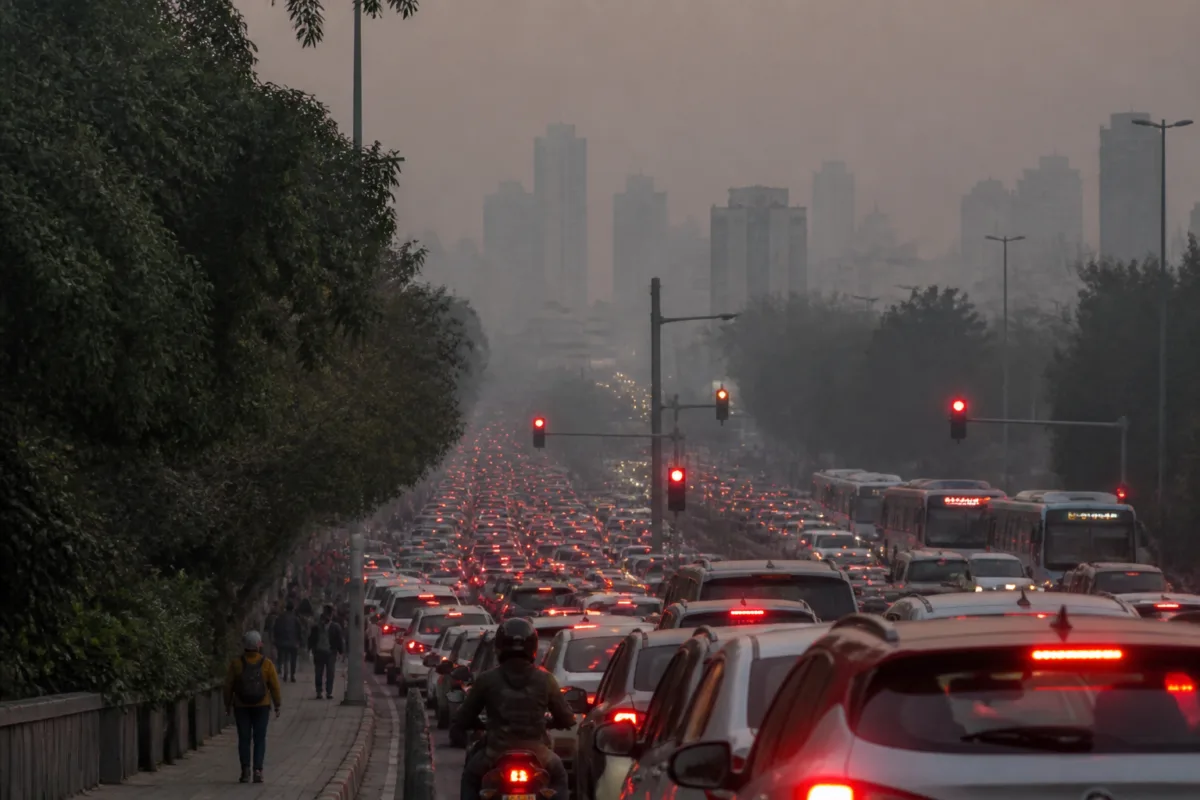
Delhi’s air pollution problem is becoming harder to explain through the familiar focus on stubble burning alone. A new analysis by the Centre for Science and Environment (CSE) says the capital entered the period before Diwali with a much higher baseline of pollution than in previous years, while vehicle emissions and other internal sources remained the dominant contributors. The findings also raise questions about whether short-term restrictions under the Graded Response Action Plan (GRAP) can address a problem produced by year-round traffic, congestion and weakly controlled urban emissions.
The CSE analysis is significant because it links Delhi’s deteriorating air quality to the way the city moves. On November 6, when Delhi’s Air Quality Index reached 382, the contribution from stubble-burning smoke was estimated at only around 8 per cent. The largest share, according to the analysis, came from vehicle emissions and other sources within the city. This does not eliminate the role of crop-residue burning or fireworks in producing sharp seasonal spikes, but it challenges the idea that Delhi’s winter pollution can be primarily attributed to emissions from neighbouring states.
The distinction matters for governance. If the largest sources are located within Delhi and the wider urban region, then measures that are activated only after air quality deteriorates will have limited effect. The CSE findings suggest that the city’s air is already heavily polluted before the most visible winter triggers intensify the situation. By that stage, emergency restrictions on construction, vehicle movement and other activities are attempting to manage a problem that has accumulated over several weeks or months.
The available figures show how early deterioration can change the starting point for the entire winter season. The average PM2.5 level before Diwali was reported at 236 micrograms per cubic metre in 2026, compared with 120 in 2025 and 179 in 2024. The 2026 level was therefore 97 per cent higher than the previous year and 32 per cent higher than in 2024. CSE’s assessment says pollution before Diwali was higher than in previous years, with only a slight decline at the end of September after rainfall.
These numbers describe more than a single episode of bad air. They indicate that the city began the high-risk season with a substantially heavier pollution load. Once the baseline is elevated, additional emissions from crop-residue burning, fireworks, traffic congestion and stagnant winter weather can push air quality rapidly into hazardous ranges. The CSE analysis argues that preventing this initial accumulation is as important as controlling the seasonal peaks.
The traffic connection is central to that argument. Delhi’s morning and evening peak-hour congestion is associated with high emissions from vehicles travelling slowly or remaining stationary on crowded roads. The analysis also points to stable night-time air, which allows nitrogen dioxide levels to remain high until midnight. In a city where large volumes of traffic continue through the evening, pollution is not confined to daytime commuting hours.
The report’s use of the Travel Time Index adds a mobility measure to the air-quality debate. Even after restrictions were introduced, commuters during peak hours spent between 13 per cent and 31 per cent more time on the roads than under normal conditions. The figure suggests that restrictions on some categories of vehicles did not resolve the underlying congestion problem. In some circumstances, partial restrictions can leave the broader volume of daily travel largely intact while shifting trips, routes or traffic loads across the network.
The stated objective of GRAP is to provide a graded response to worsening air quality. In practice, the CSE assessment says, different stages are imposed after pollution has already become severe, including curbs on vehicle movement and construction. This creates a governance pattern based on emergency intervention rather than continuous emissions management. It also produces uncertainty for residents, workers and businesses, particularly when rules change according to air-quality levels and weather conditions.
The problem is not simply that a restriction may be too weak. It is that the restriction may be aimed at the wrong level of the system. A ban on vehicles below the BS-VI emissions standard, for example, may remove some vehicles from the road without reducing the total number of journeys enough to ease congestion. If public transport does not absorb the displaced travel demand, residents may continue to make essential trips by other modes or face longer journeys on already crowded roads.
The CSE analysis therefore places public transport at the centre of the response. CSE Executive Director for Research and Advocacy Anumita Roychowdhury said Delhi would find it difficult to escape the severe pollution situation without a strategy to reduce the total number of vehicles on the roads, strengthen public transport and implement stringent measures across the National Capital Region throughout the year. The statement describes the challenge as a regional and structural one rather than a short seasonal emergency.
That regional dimension is important because Delhi’s air basin does not follow administrative boundaries. The source material identifies vehicle emissions and internal sources within the capital, while also noting the role of neighbouring states in public and political discussions about pollution. A year-round approach across the NCR would need coordination between multiple governments and agencies, although the supplied analysis does not specify a new institutional mechanism or funding arrangement for that coordination.
The evidence also points to a mismatch between the timing of action and the timing of pollution formation. The CSE analysis says the authorities apply different GRAP stages instead of taking effective measures throughout the year. This means that construction restrictions and vehicle controls are introduced when pollution is already visible in monitoring data, rather than when emissions are building up unnoticed. Emergency measures may be necessary during severe episodes, but the figures suggest they cannot substitute for a continuous urban emissions strategy.
Delhi’s traffic system makes that substitution particularly difficult. Congestion is both a mobility problem and an air-quality problem. When peak-hour travel times rise by 13 to 31 per cent, vehicles remain in the transport system for longer, even if their distance travelled does not increase proportionately. The result is a connection between road capacity, travel demand, vehicle technology and pollution exposure. The CSE analysis does not provide a complete breakdown of emissions by vehicle type or corridor, but it identifies traffic as a major part of the city’s internal pollution burden.
The health implications are also tied to where and when people travel. Elevated nitrogen dioxide levels continuing until midnight expose commuters, roadside workers and residents living near congested corridors to prolonged pollution. The supplied material does not quantify the health burden or identify specific neighbourhood-level exposure patterns. It does, however, show that air pollution is embedded in everyday urban activity rather than being limited to isolated industrial or rural sources.
The findings also complicate the public communication of pollution. Attributing deterioration mainly to stubble burning offers a simple seasonal explanation, but the CSE figures indicate that this explanation is incomplete. On the day Delhi’s AQI reached 382, the estimated contribution from stubble burning was around 8 per cent. The remaining pollution came largely from vehicles and other sources, according to the analysis. Effective communication therefore depends on distinguishing between the sources that cause acute spikes and those that maintain a high baseline.
The same distinction applies to fireworks. CSE’s assessment says that if winter began with cleaner air, and if sudden increases from stubble burning and fireworks were controlled, seasonal changes would not produce such severe pollution. This is a source-control argument: reducing peak events matters, but the outcome will remain poor if the city starts the season with a high concentration of pollution already in the atmosphere.
The available evidence does not establish that GRAP alone caused Delhi’s worsening air quality. It shows instead that the restrictions, as implemented, failed to prevent heavy congestion and did not stop the city from recording a much higher pre-Diwali PM2.5 average. That distinction is important. A response can be insufficient without being the sole cause of the problem. The CSE analysis criticises the reliance on episodic restrictions and identifies the absence of year-round control as the larger weakness.
For urban governance, the central question is whether air-quality management is being treated as an emergency protocol or as a core transport and land-use responsibility. The reported figures connect pollution to vehicle numbers, public transport capacity, traffic congestion and regional coordination. They also show that construction curbs and vehicle restrictions become disruptive when introduced late, while still failing to address the total volume of movement through the city.
Delhi’s worsening pre-Diwali pollution therefore exposes a structural gap in the current response. The evidence confirms a higher 2026 PM2.5 baseline, a limited estimated contribution from stubble burning on the worst reported day, persistent traffic congestion and continued high nitrogen dioxide levels at night. What remains unclear from the supplied analysis is how emissions are distributed among vehicle categories, corridors and other internal sources. The next test for authorities will be whether the city can move beyond seasonal GRAP interventions towards the continuous, NCR-wide emissions and public-transport strategy identified by CSE.

