


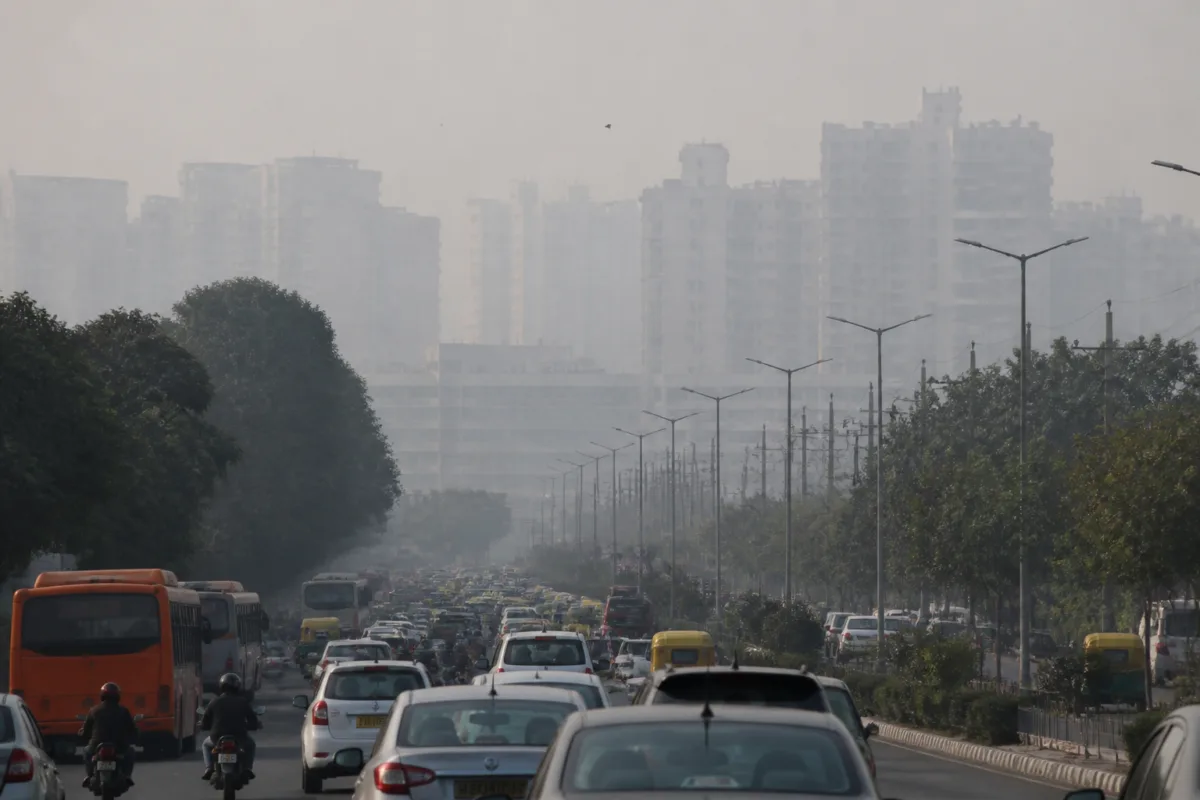
Delhi’s air quality was recorded in the poor category on Sunday morning, with the citywide Air Quality Index (AQI) reaching 222 at 9 am, according to the Sameer app. The reading places the capital in a pollution band that can affect daily outdoor activity and reflects uneven conditions across the city’s monitoring network.
Of Delhi’s 54 air-quality monitoring stations, 31 recorded readings in the poor category, while three stations reported very poor air quality. Jahangirpuri recorded the highest AQI at 345, followed by Punjabi Bagh at 317. Under the Central Pollution Control Board’s classification, readings between 301 and 400 are categorised as very poor.
The citywide AQI of 222 falls within the poor range, which covers readings from 201 to 300. The CPCB classifies AQI readings from zero to 50 as good, 51 to 100 as satisfactory, 101 to 200 as moderate, 201 to 300 as poor, 301 to 400 as very poor, and 401 to 500 as severe.
The station-level variation shows that air-quality conditions were not uniform across Delhi. While the citywide reading remained in the poor category, locations such as Jahangirpuri and Punjabi Bagh recorded substantially higher pollution levels. The three stations in the very poor band indicate that some neighbourhoods were experiencing more severe conditions than the overall average suggested.
Weather conditions on Sunday included a minimum temperature of 18 degrees Celsius, which was 1.9 degrees below the seasonal average, according to the India Meteorological Department. The weather department forecast mainly clear skies, with the maximum temperature expected to reach 29 degrees Celsius.
Relative humidity was recorded at 98 per cent at 8.30 am. The combination of high morning humidity and localised differences in air quality formed part of the conditions reported alongside the city’s poor AQI reading, although the supplied report did not identify a specific cause for the pollution levels.
The air-quality readings were reported through the Sameer app, while the CPCB’s AQI bands provide the classification framework used to interpret them. The next significance for residents will be whether the citywide reading and station-level concentrations improve or worsen in subsequent updates.

