


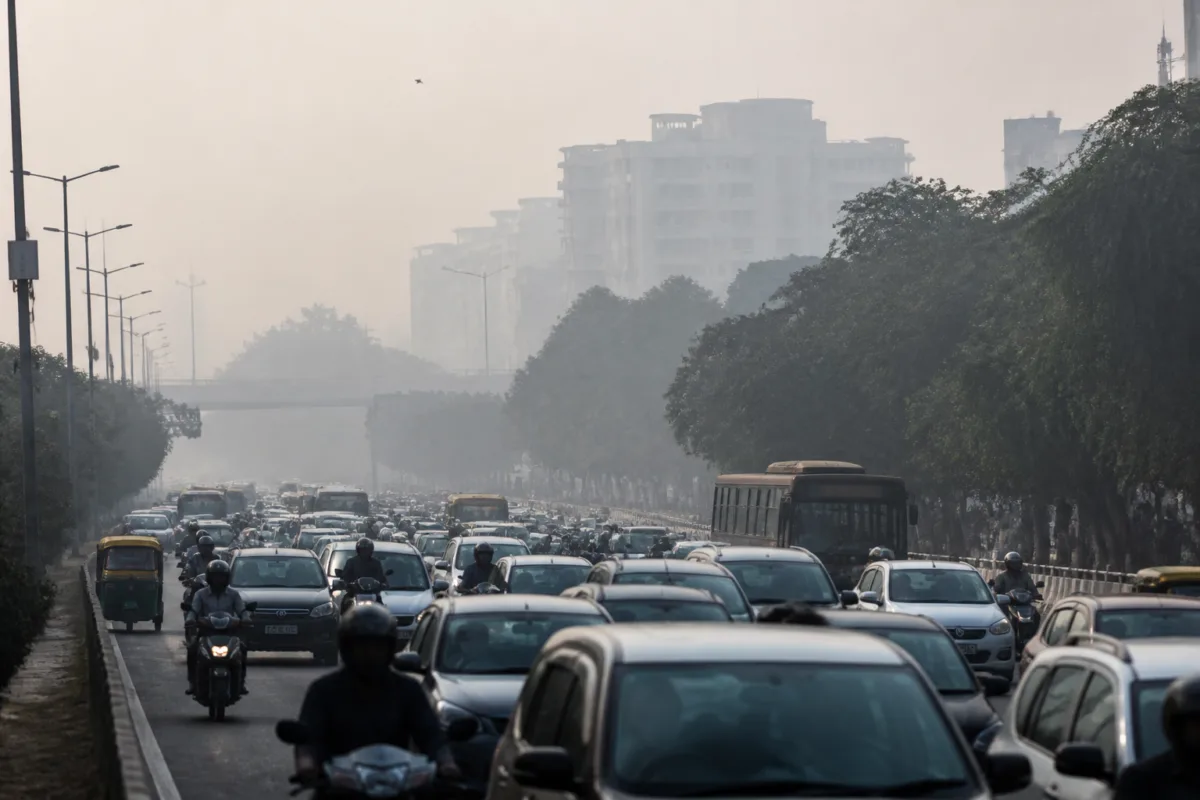
Delhi air pollution has entered its familiar October escalation, but the latest rise shows why the capital’s winter crisis cannot be attributed to a single source. Delhi’s air quality index climbed from 179 on Tuesday to 244 on Wednesday, the highest level recorded in 100 days, as fireworks, weakening atmospheric dispersion, transport emissions and rising farm fires combined to increase the city’s pollution burden.
The deterioration was accompanied by sharp overnight increases in particulate matter. PM10 reached 488 micrograms per cubic metre in Anand Vihar, while PM2.5 peaked at 305 micrograms per cubic metre in Punjabi Bagh. At Okhla Phase 2, PM10 rose to 469 micrograms per cubic metre at 10 pm on Tuesday, and PM2.5 reached 269 micrograms per cubic metre at the same location. Mandir Marg recorded a PM10 peak of 410 micrograms per cubic metre at 2 am on Wednesday.
These readings were substantially above the permissible standards cited in the report: 60 micrograms per cubic metre for PM2.5 and 100 micrograms per cubic metre for PM10. The wider National Capital Region was also affected. Noida recorded an AQI of 281 and Gurugram 220 on Wednesday, indicating that the deterioration was not confined to Delhi’s municipal boundary.
The immediate trigger was the Dussehra period, when fireworks added a concentrated burst of particulate emissions. A 2024 study by researchers at IIT Delhi found that fireworks accounted for more than 85% of the measured elemental mass in PM2.5 during Diwali celebrations between 2019 and 2021, after accounting for differences in atmospheric dispersion. Although the study concerned Diwali, its findings help explain why festival-related emissions can produce sharp short-term increases in particulate pollution when weather conditions are unfavourable.
The key urban issue is that emissions and atmospheric conditions interact. Fireworks may add a sudden load, but the ability of the atmosphere to disperse that pollution determines how long it remains concentrated near the ground. As winter approaches, Delhi becomes more vulnerable to such accumulation because the atmospheric boundary layer—the lowest part of the atmosphere through which pollutants mix—becomes shallower. Night-time temperature inversions can also prevent polluted air from rising and dispersing.
The India Meteorological Department considers an average wind speed below 10 kmph unfavourable for pollutant dispersion. According to a 2026 study published in the journal Atmospheric Environment, researchers affiliated with the Physical Research Laboratory, the Space Applications Centre and the National Centre for Medium Range Weather Forecasting found that Delhi’s boundary layer remained below 1 kilometre from November to January between October 2023 and February 2024. The study also associated lower boundary-layer heights with higher PM2.5 concentrations.
That evidence changes the way October pollution should be read. The city does not suddenly become polluted because of one festival or one category of emissions. Instead, the seasonal transition reduces the atmosphere’s capacity to dilute pollutants at the same time that several emission sources remain active. The result is a system in which short-term pollution spikes can become more severe because the background conditions are already deteriorating.
Transport remains a major part of that background. The Indian Institute of Tropical Meteorology’s Decision Support System estimated that transport emissions accounted for 21% of Delhi’s PM2.5 pollution on Wednesday, making them the largest identified source in the assessment. This is significant for urban administration because transport emissions are generated continuously across the metropolitan region, unlike fireworks or farm fires, which are more episodic.
The transport contribution also illustrates the limits of treating Delhi’s air-quality problem as a seasonal emergency alone. Vehicles operate throughout the year, and their emissions become more damaging when low wind speeds and a shallow boundary layer prevent dispersion. The available source-apportionment figures therefore point to a combination of persistent urban emissions and seasonal atmospheric vulnerability rather than a single event-driven crisis.
Farm fires add another regional layer. During the paddy harvesting season, fires in neighbouring states can contribute to Delhi’s PM2.5 pollution when their smoke is carried towards the capital. The Decision Support System estimated that stubble burning contributed around 4% of Delhi’s PM2.5 pollution on Wednesday, with the contribution forecast to rise to 15% by Friday.
Satellite-based monitoring by the Indian Agricultural Research Institute recorded 85 fire events across seven states and regions on October 21. Between September 15 and October 21, it detected 1,350 events across the northern belt: 454 in Punjab, 393 in Madhya Pradesh, 229 in Rajasthan, 190 in Uttar Pradesh, 72 in Uttarakhand, 11 in Haryana and one in Delhi.
Those numbers show both the scale and the administrative complexity of the problem. The fires are distributed across multiple states, while their effect on Delhi depends on their location, timing and wind direction. Sunil Dahiya, lead pollution analyst at Envirocatalysts, said winds were coming from the northwest at low speeds of less than 4-5 kmph, allowing smoke from farm fires to reach Delhi. He also said the increase in smoke coincided with the hours of fireworks.
The regional contribution, however, should not obscure pollution generated within Delhi and the NCR. Dahiya identified transport, power, industries and other perennial sectors as continuing contributors alongside fireworks and regional sources. The source data supplied in the report supports that broader reading: transport was the largest estimated contributor on Wednesday, while farm fires accounted for a smaller but potentially increasing share.
This division of responsibility matters because different sources fall under different institutions and enforcement systems. Festival emissions require controls around the use and sale of fireworks. Transport pollution involves vehicle activity and the wider metropolitan mobility system. Farm fires are linked to agricultural practices and state-level enforcement outside Delhi. Industrial and power-sector emissions require separate regulatory oversight. Atmospheric conditions, meanwhile, cannot be controlled by any of these agencies.
Delhi’s air-quality response is therefore not only a question of emergency restrictions. It is also a coordination problem involving the Delhi government, neighbouring states, pollution-control authorities, transport agencies, agricultural departments and weather-monitoring institutions. The figures from Wednesday show how quickly the pollution profile can change when these factors overlap, but they do not establish that any single source is solely responsible.
The health relevance is clearest in the particulate readings. PM2.5 and PM10 are solid and liquid particles suspended in the air that can be inhaled and cause serious health problems. The highest reported concentrations were recorded overnight and in the early morning, when atmospheric conditions can be particularly unfavourable for dispersion. This creates a direct connection between city residents’ exposure and the timing of emissions, weather and daily activity.
Delhi’s October pattern is thus a transition from ordinary urban pollution to a more dangerous seasonal configuration. AQI rose to 244 on Wednesday, while the city’s monitoring stations recorded particulate concentrations several times above the cited permissible standards. At the same time, the evidence shows that the seasonal deterioration is layered: fireworks created a short-term surge, transport supplied a persistent urban load, farm fires added regional smoke, and weak winds reduced the atmosphere’s capacity to disperse it.
What remains to be established is how the contributions will change as October progresses and winter conditions strengthen. The report indicates that the farm-fire share could rise to 15% by Friday, while the available research links lower boundary-layer heights with higher PM2.5 concentrations. The next milestones for Delhi’s air-quality management will therefore be the movement of winds, the depth of the boundary layer, the number and location of agricultural fires, and the performance of measures targeting the city’s continuing transport and industrial emissions.

