


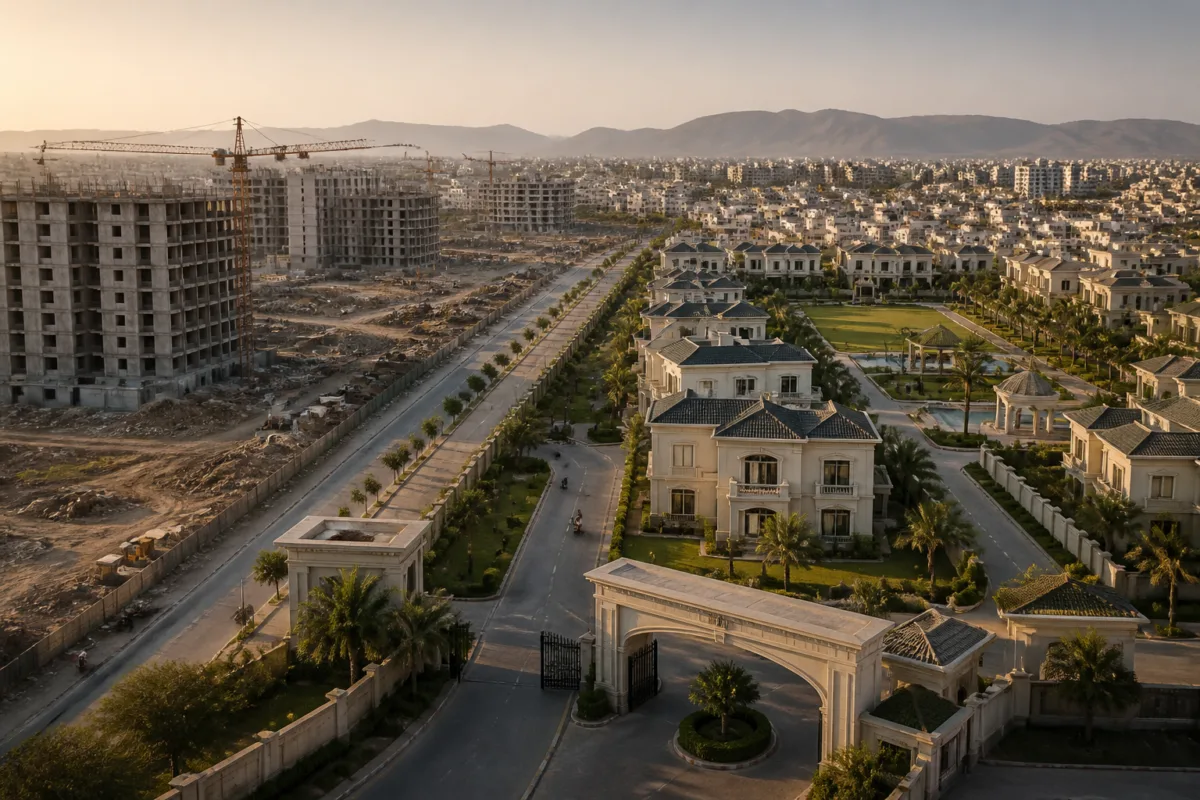
Jaipur’s housing market is showing a sharp divide between ordinary homebuyers and the city’s wealthiest property consumers. Sales of homes priced around Rs 1 crore have fallen by 40%, according to a report by The Times of India, while developers say demand for properties priced above Rs 2.5 crore remains comparatively resilient. The divergence is exposing a central tension in the city’s residential economy: demand is weakening where affordability is already under pressure, but premium development continues to attract buyers.
The slowdown is not confined to the approximately Rs 1 crore segment. Developers cited in the report said demand for homes priced above Rs 50 lakh has also weakened. This suggests that the pressure is affecting a broad middle and upper-middle segment rather than only one narrowly defined price bracket. At the same time, builders have largely declined to reduce prices, arguing that land and construction costs have increased significantly.
That combination creates a difficult market structure. Buyers are becoming more cautious, but developers say their cost base leaves limited room for discounts. As a result, the adjustment is taking place through slower sales rather than an immediate fall in advertised prices. The report does not establish whether completed transaction prices have declined, and it notes that published rates, particularly in luxury projects, may not reflect actual deals.
The most important feature of the current market is therefore not simply that sales have slowed. It is that the slowdown is uneven. A household seeking a home near the Rs 1 crore mark is facing a different market from a buyer looking at a villa or gated-community property costing several crores. That split has implications for the kinds of homes developers choose to build and for the distribution of housing supply across Jaipur.
The middle-market squeeze
The reported 40% fall in sales near the Rs 1 crore price point indicates a substantial change in buyer behaviour. Developers attributed the decline to cautious consumers, rising property prices and uncertainty over the economic outlook. One developer, quoted anonymously, said global geopolitical conditions, a falling stock market and uncertainty about the domestic economy were not supporting a sharp upward trend in demand.
These factors affect housing differently from other consumer purchases because residential property involves a large upfront commitment and long-term borrowing or savings. When buyers become uncertain about income, investment returns or the broader economy, they can postpone a purchase even if they continue to need housing. The report does not provide loan data, household income figures or booking numbers beyond the cited decline, so the precise reasons for individual purchasing decisions cannot be separated. It does, however, show that developers are experiencing weaker demand in segments where buyers appear more sensitive to price and economic confidence.
The price rigidity described by builders adds another layer to the problem. Developers said they would prefer to wait rather than cut prices because land and construction expenses have risen. This means that a slowdown in demand is not automatically translating into more affordable housing. If sellers hold prices steady while buyers retreat, the market may record fewer transactions without producing meaningful relief for households.
For Jaipur, that matters because the mid-segment is the part of the market where a large number of salaried households and growing families would ordinarily look for homes. The supplied report does not quantify the city’s housing shortage or identify which neighbourhoods are most affected. It nevertheless points to a structural question: when land and construction costs keep rising, who can still access newly built housing at prices close to Rs 1 crore?
Why luxury demand is holding up
The stronger performance of properties above Rs 2.5 crore reflects a different buyer profile and a different product. Developers said demand in this category is encouraging more high-end projects, with prices extending to Rs 12-15 crore. Rajesh Dukiya, identified in the report as a leading real estate developer in Jaipur, said buyers in this segment were increasingly seeking gated communities offering security, a sense of community and shared amenities such as gyms and recreational facilities.
This demand is not necessarily evidence of a broad housing recovery. It may instead indicate that the city’s premium market is being driven by a narrower group of buyers whose purchasing capacity is less exposed to the pressures affecting the mid-segment. The report does not identify the number of buyers, the volume of luxury sales or the proportion of projects sold. It therefore cannot establish how large or durable this premium demand is.
The reported shift towards larger gated developments is significant for the built environment even without those figures. High-end projects commonly package housing with private amenities, security and managed communal spaces. As developers respond to demand for this format, the city’s expansion may increasingly include enclosed residential enclaves designed around internal facilities rather than only standalone apartment buildings.
The report cites published market rates of Rs 25,000-35,000 per sq ft in some high-end developments, with certain villas reportedly commanding even higher rates. These are advertised prices, not confirmed transaction values. That distinction is essential. Asking prices show how projects are being positioned, but they do not reveal the final price paid by buyers, the pace of sales or the share of inventory absorbed by the market.
A market divided by price and product
The available evidence points to a two-speed housing market. In the first part, demand above Rs 50 lakh and around Rs 1 crore has weakened, with the latter segment recording a reported 40% fall in sales. In the second, luxury properties above Rs 2.5 crore retain enough interest to support additional premium projects. The two segments are connected by the same land and construction market, but they are responding differently to economic uncertainty.
This division can influence the city’s supply pipeline. If developers find that premium projects provide better demand or stronger margins than mid-segment housing, future launches may tilt towards higher-priced homes. That possibility is an implication of the reported developer response, not a confirmed forecast. The source does not provide launch data or evidence that builders are withdrawing from affordable or mid-market housing. It does show, however, that developers are discussing new high-end projects while resisting price reductions elsewhere.
The result is a mismatch between what the market can build profitably and what many households may be able to pay. Rising land and construction costs can make lower-priced projects less attractive to developers. Yet maintaining prices in a weakening market can exclude buyers without necessarily improving the financial position of projects. The report leaves open the question of whether developers will eventually revise unit sizes, payment structures, specifications or project locations to reach more buyers.
There is also an information gap in the current market picture. The reported decline is presented through developer accounts, while the source does not include registration data, transaction volumes, unsold inventory, mortgage approvals or completed-sale prices. Without those indicators, it is not possible to determine whether the slowdown is a temporary pause, a broader correction or a shift in the composition of demand. The distinction between advertised and realised prices is particularly important in the luxury segment.
The institutional and urban planning implications
Housing markets do not operate only through developer pricing. Land values, construction costs, approvals, infrastructure access and the availability of services all shape where and what gets built. The supplied report does not identify particular government policies, municipal decisions or infrastructure projects driving Jaipur’s market. It does, however, highlight land and construction costs as major constraints cited by developers.
That makes the affordability question partly an urban planning question. If high land costs are passed into housing prices, households may be pushed towards smaller homes, older stock or locations farther from established amenities. The report does not document such movement in Jaipur, so its effects cannot be stated as an established trend. But the pressure described in the market raises the need to examine how land supply, project costs and access to urban services interact.
The demand for gated communities also places attention on the relationship between private amenities and public infrastructure. Buyers are reported to value security, community facilities and gyms within premium developments. Whether these projects are well connected to roads, public transport, schools, health services and employment centres is not addressed in the source. Those factors remain important to understanding whether a luxury housing boom is strengthening integrated urban development or producing self-contained enclaves.
What the evidence confirms
The available evidence confirms a slowdown in Jaipur’s mid-segment housing demand, including a reported 40% fall in sales around the Rs 1 crore price point. It also shows weaker demand above Rs 50 lakh, continued price firmness despite that slowdown, and comparatively stronger interest in properties above Rs 2.5 crore. Developers attribute the pressure to cautious buyers, rising land and construction costs and economic uncertainty.
What remains uncertain is equally important. The report does not establish transaction prices, unsold inventory, the duration of the slowdown, the number of luxury sales or whether premium demand represents a lasting market shift. The cited luxury rates are advertised prices and may not reflect completed transactions. The next indicators to watch are therefore actual registrations, project sales, inventory levels and evidence of whether developers alter prices or project formats. Until those measures are available, Jaipur’s housing market is best understood as divided rather than uniformly weak: the middle is losing momentum while the premium end continues to find buyers.

