


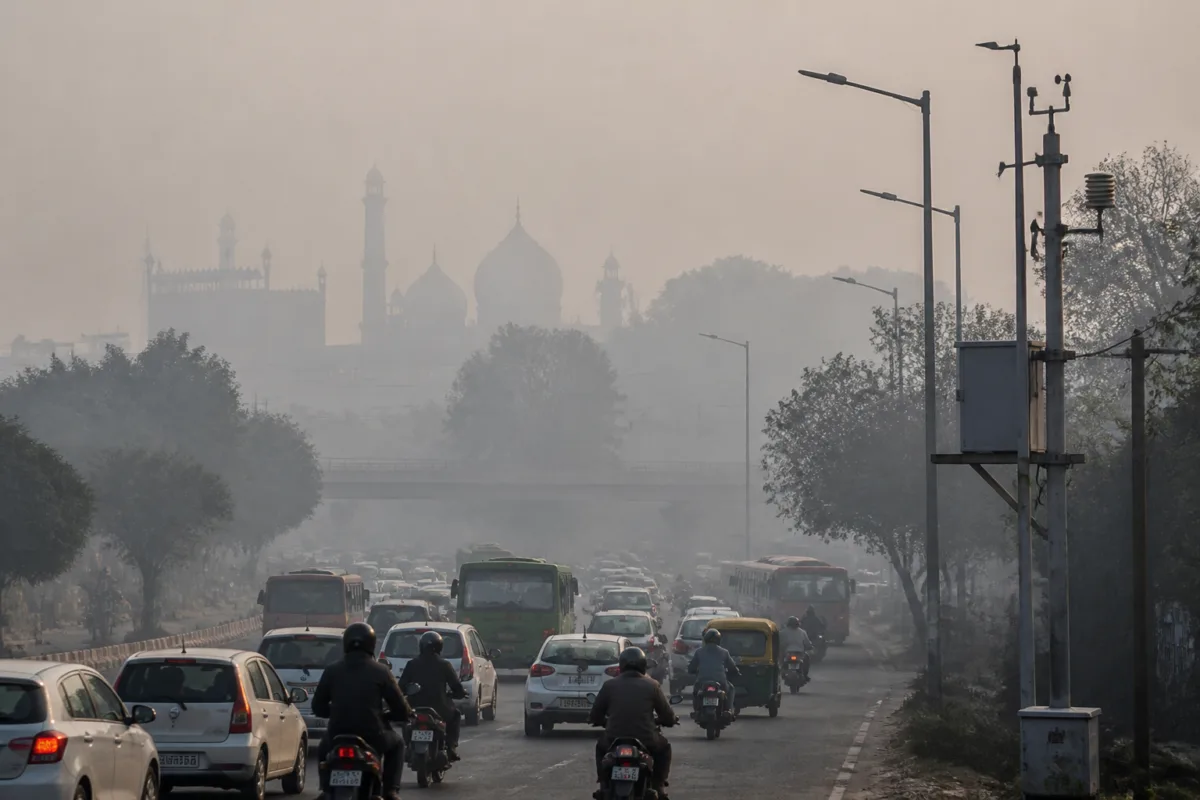
Delhi’s air pollution problem cannot be understood only through visible smoke, road dust and burning waste. An initial analysis by the Indian Institute of Tropical Meteorology (IITM), Pune, indicates that gases already present in the atmosphere are reacting chemically to form fine aerosol particles, adding a less visible layer to the city’s exposure burden and complicating the task of pollution control.
The findings come from the Atmospheric Chemistry and Aerosol Toxicity Analysis Laboratory, or AATAL, established by IITM in New Rajendra Nagar. The laboratory has been set up at a reported cost of around Rs 80 crore and contains 25 advanced instruments intended to examine the composition of pollutants, their sources and their potential health effects.
This distinction between directly emitted and chemically formed pollution is important for Delhi’s urban administration. Direct emissions can include particles released by vehicles, industries and fuel burning. Secondary aerosols, by contrast, form in the atmosphere after gases undergo chemical reactions. They may not be visible at the source, yet they can contribute to the fine particulate pollution that residents breathe.
The source report defines aerosols as extremely small solid particles and liquid droplets present in the atmosphere. Dust, smoke, soot and other fine particles can fall into this broad category. PM2.5 refers to particles measuring 2.5 micrometres or less. Because of their small size, these particles can enter the body through breathing and may remain suspended in the air for extended periods.
The initial analysis distinguishes between primary particles and secondary aerosols. Vehicles, industries and fuel combustion can release particles directly. Gases emitted by vehicles and industrial activity can also react in the atmosphere to create secondary organic aerosols. Volatile organic compounds, or VOCs, are identified as one group of gases that can contribute to their formation.
Secondary inorganic aerosols can form through reactions involving gases such as sulphur dioxide, nitrogen oxides and ammonia. These reactions can generate particles including sulphates and nitrates. The implication for pollution management is straightforward: reducing only the particles that are directly visible or measured at the point of emission may leave important chemical pathways insufficiently addressed.
The initial figures reported from Delhi provide an indication of how different sources may combine. Vehicles accounted for 25 per cent of PM2.5 pollution in the analysis. Secondary organic aerosols contributed 18.4 per cent, while secondary inorganic aerosols accounted for 16.5 per cent. Road dust contributed 10.9 per cent and waste burning five per cent.
These numbers should not be treated as a fixed annual source profile. The source report specifically notes that the estimates are based on an initial analysis for a particular day and that the contribution of different sources can change from one day to another. Weather, atmospheric conditions, seasonal activity and the volume of emissions can all affect the way pollutants accumulate and react, although the supplied report does not provide a longer time series or a detailed comparison across seasons.
Even with that limitation, the figures alter the administrative framing of Delhi’s pollution problem. Vehicles remain the largest single category in the reported analysis, but the two secondary aerosol categories together account for 34.9 per cent. That combined share is higher than the reported vehicle contribution. It suggests that the city’s pollution-control architecture must account not only for where particles are emitted, but also for the gases that help create new particles after entering the atmosphere.
This is a different governance challenge from simply clearing a visible source. Road dust can be addressed through mechanical sweeping, water sprinkling and controls around construction activity. Waste burning can be targeted through enforcement and collection systems. Vehicle emissions can be addressed through pollution-under-control checks, restrictions and public transport measures. Chemical formation requires authorities to connect these actions with controls on precursor gases and to understand how emissions interact in the atmosphere.
Delhi’s existing response includes vehicle-emission controls, pollution-under-control checks, mechanical road cleaning, water sprinkling, measures to reduce construction dust, action against waste and biomass burning, and efforts to promote public transport. Additional restrictions can be applied when pollution rises under the Graded Response Action Plan, or GRAP.
Those measures remain relevant because direct emissions continue to form part of the reported source profile. However, the IITM analysis points to a limitation in a response focused mainly on immediate, visible sources. If gases from vehicles and industries contribute to secondary organic and inorganic aerosols, then enforcement and monitoring must also identify the precursor emissions and the conditions under which they produce fine particles.
The AATAL laboratory is intended to support that deeper understanding. Its stated purpose is to analyse pollutant composition, identify sources and examine potential health effects. In institutional terms, this moves the city’s pollution response closer to atmospheric chemistry and source-based monitoring rather than relying only on broad categories such as traffic, dust or smoke.
The report does not establish a complete health-risk assessment for each aerosol category, nor does it provide a citywide, multi-season inventory. It states that the fine particles can reach the body through breathing and may harm health, but the supplied material does not include specific disease estimates, exposure thresholds or a comparison of toxicity between the identified sources. Those gaps matter because source reduction priorities require both contribution data and evidence about health consequences.
The data also show why a single-cause explanation is inadequate. Vehicles represented 25 per cent of the reported PM2.5 contribution, but road dust and waste burning were smaller categories, at 10.9 per cent and five per cent respectively. At the same time, secondary organic and inorganic aerosols represented substantial shares despite being formed through atmospheric reactions rather than emitted as identical particles from one identifiable source.
For citizens, this means that pollution may persist even when the most obvious source is not immediately visible. A road can appear free of heavy dust while gases emitted elsewhere contribute to particle formation. Conversely, a particular day’s source pattern cannot automatically be applied to every other day. The initial analysis therefore adds complexity to public understanding without eliminating the need for familiar controls.
For urban institutions, the central question is whether monitoring, enforcement and policy are organised around the full life cycle of pollutants. The agencies responsible for transport, roads, construction, waste management, industrial regulation and public health may each control part of the emissions chain. Atmospheric chemistry connects those parts, but the supplied report does not specify a new inter-agency framework or assign additional responsibilities.
That institutional gap is significant because a chemically formed pollutant does not fit neatly into one municipal department. Reducing secondary aerosols may require coordination between transport authorities, pollution-control agencies, local bodies and agencies overseeing construction and waste. It may also require measurements that track precursor gases alongside PM2.5, rather than treating particulate concentration as the only operational signal.
The evidence currently confirms three points. Delhi’s PM2.5 burden includes both directly emitted particles and secondary aerosols; the initial IITM analysis assigns significant shares to secondary organic and inorganic aerosols; and the reported shares vary by day, meaning that source apportionment must be updated over time. What remains uncertain in the supplied material is the scale of these contributions across seasons, their precise geographic distribution and the health effects associated with each source category.
The next stage of attention will therefore be the laboratory’s continuing analysis and how its findings are incorporated into Delhi’s pollution-control decisions. The city’s response can no longer be assessed only by whether it removes dust, curbs smoke or restricts traffic. It must also establish whether the gases that create new fine particles are being identified and reduced.

