


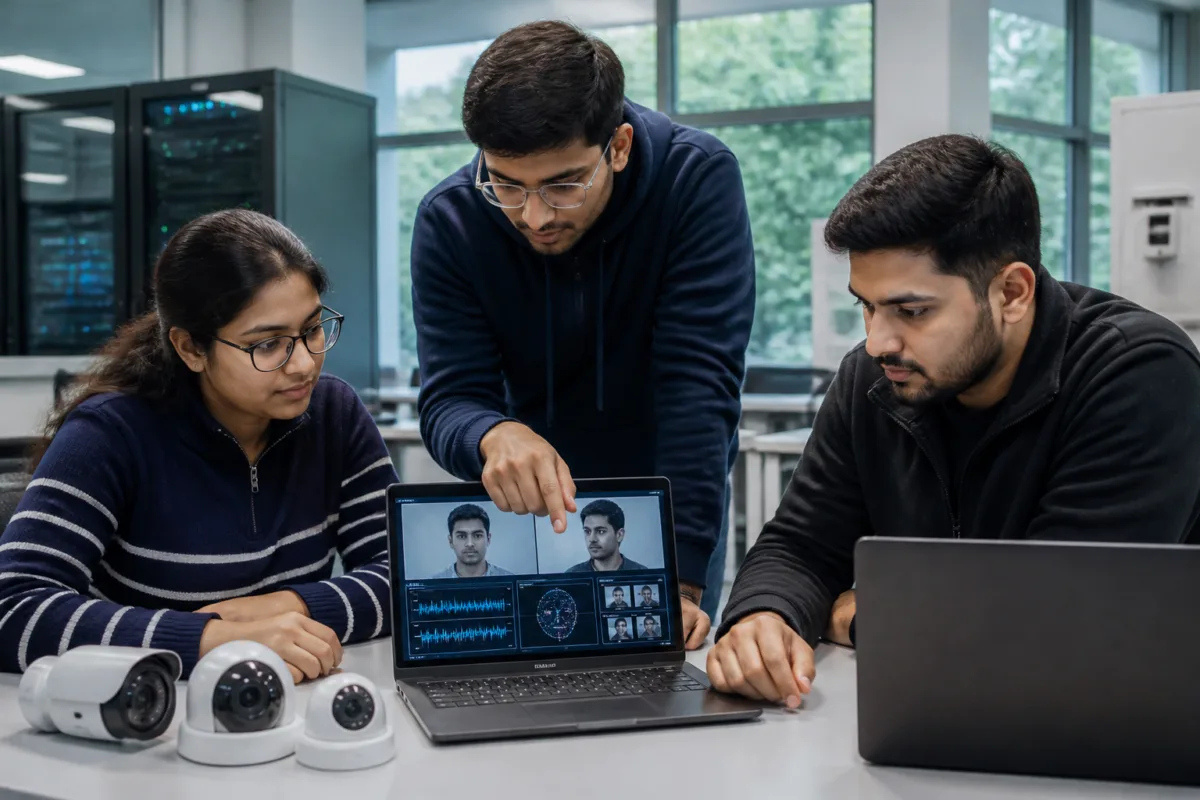
A team of students from Thapar Institute of Engineering and Technology has developed an AI deepfake detection system that, according to the team, can examine a video in about 20 seconds and alert banking agents to possible manipulation during video-based KYC checks.
The three-member team, called ‘Mama Mia’, won the first prize and a cash award of ₹2 lakh at the Rakshak-2026 national AI cybersecurity hackathon held at IIT Delhi. The team members were identified as Gani Singh, Yash Bishnoi and Keshav Juneja.
The system is designed to assess whether a video is genuine or has been altered using deepfake technology or other facial manipulation techniques. The students said it analyses signals from four types of checks, including the face, physical movements and camera-sensor-related indicators. If suspicious activity is detected, the system can alert the bank agent handling the KYC process.
The reported use case is video-based customer verification, where a person appears on a live call but the image or facial movements may have been digitally manipulated. The students said their system is intended primarily for banks and can be integrated into existing KYC processes as a business-to-business solution. They also said they plan to keep access free for customers, although the report does not establish that the system has been adopted or deployed by any bank.
The prototype was developed within a 40-hour competition window after the team began work about a week before the hackathon, according to the students. Their work included examining Reserve Bank of India guidelines, customer requirements and the technical challenge of incorporating deepfake detection into existing KYC workflows.
The system is being developed as an architecture that can operate through both a website and an application. The students said it can help identify suspicious video activity before a fraudulent KYC process is completed. Its reported role is therefore preventive: flagging a transaction or verification attempt for further attention rather than independently deciding whether a customer is genuine.
The hackathon received more than 4,700 registrations, with 30 teams presenting solutions, according to the report. The winning team built a face-detection website, while another team, called ‘Loser’, developed an application intended to detect virus cloning. Amazon is expected to support selected teams with AWS credits to help them continue developing their technologies.
The event also included remarks from Amazon India vice-president for legal Rakesh Bakshi, who said responsible companies should focus on public awareness and the investigation of unlawful activity. Amazon has established a Counterfeit Crime Unit to work on cases involving fake products, according to the report. Officials from the Information Fusion and Research Centre and IIT Delhi were also present at the event.
The students’ project highlights a growing operational challenge for digital KYC: verification systems must establish not only whether a face matches an identity document, but also whether the video interaction itself is authentic. The report confirms the prototype’s hackathon achievement and stated design, while details such as independent testing, accuracy rates, data-protection safeguards and commercial deployment remain unavailable.

