


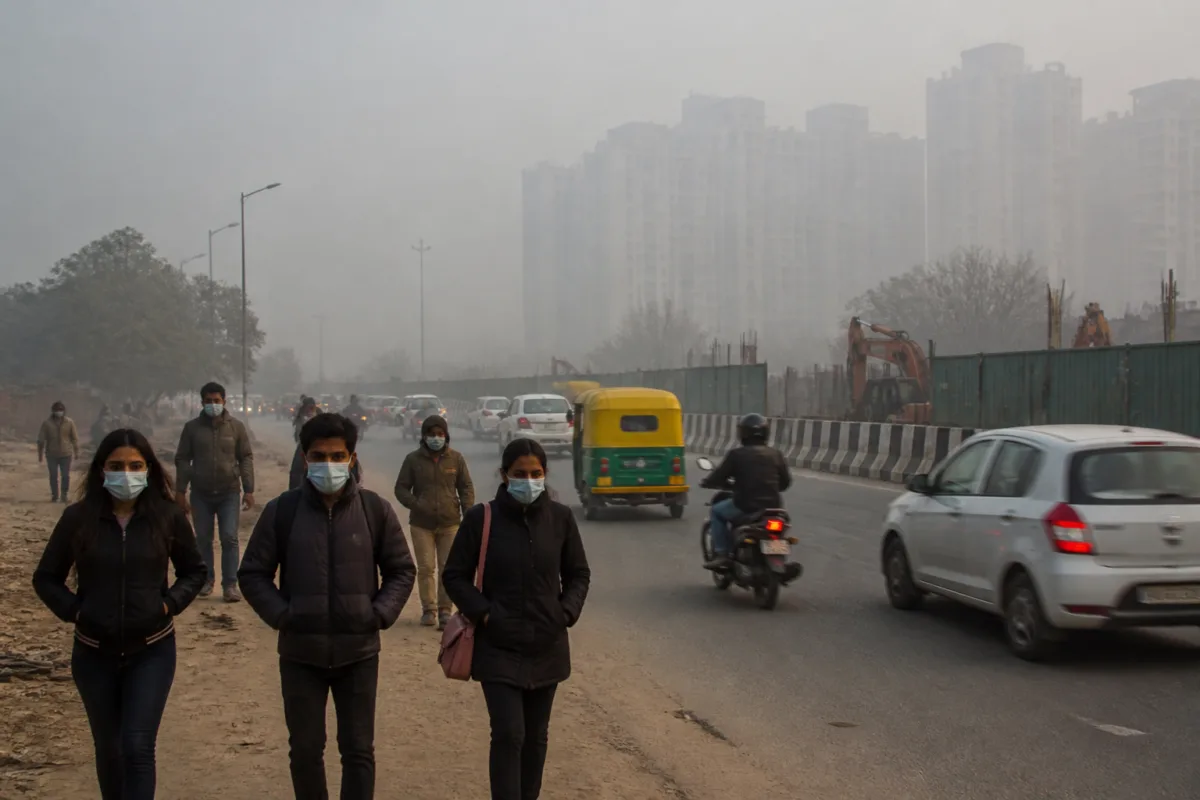
Delhi air pollution deteriorated sharply on Wednesday, with the city’s average Air Quality Index reaching 377, the worst reading since 20 January. The level was recorded in the very poor category, while 22 of the capital’s 59 monitoring stations reported severe air quality.
The highest AQI reading was recorded at IIT Delhi, where the index crossed 458. Jahangirpuri and Punjabi Bagh recorded an AQI of 448 each, while Mundka reported 439. The readings indicate that hazardous conditions were not limited to one isolated pocket but affected multiple parts of the city.
According to data cited by Jagran, the Wednesday average was only one point below the AQI of 378 recorded on 20 January. It was therefore the most polluted day in Delhi in 288 days. Of the 59 monitoring stations, 32 recorded very poor air quality, five were in the poor category and 22 were in the severe category.
The pollution profile also changed during the day. PM10 emerged as the leading pollutant after PM2.5 had remained the dominant pollutant for the previous three days. PM10 is commonly associated with larger particulate matter, including dust from roads and construction sites. The change places renewed attention on dust control across the city’s transport corridors, building sites and other exposed surfaces.
The IITM Pune Decision Support System, cited in the report, estimated that stubble burning contributed 20.2 per cent of Delhi’s pollution on Wednesday. Transport accounted for 15.5 per cent, followed by residential sources at 3.8 per cent, industry at 2.9 per cent, construction activity at 2.2 per cent, waste burning at 1.3 per cent and road dust at 1.1 per cent. Other sources accounted for 1 per cent, while an additional 28.5 per cent was classified as other contributions.
The data also recorded contributions from neighbouring National Capital Region districts. Ghaziabad accounted for 7 per cent, followed by Rohtak at 3.8 per cent, Gurugram at 2.7 per cent, Sonipat at 2.2 per cent, Jind at 1.8 per cent and Bhiwani at 1.3 per cent. These figures underline that Delhi’s air-quality readings are linked to emissions and atmospheric conditions across the wider NCR rather than only to sources within the municipal boundary.
Weather conditions accompanied the deterioration. Delhi’s maximum temperature was 29.8 degrees Celsius, 0.7 degrees below normal, while the minimum temperature was 16.1 degrees Celsius, 0.8 degrees above normal. Relative humidity ranged between 98 per cent and 61 per cent. The report did not announce a new pollution-control order or specify an additional response beyond the monitoring and source-apportionment data recorded for Wednesday.

