


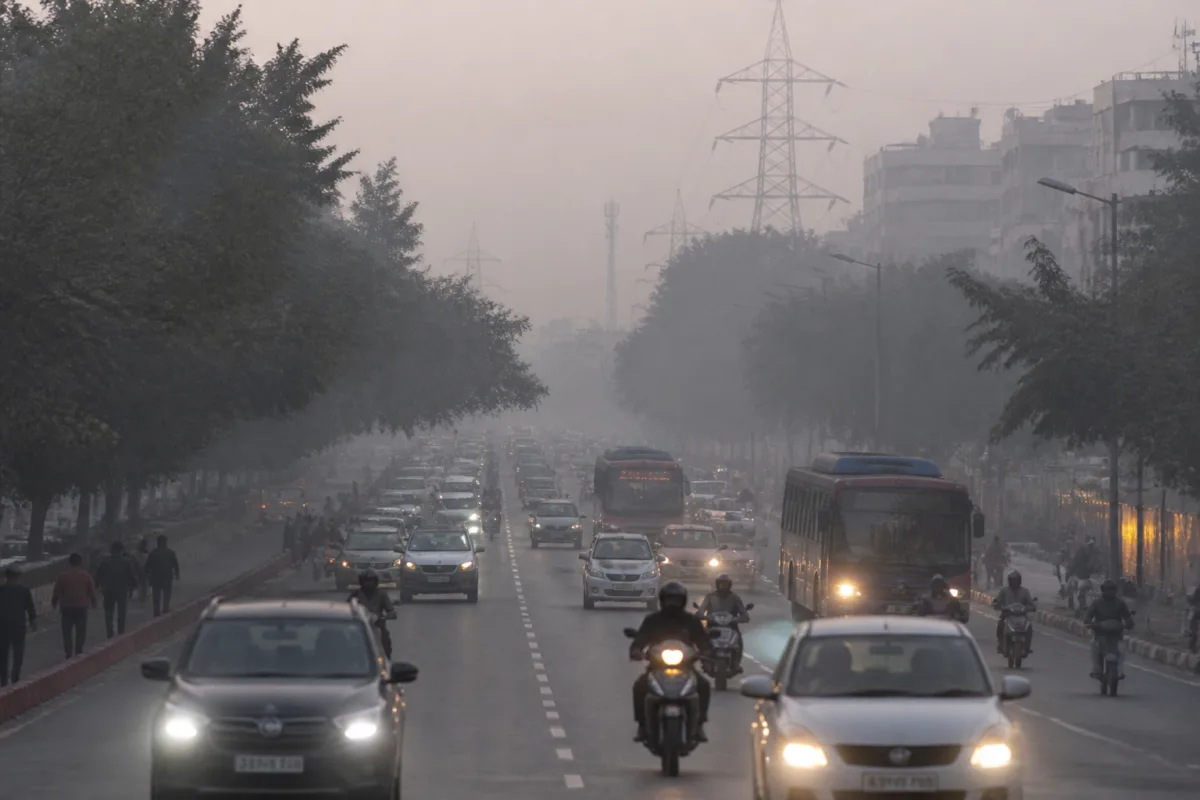
Delhi’s air quality deteriorated sharply on Wednesday, with the citywide AQI reaching 377 and 22 of its 59 monitoring stations recording readings above 400 in the severe category. The Air Quality Early Warning System has warned that pollution could worsen further between November 6 and 7, while the India Meteorological Department has forecast morning mist across Delhi-NCR until November 7.
The city’s AQI on Wednesday was categorised as ‘very poor’, but remained close to the severe threshold. The reading of 377 was the highest recorded in Delhi since January 20, when the AQI stood at 378. It was therefore the worst air-quality level recorded in 288 days, according to the report.
The most polluted location among the monitoring stations was IIT Delhi, where the AQI reached 458. Jahangirpuri and Punjabi Bagh recorded readings of 448 each, while Mundka recorded an AQI of 439. A total of 22 stations crossed the 400 mark, indicating that severe pollution was spread across several parts of the capital rather than being confined to one location.
The Air Quality Early Warning System has forecast that Delhi’s AQI may enter the severe category during November 6-7. The warning coincides with the IMD’s forecast of morning mist or light fog in Delhi and neighbouring National Capital Region areas. Such conditions can reduce visibility during the morning and coincide with a period when pollutants remain concentrated near the ground, although the supplied report does not quantify the effect of the forecast mist on AQI.
PM10 was the principal pollutant recorded in Delhi on Wednesday. The larger particulate matter is commonly associated with road dust and dust released by construction activity. PM2.5 had been the dominant pollutant during the preceding three days. The shift to PM10 points to the continuing contribution of coarse dust particles alongside other pollution sources recorded in the region.
The report also cited satellite data showing 467 farm-fire incidents across six states surrounding Delhi on November 4. Punjab accounted for 151 incidents, followed by Madhya Pradesh with 157 and Rajasthan with 111. Uttar Pradesh recorded 33 incidents, Haryana 10 and Uttarakhand five. The report said farm-fire incidents in Punjab had remained high in recent days.
Pollution levels may also be affected by emissions from heavy traffic and firecrackers, which the report identified as additional factors during the period. The city recorded a maximum temperature of 29.8 degrees Celsius and a minimum temperature of 16.1 degrees Celsius at the Safdarjung weather station on Wednesday.
The immediate forecast is for further deterioration, with the early-warning system indicating a possible move into the severe AQI category on November 6 and 7. The IMD’s morning-mist warning for Delhi-NCR remains in place through November 7.

