


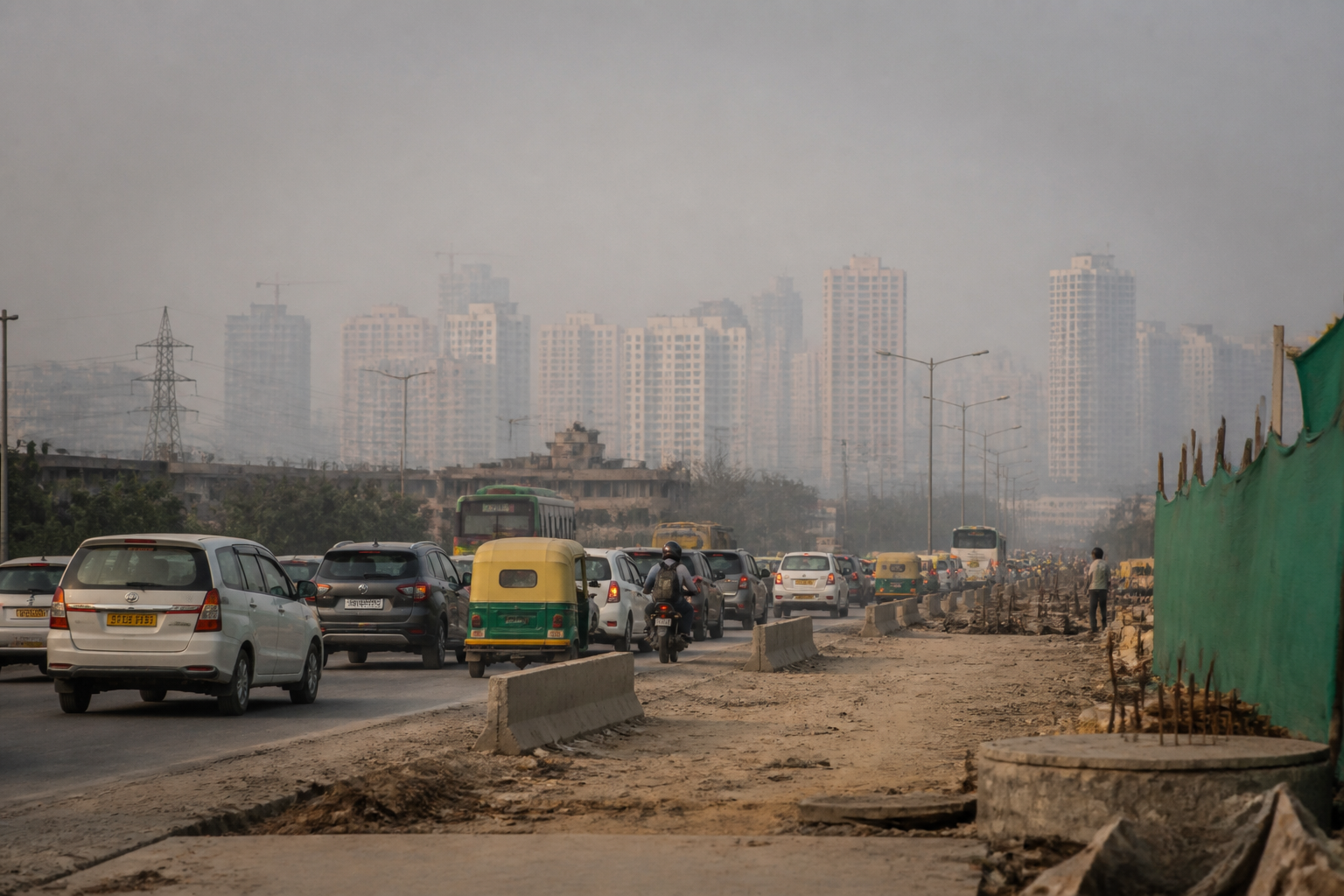
Delhi air pollution is worsening again after the monsoon, with the Air Quality Index reaching 200 to 250 in different parts of the city. The immediate concern is the deterioration of air before the winter pollution season has fully begun. The more important story, however, is what the timing reveals about the way the capital manages a problem whose sources remain active throughout the year.
The report by Jagran – New Delhi links the post-monsoon rise to the return of local pollution sources, including road dust, vehicle emissions, construction and demolition activity, and waste burning. It also points to a familiar administrative pattern: measures intended to control pollution are being initiated as air quality worsens, rather than being completed before the season begins.
That distinction matters because Delhi’s winter air crisis is often presented as a short seasonal emergency. The evidence cited in the report suggests a more persistent urban-management problem. Roads, construction sites, vehicles and waste do not become sources of pollution only in winter. What changes during winter is the severity of the consequences and the visibility of the failure.
The city therefore faces two linked questions. The first is operational: whether authorities can control known sources before the winter peak. The second is institutional: why agencies responsible for roads, construction, transport, waste and pollution control are not able to maintain continuous enforcement and preparedness throughout the year.
The seasonal cycle has become familiar. Once the AQI reaches 400 to 450, authorities have had to consider emergency measures such as restrictions on vehicles, closure of schools and work-from-home arrangements. These measures can reduce exposure or activity for limited periods, but they are responses to an already severe episode. They do not substitute for controlling the sources that produce the pollution in the first place.
The report identifies several signs of delayed implementation. The Delhi Pollution Control Committee has invited tenders for the use of new technologies at 40 pollution hotspots. An integrated command and control centre being developed at the Delhi Metro Rail Corporation’s Bhaiyya Park in Shastri Nagar has not yet begun operations. These developments may eventually strengthen monitoring and enforcement, but the fact that the processes remain under way while air quality is deteriorating highlights the gap between planning and delivery.
This gap is particularly consequential in a city where responsibility is distributed across multiple institutions. Pollution control agencies can identify sources and issue directions, but road maintenance, construction regulation, traffic enforcement, waste management and local action involve different departments and local bodies. A hotspot-based response can work only if the agencies responsible for the underlying conditions act within defined deadlines and are held accountable for results.
The report says instructions have now been issued to assign responsibility and timelines at the district level for identifying and acting against local pollution sources. Pending pothole repairs and road-related work have been given a target of completion by October 31. Such deadlines create a clearer administrative framework, but they also show how basic urban maintenance has become part of the emergency air-pollution response.
Road conditions are not merely a mobility concern in this context. Broken surfaces and unpaved edges can generate dust, while delayed construction and repair work can keep loose material exposed for longer periods. The report also refers to uncovered private construction sites and trucks emitting black smoke, including vehicles without number plates. Each example points to a different enforcement responsibility, but their combined effect is experienced by residents as one deteriorating air environment.
The same pattern applies to construction and demolition. Building activity is a normal part of a growing city, but it becomes a pollution source when material is not covered, dust is not controlled and debris is not managed. The report does not provide a citywide estimate of the contribution from each individual activity. It does, however, place construction and demolition among the local sources that government records identify as requiring action.
Vehicle emissions add another layer of difficulty because they are connected to both regulation and daily travel behaviour. The report raises the question of why more residents do not shift from private vehicles to faster and more convenient public transport such as the metro. This is not simply a question of individual preference. It also concerns the quality, accessibility and convenience of alternatives, as well as the effectiveness of enforcement against polluting vehicles.
The metro’s presence in the discussion is significant because it shows that transport infrastructure alone does not automatically change travel patterns. Residents may use public transport more consistently only when it fits their routes, time requirements and daily needs. The supplied report does not establish which barriers are most important for Delhi commuters, so it would be premature to assign the problem solely to citizen behaviour. It does establish that the city continues to face a mismatch between available public transport and the scale of private-vehicle dependence associated with emissions.
The question of outside pollution also needs to be placed carefully. During severe winter episodes, pollutants arriving from outside Delhi are often cited as a major factor. The report argues that this should not obscure the city’s own responsibilities. It states that if local sources account for 80 to 85 per cent of pollution on such days, Delhi must first control the sources within its boundaries. The wording is important: the figure is presented as a basis for prioritising local action, not as a complete explanation of every pollution episode.
The report also cites a scientific study that placed the contribution of local sources to Delhi’s winter PM2.5 at more than 70 per cent. The study is not identified in the supplied material, so its methodology, period and precise findings cannot be assessed here. Even with that limitation, the broader institutional point is clear. A city cannot treat pollution as an external event if substantial pollution-generating activity continues inside its own administrative limits.
This is where the distinction between seasonal response and year-round governance becomes central. A seasonal response activates when the AQI worsens. A year-round system would maintain road-dust control, construction compliance, vehicle inspection, waste management and hotspot monitoring before the emergency phase. It would also track whether instructions have produced measurable changes on the ground rather than merely recording that meetings, tenders or directives have taken place.
The current sequence appears to run in the opposite direction. Air quality deteriorates after the monsoon, pollution hotspots receive new attention, tenders are invited, command systems remain under development and road-related deadlines are announced. The report’s evidence does not establish that these measures will fail. It does show that key parts of the response are still being organised at the point when they should already be operational.
That timing creates a governance problem beyond the immediate pollution reading. Tenders and command centres are inputs. They can improve the capacity to monitor and respond, but they do not themselves prove that dust has been suppressed, construction sites have complied, polluting vehicles have been removed or waste burning has stopped. The urban outcome depends on enforcement, coordination and maintenance after the administrative process is completed.
District-level responsibility could help address this fragmentation if it connects each source to a named implementing agency, a deadline and a method of verification. The supplied report says that such responsibility and timelines have now been directed. It does not provide the detailed district-wise assignments or performance indicators. Those details will be important in determining whether the new framework changes implementation or remains another layer of instructions.
The public impact is immediate. Residents are exposed not only during the winter peak but also during the period when air quality begins to worsen. Emergency actions such as school closures or work-from-home orders can disrupt education, employment and household routines. They also transfer part of the cost of pollution management to citizens and businesses after the failure has already occurred. The report does not quantify these costs, but its reference to recurring emergency measures shows how pollution becomes an operational burden across the city.
The urban question, therefore, is not whether Delhi should prepare for winter pollution. It is why the city continues to prepare late for sources that are visible and identifiable throughout the year. Road dust can be linked to road condition and maintenance. Construction emissions can be addressed through site compliance. Vehicle pollution can be connected to inspection and enforcement. Waste burning can be monitored through local administration. The report presents all of these as known categories rather than newly discovered threats.
What remains uncertain is whether the latest measures will be implemented early and consistently enough to change the winter outcome. The material supplied does not include post-intervention AQI data, compliance records, the detailed tender scope for the 40 hotspots or the operational date of the command and control centre. It also does not establish the precise share contributed by each local source across different seasons and locations.
Those gaps point to the next stage of scrutiny. The October 31 deadline for pending pothole and road-related work, the implementation of hotspot technologies and the start of the integrated command and control centre will provide concrete milestones. Their importance will be measured not by announcements alone but by whether local pollution sources are controlled before the city reaches another emergency phase.
Delhi’s worsening post-monsoon air is consequently both an environmental warning and an administrative test. The evidence confirms that local sources remain central to the city’s pollution-control challenge and that preparedness is still being assembled as air quality declines. The unresolved issue is whether the institutions responsible can turn seasonal directives into continuous urban management.
