


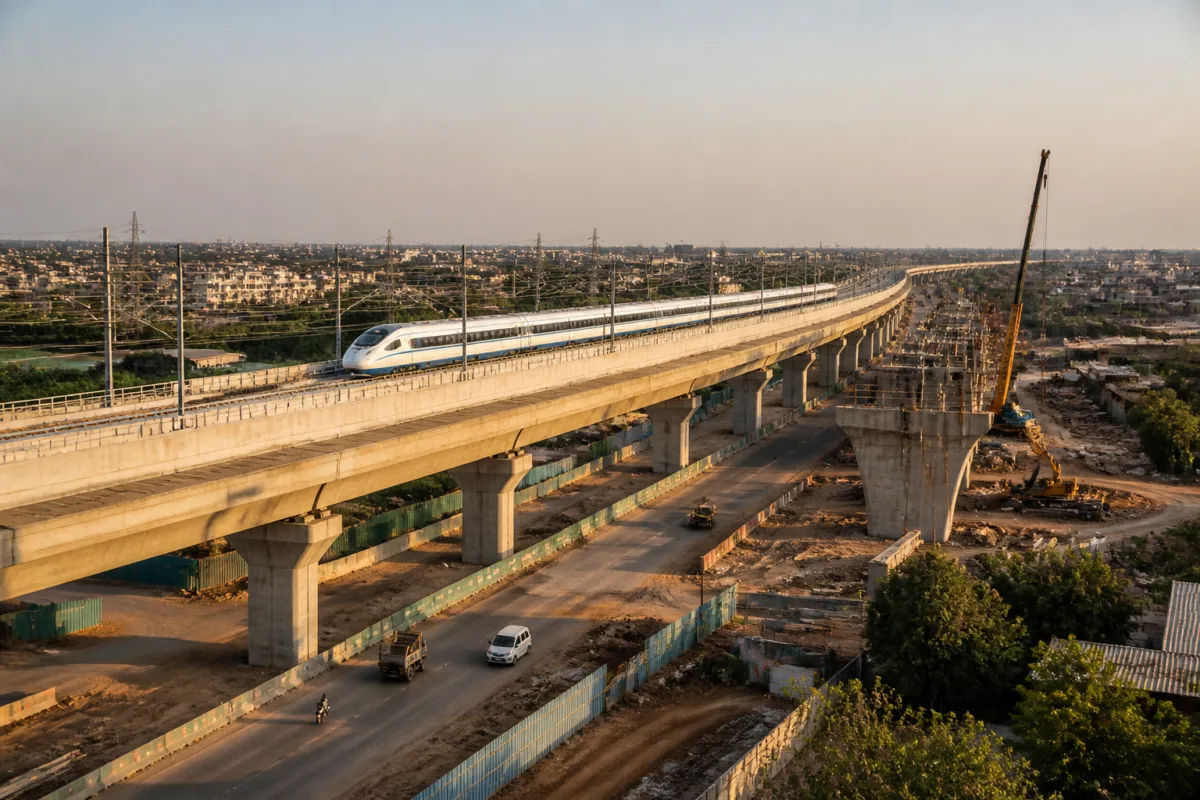
The proposed Delhi-Ahmedabad high-speed rail corridor remains a planning-stage project even as India advances its first operationally sanctioned bullet train line between Mumbai and Ahmedabad. Its absence from the seven high-speed rail corridors announced in Budget 2026-27 leaves a potential northern connection to the existing western corridor without a confirmed implementation plan.
The Delhi-Ahmedabad corridor is envisaged as an approximately 886-km route with a journey time of less than four hours. According to the report, the National High Speed Rail Corporation Limited (NHSRCL) has prepared a detailed project report and proposed 15 stations across Delhi, Haryana, Rajasthan and Gujarat. The route would begin at Dwarka Sector 21 in Delhi and terminate in Ahmedabad.
The proposed stations are Dwarka in Delhi; IMT Manesar and Rewari in Haryana; Behror, Shahpura, Jaipur, Ajmer, Vijaynagar, Bhilwara, Chittorgarh, Udaipur and Dungarpur in Rajasthan; and Himmatnagar, Gandhinagar and Ahmedabad in Gujarat. The entire corridor is proposed to be elevated.
The alignment would pass through or alongside major existing transport corridors, including the Dwarka Expressway, the Delhi-Jaipur railway line, the KMP Expressway and the Delhi-Jaipur highway. An NHSRCL official cited in the report said the alignment was selected partly to minimise land acquisition, which can be a lengthy stage in large infrastructure projects. The official also said that land acquisition had not yet begun.
This status places the proposal well behind the 508-km Mumbai-Ahmedabad High-Speed Rail corridor. The Mumbai-Ahmedabad line is under construction with Japanese technical and financial assistance and is planned to have 12 stations across Maharashtra, Dadra and Nagar Haveli, and Gujarat. It has a designed maximum speed of 350 kmph and an operational speed of 320 kmph.
The government said in July 2026 that the first service on the Surat-Vapi section of the Mumbai-Ahmedabad corridor was expected to begin in August 2027, according to the report. The full corridor remains a separate, longer-term undertaking. The project has also faced delays, including land acquisition challenges in Maharashtra, while its cost has risen substantially from the original estimate.
A Delhi-Ahmedabad line would not automatically create a direct Delhi-Mumbai bullet train service. Such a service would require the proposed corridor to receive formal sanction, financing and clearances, followed by land acquisition and construction. It would also require decisions on through-services and operating arrangements between the two corridors.
The potential network value lies in linking major urban and economic centres rather than simply reducing the journey between two terminal cities. The proposed route would connect the National Capital Region with parts of Haryana, Rajasthan and Gujarat before joining the existing high-speed rail ambition towards Mumbai. At present, a train journey between Delhi and Ahmedabad takes around 14 hours, while the proposed corridor is intended to reduce that journey to less than four hours.
However, faster trains alone would not determine whether the corridor delivers broad public value. Station locations, service frequency, ticket prices and connections with local buses, roads, metro systems and conventional rail would influence access and passenger demand. Cities such as Jaipur, Ajmer, Udaipur, Gandhinagar and other proposed stops could benefit from stronger links to larger employment, education, tourism and commercial markets, but those outcomes would depend on how the stations are integrated with their surrounding urban areas.
The corridor would also have to be assessed alongside other transport investments. Dedicated freight corridors are designed to move goods, while high-speed rail is primarily a passenger system. The Western Dedicated Freight Corridor connects the Delhi-NCR region with the Jawaharlal Nehru Port area near Mumbai, serving a different but related objective of improving links between industrial, consumption and logistics centres. High-speed rail would not replace freight lines, highways or conventional rail; it would add a faster passenger layer to the transport network.
The same network question applies to the seven high-speed rail corridors announced in Budget 2026-27 as “growth connectors”. The reported objectives include improving regional connectivity, supporting tourism and investment, and encouraging a shift from road and air travel to rail. Delhi-Varanasi was included in that announcement, while Delhi-Ahmedabad was not.
The omission does not establish that the Delhi-Ahmedabad proposal has been abandoned. It does indicate that the corridor does not currently have the same announced policy momentum as the new corridors or the construction status of Mumbai-Ahmedabad. The Railway Ministry has cautioned, as reported, that sanctioning high-speed rail projects depends on detailed project reports, technical and economic feasibility, and the availability of resources.
That distinction matters for public expectations. A detailed project report and a proposed alignment do not amount to a construction commitment. Before work could begin, the Delhi-Ahmedabad corridor would need decisions on project sanction, financing, final alignment, statutory clearances and land acquisition. The timing of any future service therefore remains unspecified.
For urban regions along the route, the most important issue is not only whether the corridor is built but how it is connected to the cities it proposes to serve. A high-speed station located far from employment centres, without reliable local transport and manageable access costs, could limit the benefits of reduced inter-city travel time. Conversely, integrated stations could strengthen regional links and support more efficient movement between metropolitan and intermediate cities.
The proposed Delhi-Ahmedabad corridor is therefore best understood as a missing potential link, not an imminent Delhi-Mumbai bullet train. Its wider significance will depend on whether the Centre moves it from planning to execution and whether future high-speed rail decisions create a coherent, connected passenger network rather than a collection of isolated corridors.

