


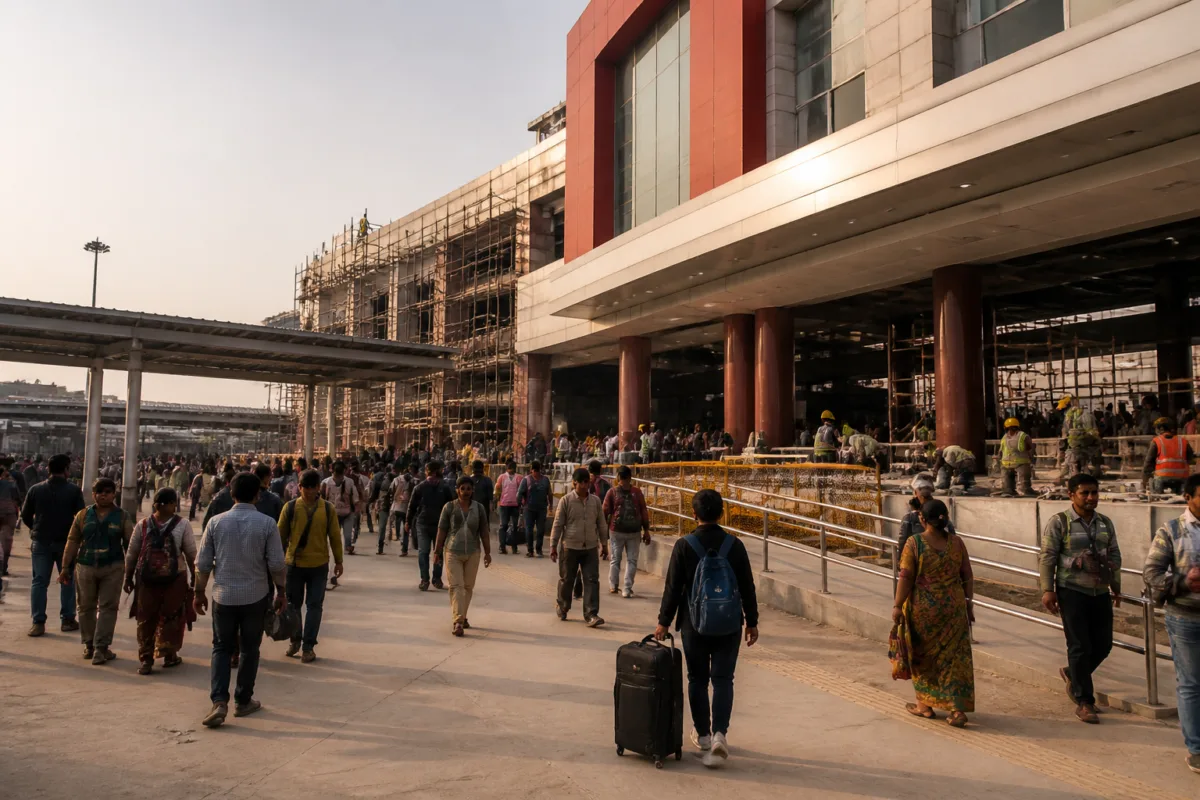
Delhi’s railway station redevelopment programme covers 13 stations and is part of infrastructure works valued at Rs 8,976 crore, according to statements attributed to Chief Minister Rekha Gupta in a report published on November 18.
The stations identified for redevelopment are New Delhi, Old Delhi, Hazrat Nizamuddin, Anand Vihar Terminal, Delhi Cantonment, Sarai Rohilla, Shahdara, Narela, Safdarjung, Bijwasan, Sabzi Mandi, Tilak Bridge and Adarsh Nagar.
The reported works include improved entry and exit arrangements, modernised station buildings, waiting areas, seating, toilets, drinking-water facilities, platform shelters, foot overbridges, lifts and escalators. Parking, access for persons with disabilities, passenger information systems and stronger connections between both sides of the city are also listed as priorities.
These interventions would affect more than the appearance of station buildings. Entry and exit redesign can influence how passengers reach platforms and interchange with roads and other transport services. Lifts, escalators, accessible routes and clearer information systems are particularly important at large stations, where crowd movement and wayfinding can determine how easily passengers transfer between city-side access points and platforms.
The report says New Delhi station’s holding area on the Ajmeri Gate side has been completed and that redevelopment work has begun. At Hazrat Nizamuddin station, redevelopment of a second entrance on the Sarai Kale Khan side is under way, according to the report. The account does not provide station-wise project costs, completion dates, construction phasing or details of how passenger movement will be managed during the works.
Gupta also said that Rs 2,711 crore had been allocated for railway development in Delhi in the financial year 2026–27. The report describes this as a record budget allocation but does not specify how much of it is earmarked for each station or how it relates to the broader Rs 8,976-crore programme.
The redevelopment plan comes alongside track-related works, including doubling, and measures described as strengthening passenger safety. However, the report does not provide details of the specific track sections, safety systems or construction agencies involved. It also does not state whether all 13 stations are at the same stage of redevelopment.
The report links the broader railway push to the Centre’s Viksit Bharat programme and says the Central and Delhi governments are committed to modernising the capital’s infrastructure and improving public facilities. It also refers to the proposed or announced New Delhi–Varanasi Vande Bharat sleeper service as an initiative intended to make travel between Delhi and major Uttar Pradesh cities more convenient.
For passengers, the outcome will depend on how consistently the stated improvements are delivered across the 13 stations. Station-side facilities such as toilets, drinking water, seating and shelters provide immediate usability benefits, while accessible routes, lifts and escalators are essential for older passengers, people with disabilities and those travelling with luggage. Better links across both sides of a station could also reduce dependence on a single entrance, although the report provides no design or traffic-management details.
The available account establishes the scope of the announced works but leaves key implementation questions open. These include the delivery timetable for each station, the agencies responsible, the extent of temporary disruption, the treatment of informal access and vending around station approaches, and the integration of upgraded entrances with buses, autos, taxis and pedestrian routes. Those details will determine whether the programme produces coordinated city transport improvements or mainly upgrades individual station premises.

