


A new global assessment that places 96 per cent of shallow-water coral reef systems at extremely high risk of collapse by 2075 is not only a warning about marine biodiversity. It is also a warning about the weakening of coastal systems that support communities, tourism, fisheries and protection from erosion and storms. The assessment by the International Union for Conservation of Nature, released alongside a United Nations biodiversity conference in Albania, identifies climate change as the single most consistent threat driving coral reef decline worldwide.
The finding matters because reefs are not isolated underwater habitats. They are part of the physical and economic infrastructure of tropical and subtropical coasts. The assessment covers 127 ecoregions and 188,362 square kilometres of coral reefs globally. It places major reef systems, including Australia’s Great Barrier Reef, the Coral Triangle in the Western Pacific and Southeast Asia, the Mesoamerican Barrier Reef System and the Red Sea reefs, in the critically endangered category.
For countries with populated coastlines, the loss of reef function creates a problem that extends beyond conservation. Coral reefs often act as buffers against coastal erosion and storms. They also support coastal communities and businesses through seafood and tourism. When reef ecosystems deteriorate, the consequences are therefore distributed across ecology, livelihoods and the physical safety of settlements near the sea.
The IUCN assessment describes coral reefs as among the clearest vital signs of ocean health. Their condition provides a concentrated view of the pressures affecting the marine environment, particularly the effects of warming oceans and marine heat waves. The assessment’s central finding is that these pressures have already moved most shallow-water reef systems into a high-risk category, rather than representing a distant possibility confined to a few damaged locations.
## What coral reef collapse means
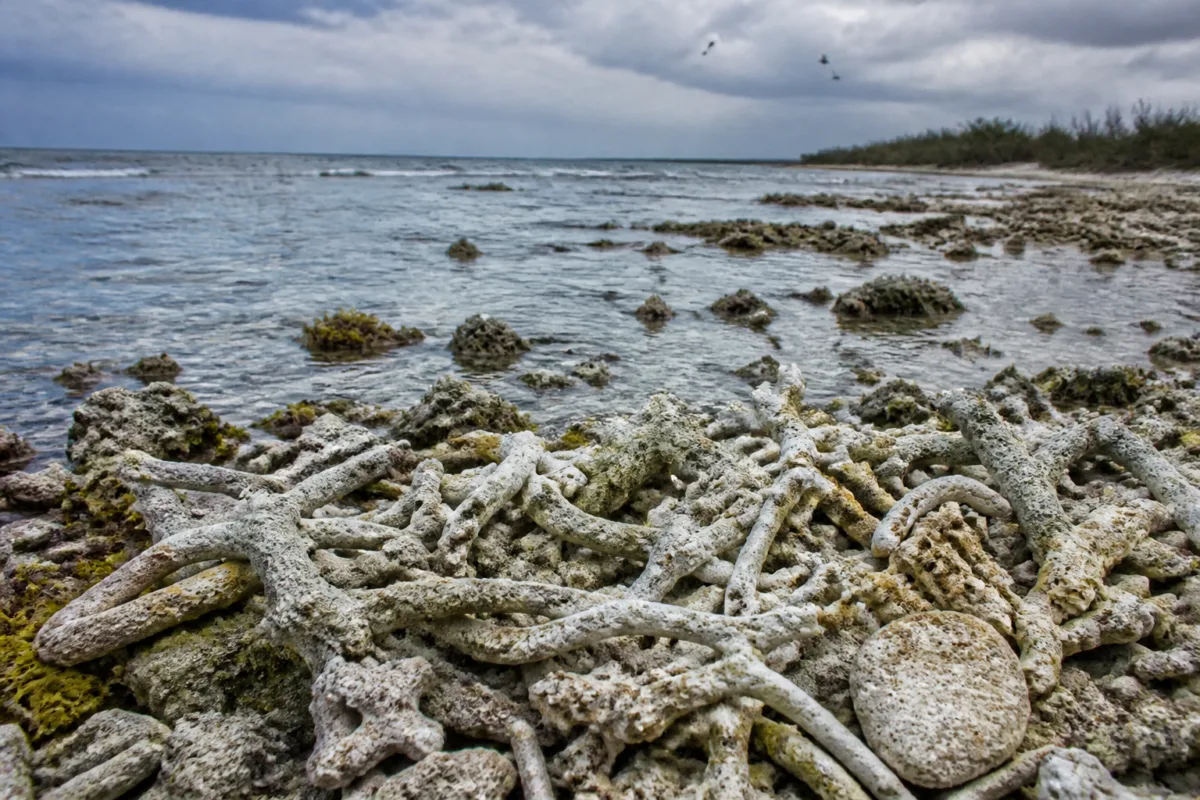
A reef does not simply become less colourful when it collapses. According to the assessment, hard corals disappear and are replaced by algae, rubble and sponges. The resulting ecosystem can no longer support the same diversity of life, including tiny invertebrates and reef fish such as grouper. This ecological change reduces the range of functions that reefs perform for both marine species and human communities.
The distinction is important for coastal planning. A living reef is a complex structure that supports biodiversity and contributes to the stability of the nearshore environment. A degraded area dominated by algae, rubble and sponges may occupy the same location on a map, but it does not provide the same ecological or protective value. The physical presence of a reef should therefore not be confused with the continued presence of a functioning reef system.
The IUCN’s scientific lead for the assessment, Mishal Gudka, said coral reefs had shown an ability to recover from devastating bleaching events. He also cautioned that only pockets of surviving, resilient reefs may remain in the future and said efforts should focus on creating conditions in which those reefs can survive. This introduces an important distinction between the widespread risk identified by the assessment and the possibility of preserving some areas of ecological resilience.
The assessment does not present resilience as a substitute for emissions reduction. Instead, it places survival within a broader response that includes reducing global emissions, lowering pollution, addressing overfishing and managing coastal development. These pressures can interact. A reef already stressed by unusually warm water may have less capacity to recover when local pollution, intensive fishing or construction-related disturbance is added.
## The climate signal is already visible
The assessment follows a series of indicators showing that coral stress is occurring alongside broader changes in the ocean. A study published in Nature a week earlier found that nearly 44 per cent of reef-building coral species face an elevated risk of extinction because of climate change. A survey a year earlier reported that harmful bleaching had affected 84 per cent of the world’s reefs, described in the report as the most intense such event recorded.
The climate context is equally significant. The source report notes that 2024 was the hottest year on record and that much of the additional heat was absorbed by the oceans. The average annual sea surface temperature in ocean areas away from the poles reached a record 20.87 degrees Celsius. These figures connect reef decline to a wider change in the ocean environment rather than treating bleaching as a sequence of isolated local disasters.
For urban and coastal authorities, this changes the character of the planning challenge. A reef collapse forecast for 2075 is not a remote environmental issue if current coastal infrastructure, settlements and economic activity are already organised around the services reefs provide. Tourism facilities, fishing economies and communities exposed to coastal erosion may all be affected by the same underlying change, even though their immediate responsibilities are divided among different departments.
The evidence also shows why a single intervention cannot resolve the problem. Local reef protection may reduce the effects of pollution, overfishing or poorly managed coastal development, but it cannot by itself stop ocean warming. Conversely, global emissions reductions are essential but do not remove the local pressures that can make recovery more difficult. Reef survival therefore depends on actions operating at different scales, from international climate policy to local coastal management.
## The coastal governance problem
Coral reefs sit at the intersection of institutions that are often managed separately. Climate policy addresses emissions. Environmental authorities oversee marine ecosystems. Coastal administrations manage development and erosion. Fisheries departments regulate fishing activity. Tourism agencies depend on the attractiveness of reef environments, while local communities rely on the income and food systems connected to them.
The IUCN’s recommendations reflect this overlapping responsibility. Grethel Aguilar, the organisation’s director general, called for ambitious emissions reductions, stronger protection and restoration efforts, and sustained investment in resilient coastal ecosystems and the communities that depend on them. The statement places ecological restoration and community resilience alongside emissions reduction rather than presenting them as separate policy tracks.
That framing is relevant to the way coastal infrastructure is planned. If reefs provide a buffer against storms and erosion, their deterioration can increase the pressure on other forms of protection. The source material does not quantify that future burden or compare reef protection with engineered coastal structures. It does, however, establish that reef systems already provide a protective function and that their collapse would remove part of the natural system supporting coastal settlements.
The institutional challenge is made more difficult by the long time horizon. The assessment points to possible collapse by 2075, while bleaching, record ocean temperatures and species extinction risks are already being recorded. Governments must therefore respond to a long-term structural risk through decisions about present-day emissions, land use, fishing, pollution control and restoration. The gap between the timescale of infrastructure decisions and the timescale of ecological decline cannot be treated as a reason to defer action.
## From biodiversity loss to urban resilience
The strongest urban lesson from the assessment is that biodiversity and infrastructure are not separate planning categories along the coast. Reefs support marine species, but they also help sustain the economic and physical systems around them. The report identifies seafood, tourism, coastal communities and protection from erosion and storms as part of the reef-linked system.
This means that a reef collapse can appear in different forms depending on where its effects are felt. In a fishing community, it may be reflected in the loss of habitat that supports commercially important species. In a tourism economy, it may weaken one of the natural assets on which businesses depend. Along an exposed coastline, it may remove a buffer that helps reduce the impact of storms and erosion. These are different outcomes, but they originate in the same ecological decline.
The photograph referenced in the source report, showing dead corals on Kariyachalli Island off Tamil Nadu’s Thoothukudi coast, gives the global assessment a direct Indian coastal context. The image does not establish the causes or future effects at that location, but it illustrates that reef degradation is not an abstract phenomenon confined to distant ocean systems. It can be seen along India’s own coast, where ecological conditions and coastal livelihoods are connected.
The assessment also cautions against reducing the debate to a simple choice between despair and optimism. Gudka described the risk as escalating but said the findings should be a wake-up call rather than a cause for despair. The possibility of resilient pockets remains, but the report’s broader evidence shows that resilience is being tested across almost all shallow-water reef systems.
The remaining question is whether protection and restoration can be implemented at a scale and speed that matches the combined pressures identified by the assessment. The evidence confirms the severity of the risk, the central role of ocean warming and the importance of local stressors such as pollution, overfishing and coastal development. It does not establish which reef systems will survive or how specific coastal economies will change.
What deserves monitoring now is the interaction between global emissions trends, future bleaching events, the condition of reef-building coral species, local coastal development and the effectiveness of protection and restoration programmes. The IUCN assessment makes clear that coral reef collapse is not only a conservation warning. It is a test of whether coastal governance can protect the natural systems on which urban economies, communities and physical resilience depend.

