


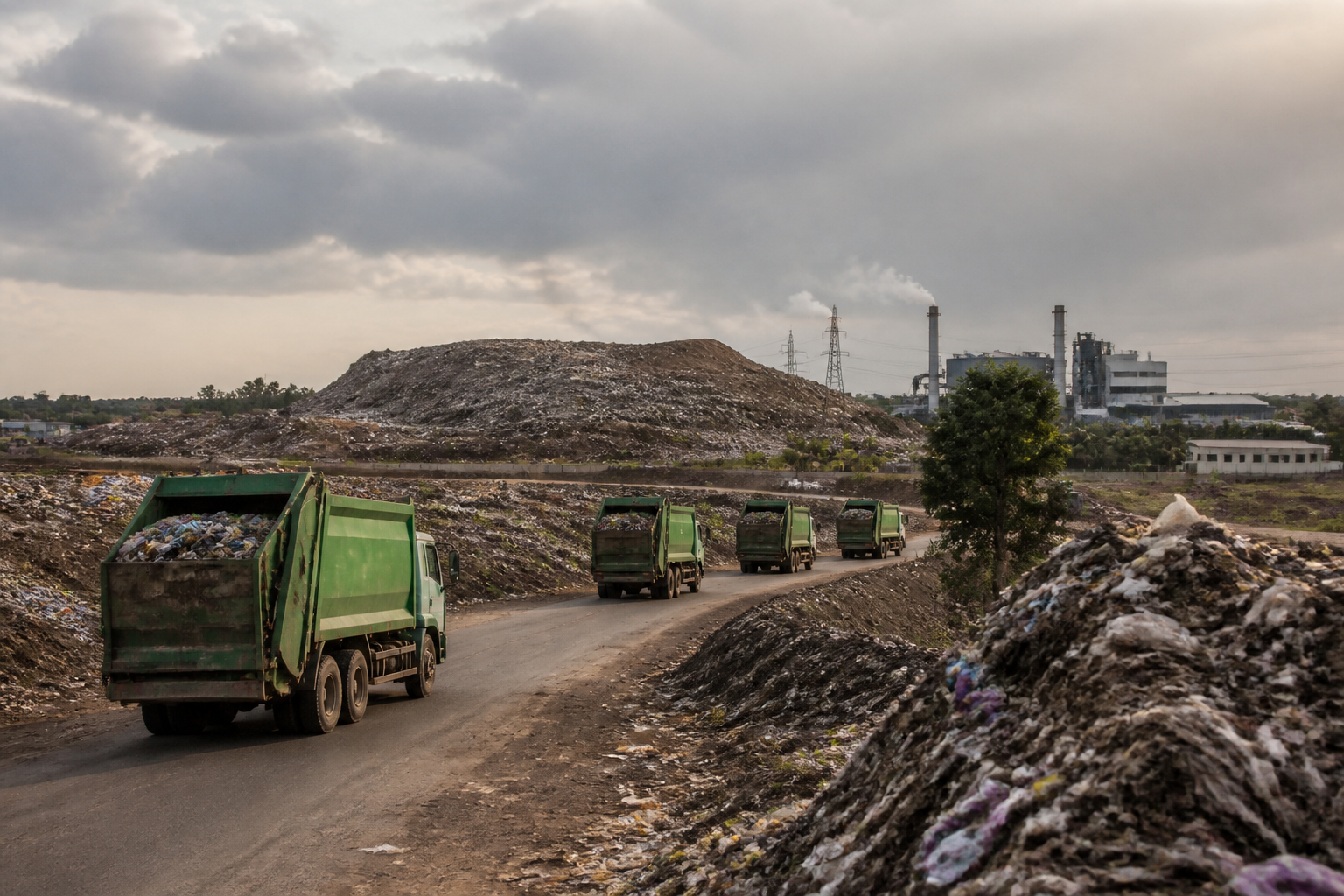
The Coimbatore-Tirupur waste-to-energy plant has received another tender deadline extension, moving the application closing date to October 31. The latest delay is not merely an administrative update. After extensions in April, July, August and September, the project’s stalled tender process is bringing a larger urban question into focus: whether a centralised incineration-based waste system can secure investors and public acceptance when local groups are demanding decentralised alternatives.
The project was announced in the Tamil Nadu state budget for 2025 and subsequently proposed at a cost of Rs 450 crore. It is planned at the Vellalore dump yard, with a proposed processing capacity of 1,200 tonnes of waste per day for the Coimbatore-Tirupur cluster. Tender documents were uploaded in February, but the application deadline has been repeatedly extended since then.
The supplied report does not establish whether the extensions were caused by an absence of bids, requests for clarifications, changes to the tender conditions or other administrative factors. However, the repeated movement of the deadline indicates that the project has not yet reached the stage of a settled procurement process. It also places the proposed facility at the intersection of three difficult questions for urban governments: how to process growing volumes of municipal waste, how to finance large treatment infrastructure and how to distribute environmental risks across neighbourhoods.
The location is central to the controversy. The proposed facility would be established at Vellalore and would receive waste from the wider Coimbatore-Tirupur cluster. K S Mohan, secretary of the Kurichi-Vellalore Pollution Prevention Action Committee, said the state government should instead implement decentralised waste management. He argued that bringing waste from Coimbatore corporation and Tirupur to Vellalore would concentrate the burden in an area where residents have been protesting against the proposal.
That objection is about more than the location of a plant. It challenges the logic of treating a regional waste cluster as the most efficient administrative unit for handling municipal waste. A cluster approach can potentially consolidate investment, land, machinery and operating capacity. But it can also create a single large site that carries the traffic, odour, pollution and residue-related concerns associated with waste processing. The supplied material does not provide an official assessment comparing the cluster model with decentralised systems, leaving that policy choice unresolved.
The project’s proposed capacity of 1,200 tonnes per day illustrates the scale of the planned intervention. It is not a small ward-level facility but a regional piece of infrastructure intended to serve waste streams from two urban areas. That scale may be one reason the project requires a large capital commitment of Rs 450 crore. It also means that any failure, underperformance or public opposition could affect waste-management planning beyond a single municipal corporation.
The project’s financial structure is not detailed in the supplied report. There is no confirmed information on the number of bidders, the proposed concession model, the expected power output, tipping fees, viability-gap support or the responsibility for handling ash and other residues. Those details are important because the label “waste-to-energy” describes an intended outcome, not the full operating model. The viability of such a facility depends on the quality and composition of incoming waste, the reliability of collection and segregation, the cost of treatment and the ability to manage residual material safely.
R Sathish Kumar, an activist in Tirupur, said the project should be reconsidered if investors were not coming forward. He also criticised incineration as an unsustainable waste-management approach and referred to the Kodungaiyur plant in Chennai as an example of what he described as a failure model. According to his statement, fly ash from that plant created a health hazard for surrounding residents and the facility was later shut down following protests.
Those claims are presented in the supplied report as an activist’s criticism, not as an independent technical assessment or an official finding. The report does not include a response from the state government, Coimbatore corporation, Tirupur authorities or the project’s tendering agency. It also does not establish whether the proposed Coimbatore-Tirupur facility uses the same technology, operating standards or safeguards as the Chennai plant cited by Kumar. These distinctions matter because comparisons between facilities require evidence on technology, emissions control, waste composition, ash management and regulatory compliance.
At the same time, the criticism identifies the institutional gap that often surrounds large urban waste projects. Municipal authorities are responsible for ensuring that waste is collected and processed, but the infrastructure may be designed, financed and operated through state-level or private-sector arrangements. Residents then experience the consequences at the local level, even when key decisions are made elsewhere. In Vellalore, the dispute therefore involves not only technology but also who has authority to decide, who bears the risks and what evidence is made public before construction begins.
The absence of a documented official response in the supplied material is significant for the next phase of the tender. The authorities will need to clarify why the deadline has been extended repeatedly, whether the tender conditions have changed and what safeguards are proposed for emissions, fly ash and other residues. They will also need to explain how waste from Coimbatore and Tirupur would be transported to Vellalore and how the facility would fit into existing collection, segregation and disposal systems.
The debate over centralised and decentralised waste management is also a debate over the scale at which cities govern waste. A central plant treats waste as a regional infrastructure problem, requiring a large site and high-capacity equipment. A decentralised model places greater emphasis on processing closer to where waste is generated. The supplied report does not provide comparative cost, capacity or performance data for either model, so it cannot establish which approach would be more effective. It does show, however, that the proposed regional model has not resolved concerns among local groups.
The repeated tender extensions make procurement itself part of the story. A tender deadline is usually treated as a technical milestone, but multiple extensions can reveal that a project is still trying to align its design, market appeal and local legitimacy. The report does not say that the project has been cancelled or that the government has decided to revise it. Nor does it confirm that the absence of investors is the reason for the extensions. What is established is that the application deadline has moved several times since the tender was uploaded in February.
That uncertainty has consequences for municipal waste planning. Until the tender produces a selected agency and the project moves into implementation, the proposed 1,200-tonne-per-day capacity remains a plan rather than an operating solution. Coimbatore and Tirupur authorities must continue managing waste through existing arrangements while the regional facility remains under procurement. The report does not provide details of those arrangements or their current capacity, so the extent of the immediate operational pressure cannot be quantified from the available evidence.
The project’s next deadline, October 31, will therefore be watched for more than the number of applications received. It should clarify whether the proposal can attract a developer or operator, whether the tender is revised again and whether the government responds to demands for a decentralised system. It should also bring greater clarity on the safeguards and institutional responsibilities that would govern the facility if it proceeds.
The evidence currently confirms a Rs 450-crore proposal for a 1,200-tonne-per-day waste-to-energy plant at Vellalore, announced after the 2025 state budget and subject to repeated tender extensions. It also confirms organised opposition to the proposed location and technology. What remains unclear is the reason for the procurement delays, the level of investor interest, the project’s technical safeguards and whether authorities have assessed decentralised alternatives. Those questions will determine whether the next deadline marks progress or another pause in the region’s search for a workable waste-management system.
