


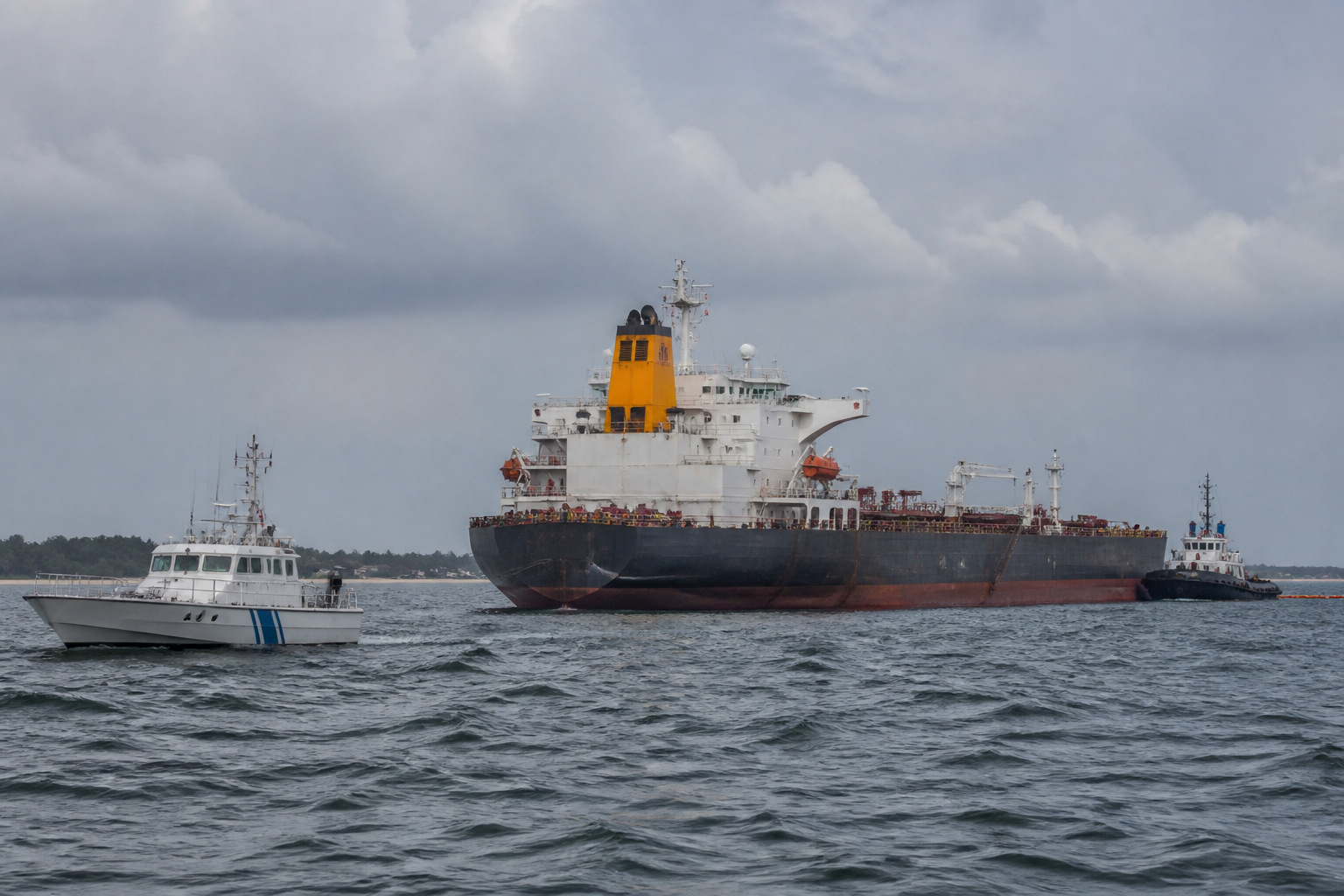
The Indian Coast Guard rescued and stabilised the Belize-flagged tanker MT Seagull 9 after engine failure and flooding threatened to capsize the vessel 37 nautical miles east-southeast of Paradip, Odisha, on September 27. The tanker was carrying 9,000 metric tonnes of palm oil and had 23 crew members on board.
The vessel issued a distress call at around 7.30 am after its main engine failed and its ballast tanks began flooding rapidly. The Coast Guard dispatched ICGS Vishwast, whose specialised damage-control team boarded the unstable tanker and deployed submersible de-flooding pumps and other equipment.
The response team stopped the leakage and isolated damaged seawater pipelines. “The team arrested the leakage, blanked two damaged seawater pipelines and contained a third fractured line,” Commandant Amit Uniyal, Chief Public Relations Officer of the Indian Coast Guard, said.
The Coast Guard also diverted a Pollution Control Vessel and an Offshore Patrol Vessel to support pollution management and maintain round-the-clock monitoring around the tanker. An ICG Dornier aircraft launched from Bhubaneswar conducted aerial surveillance of the affected area.
According to the Coast Guard, coordinated operations by its team and the tanker’s crew included simultaneous cargo transfer and de-flooding. These measures stabilised the vessel and removed the immediate risk of capsizing. The incident nevertheless triggered a pollution-response operation because of the tanker’s palm oil cargo and the possibility of leakage in coastal waters.
A minor palm oil sheen detected near the vessel on September 27 had fully dissipated by the time follow-up aerial sorties were conducted on September 28, Uniyal said. The Coast Guard said it continued to maintain pollution-response measures to safeguard the marine ecosystem.
After the tanker was stabilised, Paradip Port Authority tug Dolphin towed it towards the anchorage area off Paradip. Repair work on the vessel’s main engine is underway with assistance from the technical team aboard ICGS Vishwast. The Coast Guard, its pollution-response vessels and the port authority are continuing to monitor the vessel while repairs proceed.
