


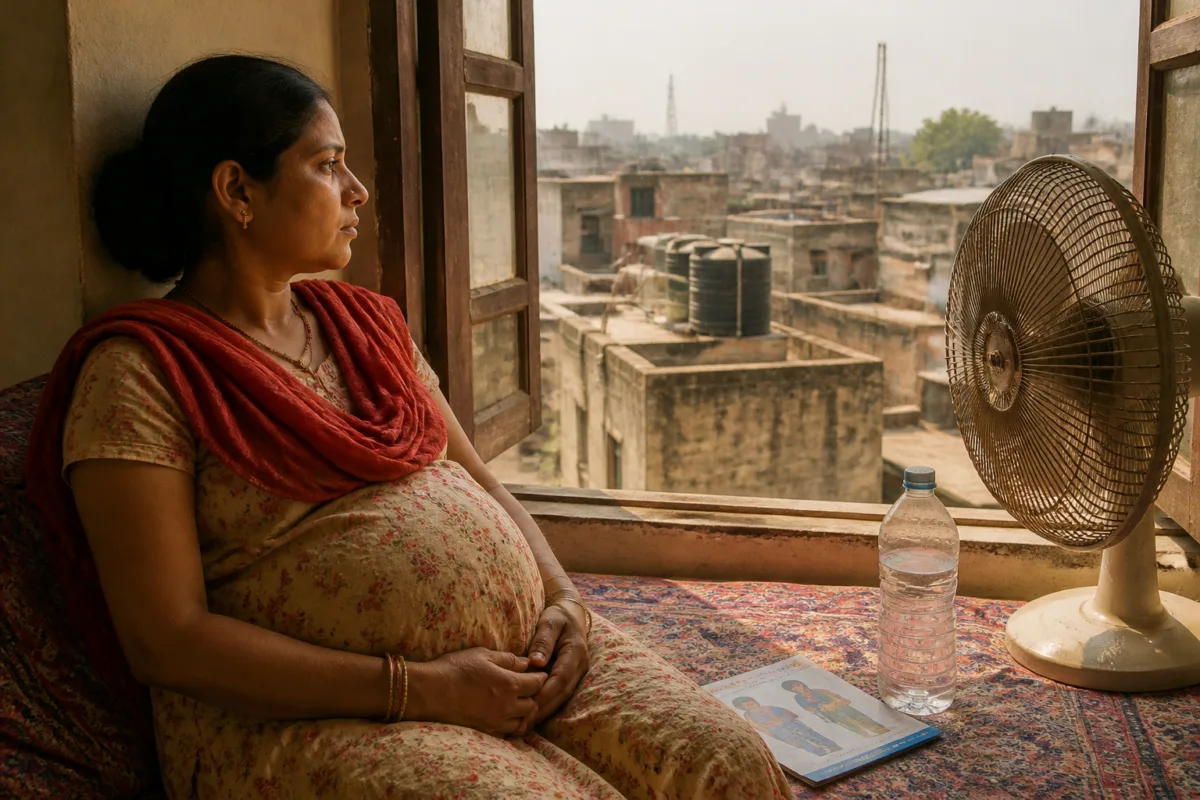
An estimate of 8,830 climate-linked premature births in India during the extreme heat of April 2024 shows how climate change is moving into a part of urban and public health policy that has received limited attention: pregnancy. The finding, reported from a study by Zero Carbon Analytics, connects rising heat not only to outdoor work, water stress and electricity demand, but also to the health of pregnant women and newborn children.
The study estimated that India, Bangladesh and the Philippines experienced around 16,150 additional premature births during the unusually hot April, compared with a normal April. Of these, 10,600 were attributed specifically to human-caused global warming. India accounted for an estimated 8,830 of those climate-linked cases, while Bangladesh accounted for 1,479 and the Philippines for 263.
The distinction between the two numbers is important. The estimate of 16,150 refers to additional premature births associated with the extreme heat event when compared with a normal April. The figure of 10,600 refers to the share of those additional births that the study associates with human-driven warming, compared with a world without the temperature increase caused by human activity. These are modelled estimates, not a count of individual cases recorded through a national health registry.
That distinction does not reduce the importance of the finding. It changes the policy question. Heat is generally treated as an environmental or occupational hazard, while premature birth is handled through maternal and neonatal healthcare. The study suggests that these are no longer separate policy areas. A heatwave can become a maternal-health event, particularly where pregnant women face inadequate cooling, poor nutrition, anaemia, long hours of outdoor work or limited access to timely medical care.
The geography of the estimated burden also matters. In India, Bihar, Uttar Pradesh, West Bengal and Jharkhand were estimated to account for approximately two-thirds of the country’s additional premature births linked to the April heat. These states include large populations and substantial variation in access to maternal healthcare, housing quality, cooling and safe working conditions. The figures therefore point to an uneven climate-health burden rather than a uniform national risk.
The report’s regional distribution illustrates why national averages can conceal the way climate risk is experienced. In Bangladesh, the Dhaka and Chattogram divisions accounted for 47 per cent of the country’s additional cases in the study’s estimate. In the Philippines, Calabarzon had the highest estimated number, followed by Metro Manila and Central Luzon. Metro Manila alone accounted for 14 per cent of the country’s additional cases.
The underlying heat event was itself unusually severe. According to the study, human-caused climate change made the April 2024 heat in South Asia approximately 45 times more likely. The report also concluded that, without human-caused warming, a heat event of this kind in the Philippines would have been almost impossible. These findings place the premature-birth estimates within a broader attribution analysis: the health burden was associated with an extreme event whose likelihood and intensity were increased by global warming.
Premature birth is not a minor or short-term health outcome. The report notes that preterm birth is the leading cause of death among newborns globally. Children born prematurely can face serious health problems in the early stages of life, as well as challenges related to physical growth, brain and nervous-system development and later social and economic participation.
For urban policy, this means that the impact of heat cannot be assessed only through temperature records or heat-related deaths. Cities and districts also need to consider how heat affects people who may not be visible in conventional heat-risk assessments. A pregnant woman working outdoors, living in a poorly ventilated home or travelling long distances to a health facility may face a combination of exposure and vulnerability that is not captured by a city’s daily temperature alert.
Dr Rashmi Agarwalla, associate professor in the Department of Community and Family Medicine at AIIMS Guwahati and the institution’s nodal officer for climate change, said pregnant women and newborns in climate-vulnerable countries such as India are directly exposed to the crisis. She identified anaemia, poor nutrition and prolonged outdoor work as factors that can increase heat-related risks for pregnant women.
Her comments also point to an institutional gap. Heat is often addressed through public advisories focused on hydration, working hours, outdoor exposure and emergency response. Maternal and newborn health programmes, meanwhile, tend to be organised around antenatal visits, nutrition, disease prevention and clinical care. The report argues that these systems need to be connected more deliberately, so that heat protection becomes part of routine care during pregnancy rather than an occasional emergency message.
The study’s lead author, Dr Joanne Bentley-MacCun, a senior research analyst at Zero Carbon Analytics, said rising temperatures are making extreme-heat events more frequent and intense. She linked this increase to a higher risk of premature birth and potential long-term effects on children’s health. She also pointed to improved antenatal care, access to cooling and early-warning systems as measures that could reduce some of the risk.
These interventions operate at different levels of the urban system. Antenatal care is delivered through health facilities and frontline workers. Cooling depends on housing, electricity, public buildings and household affordability. Early warning depends on weather information being translated into timely and usable messages for local communities. Protection from outdoor heat also involves labour conditions, transport access and the ability of workers to change schedules without losing income.
The report states that existing maternal-health policies and heat-action plans in India, Bangladesh and the Philippines do not yet systematically include measures to protect pregnant women and newborns from extreme heat. It identifies several areas for integration: heat-protection advice during pregnancy, access to cooling facilities and local early-warning systems that can reach vulnerable households in time.
This is significant because heat-action plans are often designed around broad population groups rather than specific stages of life. Older people, outdoor workers, children and people with existing illnesses may be identified as vulnerable, but pregnancy can remain less visible in public heat planning. The study’s findings suggest that maternity services and heat-response systems need to share information and responsibilities instead of operating as separate administrative tracks.
The issue is especially important for Indian cities and rapidly urbanising districts. Built-up areas can intensify heat exposure through dense construction, limited shade, poor ventilation and a shortage of accessible cooling spaces. The supplied report does not provide city-level temperature or housing data, so it cannot establish how much of the estimated burden came from urban conditions. It does, however, show that the largest estimated state-level burdens in India were concentrated in Uttar Pradesh, Bihar, West Bengal and Jharkhand, making local health capacity and heat preparedness central to the response.
The study’s projections make the question more urgent. Using two climate scenarios—one involving moderate warming and another involving higher warming—it estimated that India could experience more than 15,000 additional premature births during a normal April around the middle of the century. In other words, an ordinary April around 2050 could carry a larger premature-birth burden than the exceptionally hot April of 2024.
The projection identifies Uttar Pradesh as the state expected to face the greatest impact, followed by Bihar and Rajasthan. In Bangladesh, the study estimated that rising temperatures could produce around 1,500 additional premature births during a normal April by mid-century, with the Dhaka division potentially most affected, followed by Chattogram and Rajshahi.
These projections are not a forecast of a fixed number of births. They are estimates based on future temperature scenarios and the relationship between heat and premature birth used by the researchers. Their significance lies in the direction of change: if ordinary seasonal temperatures begin to resemble today’s extreme events, health systems may have to manage the consequences without the event being formally classified as an exceptional heatwave.
That possibility challenges the way climate preparedness is usually organised. Emergency plans are easier to activate when a heatwave has a clear start and end. A gradual increase in average heat creates a less visible but more persistent demand for antenatal counselling, cooling, medical monitoring and neonatal care. It also raises questions about whether hospitals, primary health centres and community health workers have the facilities and guidance needed to respond to heat-related pregnancy risks.
The report’s timing coincides with wider international attention to health and climate change. It states that health is expected to be a major priority at the upcoming COP31 conference and that the United Nations climate chief has called for action on the effects of rising heat on pregnancy and childbirth. The World Health Organization, World Meteorological Organization, UNICEF and UNFPA have also launched a global framework to track extreme-heat health risks for pregnant women, newborns and children, according to the report.
The evidence therefore supports a broader definition of climate resilience. It is not limited to flood barriers, water storage, power supply or cooling shelters. It also includes whether a pregnant woman can receive heat-related advice, avoid dangerous exposure, access a cool environment and reach a health facility when symptoms appear. These requirements connect climate policy to the everyday design and functioning of homes, workplaces, transport systems and neighbourhood health services.
What the April 2024 estimates establish is that climate-linked heat exposure has consequences for pregnancy and newborn health in India. What remains uncertain in the supplied material is the precise contribution of individual factors such as housing, occupation, nutrition, healthcare access and local temperatures to each estimated case. The next policy test will be whether maternal-health programmes and heat-action plans begin measuring and addressing these risks together, while wider efforts to limit fossil-fuel emissions continue.

