


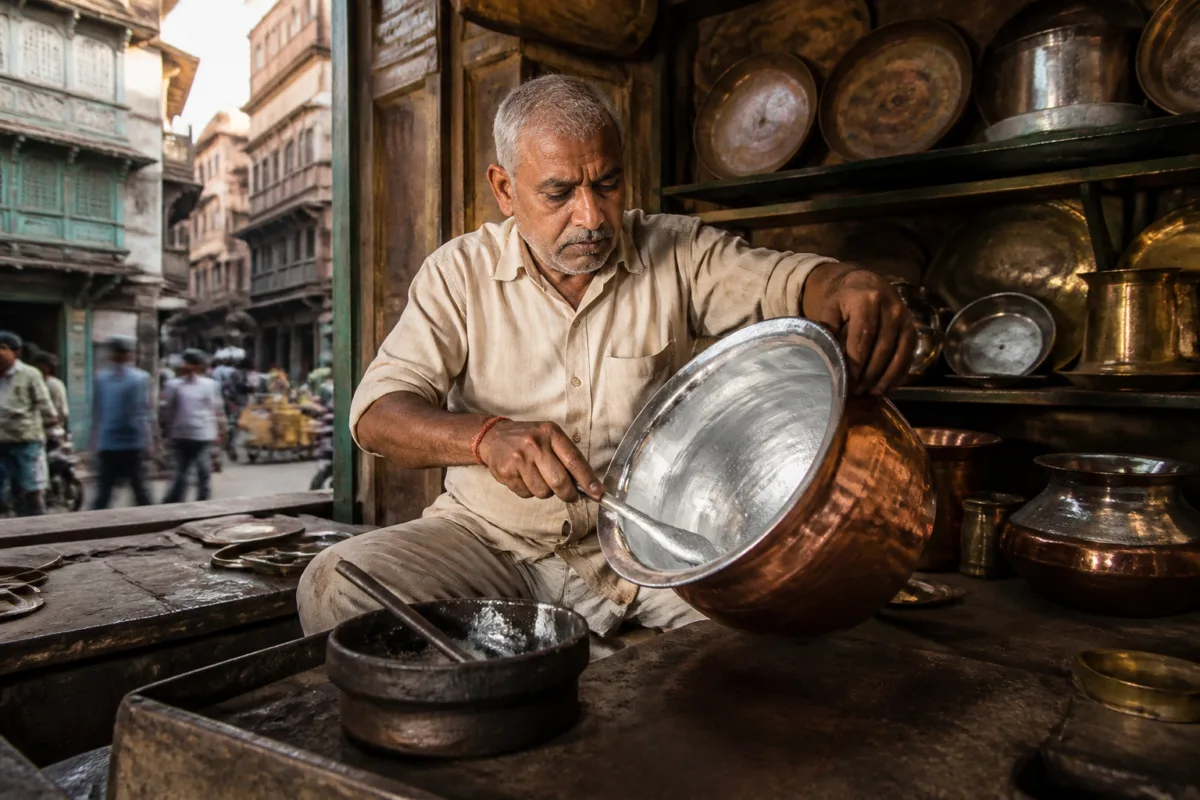
An 80-year-old kalai shop in Ahmedabad’s Manek Chowk is keeping alive a craft that once moved through the city’s pols before Diwali and other important occasions. The shop, now run by its fourth generation, continues to coat the interiors of copper and brass vessels with tin even as steel utensils, changing household routines and modern technology have reduced the demand for the work.
The story of kalai is therefore not only about an old utensil-finishing technique. It is also about how a city’s everyday economy changes when domestic materials, purchasing habits and food practices change. In Ahmedabad, the decline of kalai appears in the disappearance of the travelling artisans who once went from house to house with their equipment. According to the report by Gujarat Samachar, only one shop in Manek Chowk currently continues to perform the work.
That contraction is significant because kalai was once connected to a recurring urban ritual. Families would have copper and brass vessels coated before Diwali, while new vessels were also routinely treated before use. The service was not confined to a specialised workshop. Artisans travelled through the pols, taking the work to neighbourhoods and homes. The trade was consequently embedded in the city’s residential and commercial fabric rather than operating as an isolated heritage activity.
The Manek Chowk shop represents the surviving end of that system. Its continuity across four generations suggests that the craft has retained some demand, but the report also describes the business as struggling to remain viable. The shopkeepers say household orders have declined, while seasonal demand continues from caterers, hotels and restaurants, particularly around Diwali. This indicates a shift from routine domestic use to occasional or commercial use.
That change matters for the economics of a traditional craft. A business dependent on household maintenance receives frequent, distributed demand. A business dependent on festivals and institutional customers works in a more limited cycle, with orders concentrated around particular periods. The supplied report does not provide annual order numbers, revenue figures or employment data, so the scale of the decline cannot be measured precisely. It does, however, identify a clear direction: regular household demand has weakened, while seasonal commercial work has become more important.
The material itself also places pressure on the trade. The shopkeepers say tin is imported from several countries and that Malaysian tin is considered the purest among the varieties they use, costing approximately ₹5,400 per kilogram. The report does not establish import volumes, supply-chain arrangements or how the price has changed over time. The figure nevertheless illustrates why the work is not simply a low-cost polishing service. It depends on a specialised input whose price affects the cost of treating every vessel.
Kalai is applied as a thin tin coating on the inner surface of copper and brass vessels. The report explains that these metals can react with acidic foods such as dal, kadhi and tomato-based preparations. It presents the coating as a protective layer intended to prevent direct contact between the food and the vessel’s reactive surface. The report also states that the coating helps preserve the natural taste of food and makes the utensils easier to clean.
These health-related claims require careful framing. The source says that some artisans mix lead with tin to reduce costs and that prolonged exposure to lead can cause serious harm to the liver, kidneys and brain. It does not provide laboratory testing, regulatory records or an independent public-health assessment. That means the account establishes a reported safety concern, not a verified measurement of contamination in the Manek Chowk shop or across the wider trade. Any effort to revive kalai would therefore need to distinguish between the cultural value of the craft and the safety standards governing the materials used.
This distinction is important because traditional practice and safe practice are not automatically identical. A technique may have served households for generations, but its contemporary use depends on the quality and composition of the materials, the skill of the artisan and the information available to customers. The source report identifies tin as the intended coating and raises concern about lead adulteration. It does not say whether the shop’s material has been independently tested or whether customers receive any documentation about its composition. Those unanswered questions are central to understanding the trade’s future.
The decline of kalai also shows how the spread of steel changes more than the appearance of kitchens. Steel utensils reduce the need to maintain copper and brass vessels through repeated coating. When a household no longer uses those vessels for everyday cooking, the supporting service network loses its regular customer base. The disappearance of travelling kalai workers is consequently a sign of a broader change in consumption and domestic labour, not merely the disappearance of one occupation.
The report attributes the reduced use of copper and brass to changing lifestyles and modern technology. It does not specify which technologies or household practices have had the largest effect, nor does it provide comparative figures for steel, copper and brass use. Even without those numbers, the contrast is visible in the reported business model. The surviving shop is no longer described as serving a wide network of households. Its continuing orders come mainly from festival-related catering, hotels and restaurants, where large numbers of vessels may still require treatment.
Manek Chowk’s role adds another layer to the story. The market is presented as the last visible location in Ahmedabad where this work continues. The shop is therefore functioning simultaneously as a commercial establishment and as a repository of urban memory. Its value is not only in preserving a technique for display. It keeps alive knowledge of how vessels were prepared, maintained and used within older neighbourhood economies.
That knowledge is vulnerable because it is carried through practice and family succession. The report identifies the current operators as the fourth generation of the business, but it does not provide information about the number of workers, training arrangements or whether another generation is preparing to enter the trade. The fact that the business has survived for 80 years does not by itself guarantee continuity. A craft can remain visible in one shop while losing the wider network of workers, customers and suppliers that once made it economically sustainable.
The institutional landscape is also largely absent from the supplied account. It does not identify a municipal heritage programme, a formal artisan-support scheme, a market association initiative or a public safety protocol for tin coating. Nor does it establish whether the craft is recognised under any cultural or livelihood policy. This absence should not be read as proof that no support exists; it simply means that the report does not document such support. For the same reason, the future of the shop cannot be assessed through policy claims that are not present in the evidence.
What the available evidence does show is a tension between heritage and viability. The craft survives because a shop continues to receive enough work to operate, because family knowledge remains available and because some customers still use copper and brass vessels. It is under pressure because everyday household demand has fallen, the principal input is costly and the work is concentrated in a shrinking number of locations. These are practical conditions, not abstract questions of nostalgia.
The central urban question is whether a traditional occupation can remain part of a changing city without being reduced to a symbolic relic. In Ahmedabad’s case, the answer depends on the relationship between material safety, customer demand, artisan skill and access to viable commercial work. The supplied report confirms the survival of one 80-year-old Manek Chowk business and the decline of the larger neighbourhood-based practice. It does not establish how many artisans remain, how safe different kalai materials are or what formal support is available. Those are the facts that would need to be documented before the city’s surviving kalai work can be understood as either a recoverable livelihood or a craft approaching its final stage.

