


India’s estimated annual food loss of $13 billion due to climate risks and weak storage is not only an agricultural problem. It exposes a supply chain that remains vulnerable after crops leave the farm, with consequences for wholesale markets, livestock, food prices and urban kitchens. A new Climate Trends white paper, cited by Jagran, places the country’s food-security challenge at the intersection of extreme weather and inadequate post-harvest infrastructure.
The report, titled “From Risk to Resilience: Climate Change, Ecology and the Future of Indian Agriculture”, says that around 40% of India’s fruits and vegetables are lost before reaching consumers. It also estimates that 5% to 6% of grains are wasted. Only 4% of fresh produce is reported to be covered by cold-chain facilities, leaving much of the country’s perishable food exposed to heat, unseasonal rain, delays and weak storage conditions.
That combination changes the meaning of food security. Food availability is often measured by how much is produced, but the evidence cited in the report points to a second and equally important question: how much of that production survives the journey to consumers? A harvest can be adequate at the farm level and still fail to support stable urban supply if it deteriorates in transit, at wholesale markets or in storage.
The vulnerability is particularly visible in the relationship between rural production and cities. Urban consumers depend on a continuous flow of fruits, vegetables, milk and grains from dispersed agricultural regions. These supplies pass through mandis, transport networks, warehouses, retail markets and household kitchens. Weakness at any stage can increase wastage and reduce the quantity that reaches the market in usable condition.
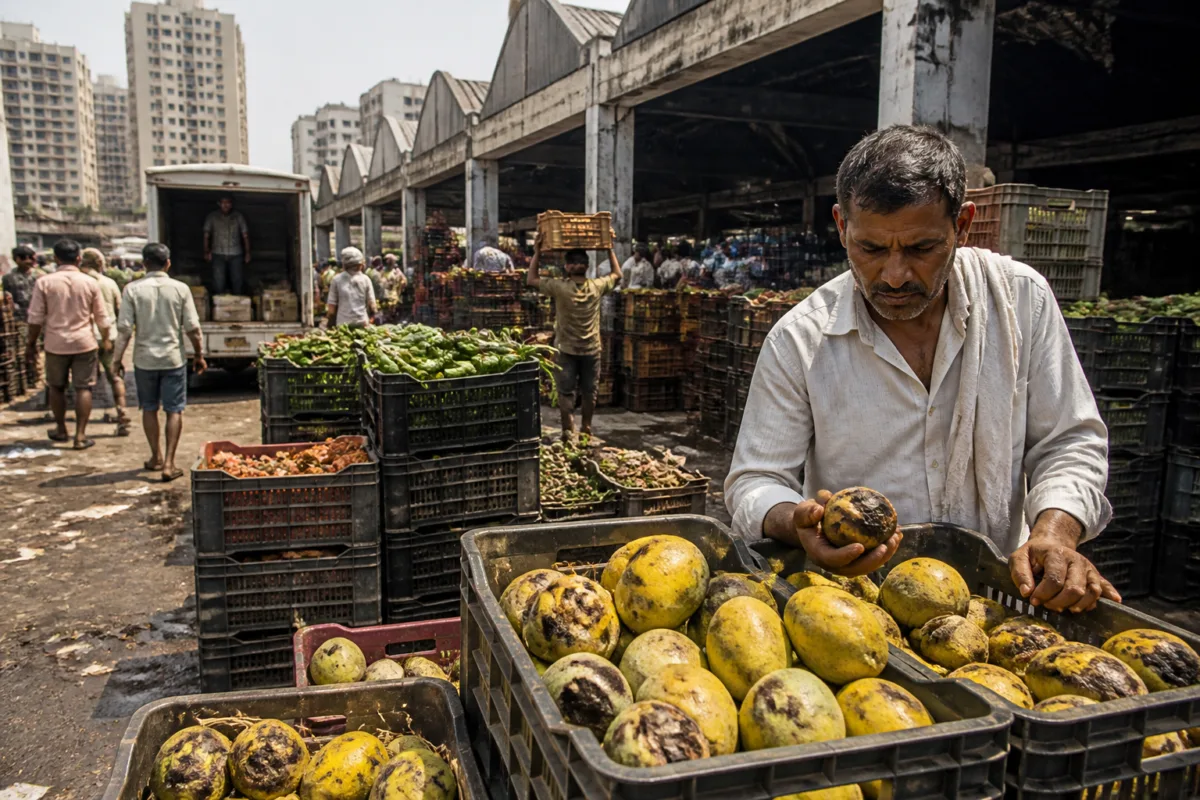
The report’s example from Delhi’s Azadpur Mandi illustrates how climate exposure can turn into a market-level loss. During the severe heat of 2024, mangoes reportedly spoiled in a single day, causing heavy losses for traders. The episode shows that the post-harvest system is not protected simply because produce has reached a major urban market. Without adequate cooling, shade, handling and timely movement, the market itself becomes a point of vulnerability.
This is an infrastructure problem as much as an agricultural one. Cold chains require more than refrigerated vehicles. They depend on storage facilities, reliable power, appropriate packaging, loading and unloading systems, distribution planning and coordination between producers, traders and retailers. The reported 4% coverage for fresh produce indicates that these systems remain limited relative to the scale of India’s perishable-food economy.
Climate change increases the pressure on that weak infrastructure. The source report identifies excessive heat and unseasonal rainfall as factors that raise post-harvest losses. Heat can accelerate spoilage, while rain at the wrong stage can disrupt harvesting, transport and market operations. When these events occur across multiple locations, the effects are not restricted to individual farmers or traders; they can affect the regularity and cost of supply to cities.
The food system’s exposure also extends beyond crops. The report says heat stress is reducing India’s milk production by 1.8 million tonnes a year, or approximately 2%, resulting in an estimated economic loss of Rs 2,661 crore. It further states that 40% of the country’s livestock population is highly sensitive to extreme weather. These figures connect climate risk to another essential urban supply: milk and other animal-based foods that require uninterrupted collection, cooling and distribution.
The reported agricultural exposure is broad. According to the white paper as cited, 45% of agricultural land falls in areas at serious risk of flooding, while natural disasters have affected more than 2 million hectares, equivalent to 14% of the sown area. These figures suggest that food-system resilience cannot be built only through isolated storage projects. It also depends on how land, water, transport and disaster-response systems are managed across regions.
The report’s discussion of drought adds an administrative dimension. Dr G V Ramanjaneyulu, executive director of the Centre for Sustainable Agriculture, is quoted as saying that six states officially declared drought this year. He also cautioned that conditions can differ between districts and blocks within the same state. This matters because agricultural distress and food-supply disruption may not follow state boundaries or respond neatly to a single statewide classification.
The source report further says that rising crop-insurance costs and premiums may be discouraging states from declaring droughts. If accurate, that creates a gap between local climate stress and formal administrative recognition. Such a gap can affect the timing of relief, insurance responses and other forms of institutional support. It also makes a uniform, state-level assessment less capable of representing highly uneven conditions on the ground.
The same problem appears in the gap between early warning and action. The report argues that issuing weather alerts at the beginning of a season is not enough and that timely ground-level measures are necessary. For farmers, traders and urban supply networks, an alert has practical value only if it is linked to decisions about harvesting, storage, transport, livestock care, market operations and emergency procurement.
The policy challenge is therefore distributed across several institutions. Agricultural departments deal with production and extension services. Disaster-management authorities respond to floods, droughts and extreme weather. Insurance systems address crop losses. Municipal bodies influence wholesale-market operations, waste management and local storage conditions. Transport and energy systems determine whether perishable goods can move and remain cooled. The figures in the report show that these responsibilities are connected, even when administration remains divided.
The fertilizer data cited in the report adds another layer to the resilience question. Chemical-fertilizer use increased from 73.5 kilograms per hectare in 1990 to 199 kilograms per hectare in 2023, more than doubling over that period. The white paper raises concern about this increase while arguing for agricultural systems capable of tolerating climate risks. The supplied material does not establish a direct causal relationship between fertilizer use and the reported food losses, but it places input-intensive farming within the broader debate over ecological sustainability and long-term resilience.
The data also reveals a mismatch between production and protection. India can lose approximately 40% of its fruits and vegetables before consumption while having cold-chain coverage for only 4% of fresh produce, according to the cited report. These figures do not describe a temporary disruption alone; they indicate a structural capacity gap. The issue is not simply whether farmers can produce more, but whether the system can preserve, move and distribute what is already produced.
For cities, the implications are immediate even when the original climate shock occurs far away. Urban food markets are dependent on rural landscapes, regional roads, logistics operators, wholesale yards, electricity networks and storage facilities. A disruption at one point can travel through the chain as spoilage, reduced availability, trader losses or pressure on household budgets. The source material does not provide a quantified estimate of the effect on consumer prices, but it establishes the pathway through which climate stress can reach urban food access.
The central evidence therefore points to a food-security model that remains heavily focused on output rather than survivability. A resilient system would need to account for what happens between harvest and consumption, as well as for the ability of livestock and farms to withstand extreme weather. It would also need administrative systems that recognise uneven local conditions and connect warnings with timely action.
What the supplied evidence confirms is the scale of the reported exposure: $13 billion in annual food loss, high losses for fruits and vegetables, limited cold-chain coverage, declining milk production under heat stress and extensive exposure of agricultural land to floods and disasters. What it does not establish is how much of the loss is attributable separately to climate change, storage gaps, transport failures or market practices. That distinction will matter as policymakers design responses.
The developments to watch are whether governments expand cold-chain and storage capacity, how drought and flood conditions are assessed at district and block levels, and whether early-warning systems are connected to operational support. India’s food-security challenge is no longer confined to the farm gate. The evidence cited in the report shows that the resilience of cities will also depend on whether the country can protect food through every stage between cultivation and consumption.

