


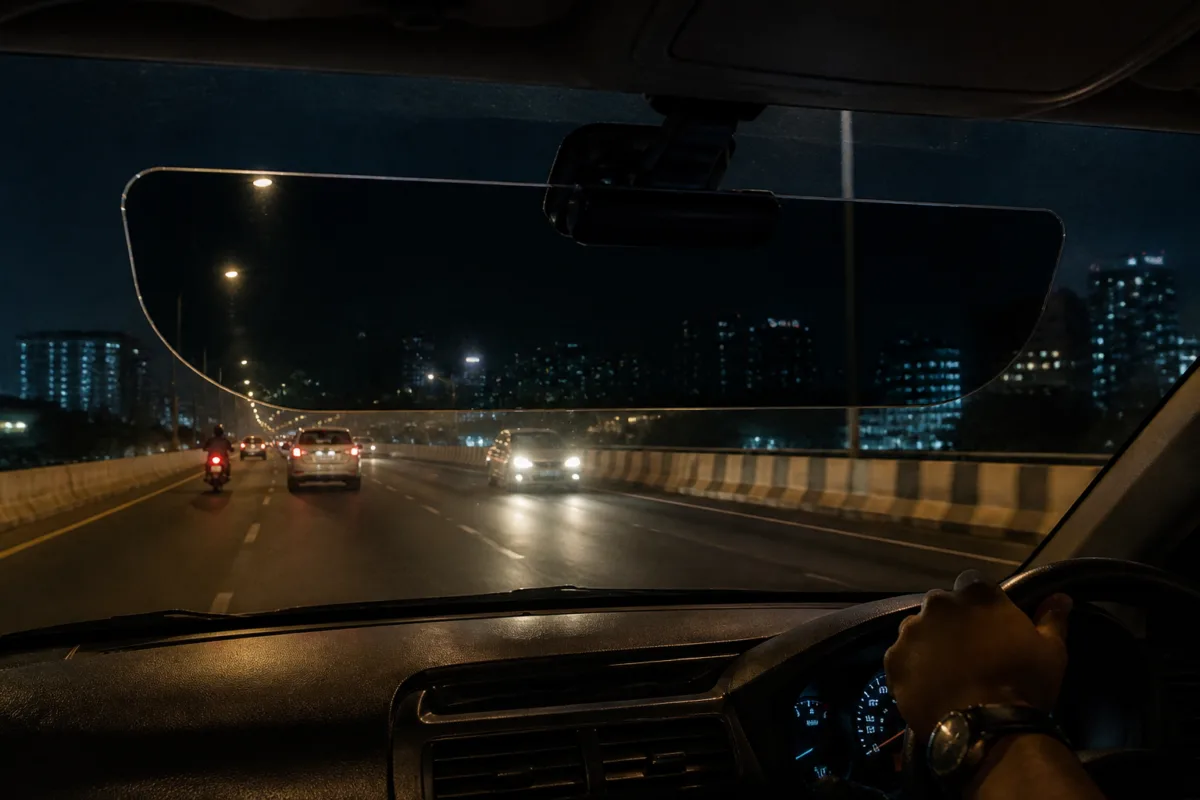
The Clarivisor device developed by the Central Road Research Institute (CRRI) is designed to reduce the glare from oncoming headlights and improve driver visibility at night. The electronic device can replace the conventional sun visor fitted in front of the windscreen of cars, jeeps and buses.
According to the report, the device measures the intensity of light outside the vehicle and automatically darkens within a few seconds when it detects strong glare. Unlike a conventional dark glass or film, Clarivisor uses automatic optical filter technology and remains transparent when the light intensity is normal. It is intended to allow only the amount of light needed for ordinary vision to reach the driver’s eyes.
CRRI has licensed the technology to two private-sector companies for bringing the device to the market. The report does not provide the names of the companies, the expected retail price, or a commercial launch date.
The device addresses a visibility problem that can become particularly dangerous after sunset. Data presented in Parliament and cited in the CRRI report show that India recorded 4,61,312 road accidents in 2022. More than 2.24 lakh of these accidents occurred between 6 pm and 6 am, meaning that nearly half were recorded during the evening and night-time period.
Scientists involved in developing Clarivisor said several studies have found that around 30 per cent of night-time accidents occur because drivers cannot clearly see hazards due to the headlights of vehicles approaching from the opposite direction. Glare can delay hazard recognition by between 3.5 and 15 seconds, according to the report.
At a speed of 60 kilometres per hour, a vehicle travels about 17 metres every second. A delay of 3.5 to 15 seconds in identifying an obstacle could therefore allow the vehicle to travel approximately 60 to 250 metres before the driver responds. The figures illustrate the distance covered while visibility is impaired, although the report does not specify how many accidents Clarivisor has prevented in testing or on public roads.
The technology was developed under the leadership of Dr Vinod Karar, a scientist associated with CRRI’s Traffic Engineering and Safety Planning, Monitoring and Evaluation Division. CRRI Director Dr Ravi Shekhar Chalamuri said glare affects the smooth movement of traffic because it makes it difficult to identify hazards in time. He described Clarivisor as a solution to the problem.
The next step is the transfer of the licensed technology to the two private companies. Details of regulatory approvals, vehicle compatibility, performance testing, pricing and the market launch timeline were not available in the report.

