


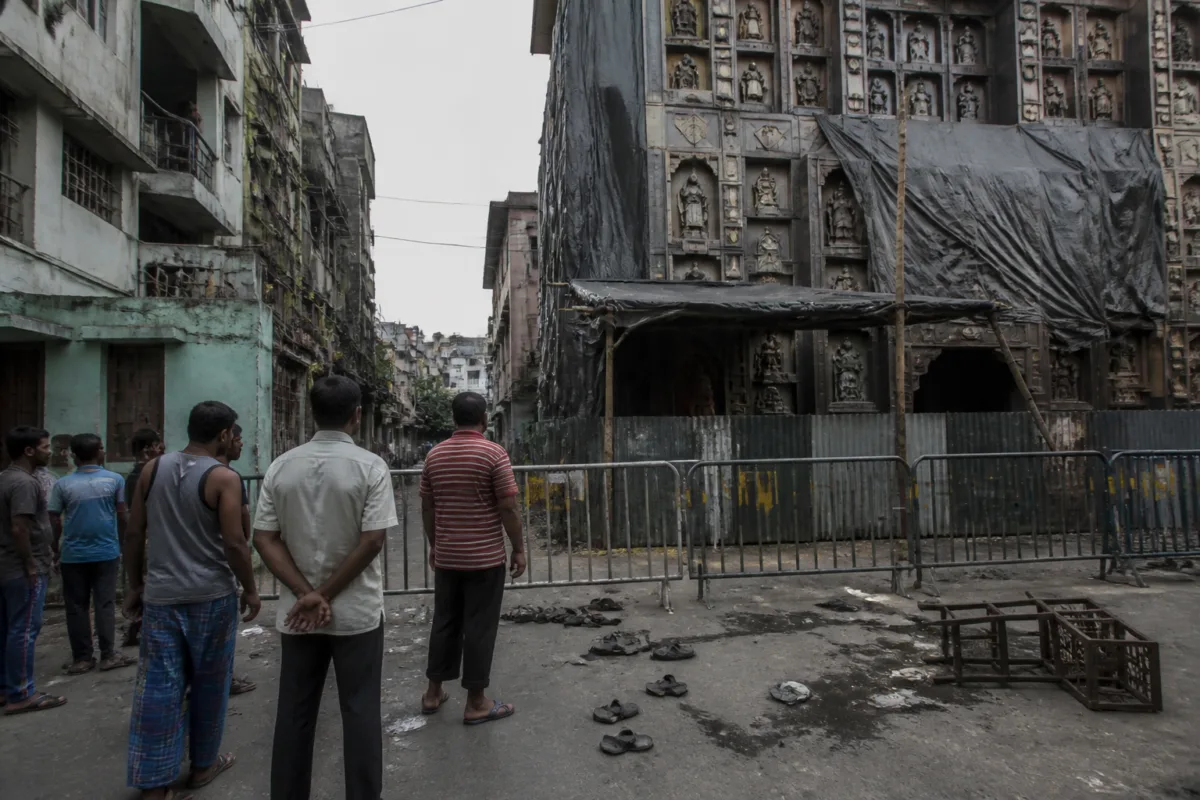
A week after the Chorbagan Durga Puja stampede killed 19 people, a sealed park, police barricades and a neighbourhood that has stopped celebrating have turned the Kolkata locality into a reminder of how quickly a public festival can become an urban safety crisis. The immediate tragedy is being mourned in silence, but the questions raised by residents are about the design, management and enforcement of safety systems that govern large gatherings.
The Chorbagan pandal remains cordoned off, with guard rails marking its entrance and exit and police preventing people from entering the site. Residents whose homes fall within the restricted area have been issued gate passes, while visitors from outside the neighbourhood have begun arriving to take photographs from a distance. Inside the sealed zone, shoes and slippers remain scattered and broken furniture is stacked near the entrance.
These physical remnants matter because a festival site is not only a temporary cultural installation. For a limited period, it becomes a high-footfall public space, with people entering, moving through and leaving a confined area in large numbers. The source does not establish what specifically caused the stampede or whether any particular safety rule was breached. It does, however, record residents’ concern that future events must pay closer attention to the movement of people through entrances, exits and internal spaces.
The neighbourhood’s grief has also exposed the social scale of the event. Durga Puja in Chorbagan was described by residents as a collective source of pride, not merely a private religious observance. People visited the local pujas, exchanged greetings, distributed sweets and went to the homes of friends and relatives. One week after the stampede, those routines have stopped.
“Durga Puja is a grand affair in our area. We visit all the neighbourhood pujas, too. This time, we have abstained from doing anything celebratory,” Sathi Ghosh, a resident of Parbati Ghosh Lane, told the Times of India. Her account shows how the consequences of a crowd disaster extend beyond the site itself. The event has altered how residents use their neighbourhood, interact with one another and relate to a festival that normally fills the streets with movement.
This is the first urban question raised by the Chorbagan tragedy: how should cities manage temporary public spaces that attract crowds far larger than their everyday capacity? A pandal may operate for only a few days, but during that period it can function like a major public venue. Its safety depends on more than the structure’s appearance. Entrances, exits, lighting, ventilation, circulation routes, police deployment and the ability to prevent dangerous crowd concentration all become part of the public infrastructure of the event.
Residents have identified those concerns in specific terms. Swapan Banerjee of Parbati Ghosh Lane said authorities must ensure that organisers do not flout safety norms. He called for spacious entrances and exits, adequate lighting and air-conditioning inside the pandal. These are resident demands, not findings of an official inquiry, but they point to the practical conditions that shape how people move and respond in crowded environments.
The emphasis on entrances and exits is especially significant. In any crowded venue, access points determine whether people can enter, leave or disperse without creating pressure points. A narrow or poorly managed route can become hazardous when arrivals and departures overlap. The material supplied does not provide measurements of the Chorbagan pandal, its visitor numbers, its approved capacity or its evacuation plan. It therefore cannot establish whether the site’s physical design or crowd management caused the deaths. It does show that residents now see the arrangement of movement as central to preventing a repeat.
Lighting and ventilation raise a second dimension of temporary-event safety. People need to see the route ahead, identify exits and maintain awareness of those around them. Ventilation becomes relevant when large numbers gather inside an enclosed or semi-enclosed structure. Again, the source does not say whether inadequate lighting or ventilation contributed to the stampede. The concerns have emerged from the neighbourhood’s experience of the site and from its demand that future celebrations not expose visitors to avoidable risks.
The police cordon has also changed the relationship between the festival site and the surrounding settlement. Some residents are able to access their homes only through gate passes. This means that the restricted zone is not an isolated event venue; it overlaps with ordinary residential life. The management of a sealed site therefore involves both preservation of evidence and the continued movement of people who live nearby.
That overlap illustrates a wider governance challenge. Urban authorities and event organisers must manage spaces that are simultaneously public venues, neighbourhood streets and access routes for residents. During a festival, these functions can come into conflict. Visitors seek access to the attraction, residents need access to their homes, and authorities must maintain safe movement while responding to emergencies. The source does not identify which agency is responsible for each aspect of the Chorbagan arrangements, nor does it detail the approvals granted to the organisers. Those institutional details remain important to understanding how accountability is distributed.
The tragedy has also created a difficult balance between mourning, investigation and public curiosity. The site remains sealed, while people from outside the area arrive to photograph it. Residents have been left to live beside barricades and reminders of the stampede. The physical closure may be necessary for official reasons, but it has also made the location a place of public attention at a time when the community is grieving.
For residents, the issue is not only that 19 people died. It is also that the name of a puja associated with collective pride has been transformed by the event. Ramji Sau, who lives near Muktaram Babu Street, said residents were yet to come to terms with the loss and that the incident had shaken the neighbourhood from within. His words capture the damage to civic confidence: a gathering that once represented local identity is now associated with danger and loss.
The immersion of the idol brought the neighbourhood into public view again. Many residents came out on Saturday evening, with some treating the farewell as a moment for prayer and reflection. Nehal Jain of Basak Bagan Lane said he sought forgiveness and hoped the goddess would return the following year. His account reflects an internal reassessment of what the celebration should represent, including a concern that worship may have been overshadowed by the display of crowds and themes.
That reflection is not a substitute for formal safety review. Cultural meaning and public administration operate on different planes. Residents may mourn, organisers may reconsider the character of the event, and authorities must still establish what happened, whether safety requirements were met and what controls will govern future gatherings. The supplied report does not provide the findings of such a review, identify any official conclusions or state whether action has been taken against any individual or organisation.
The absence of those details is important. Public discussion after a crowd disaster can quickly focus on visible features such as barricades, the size of a pandal or the behaviour of visitors. A complete account requires a broader examination of the event’s permissions, capacity planning, crowd-flow arrangements, emergency access, communication systems, on-site personnel and enforcement mechanisms. None of those elements can be treated as established facts here because the source does not document them.
What the available evidence does establish is that residents want future celebrations to be safer and that the current restrictions have disrupted everyday life. It also establishes that the neighbourhood’s response has been shaped by both grief and a loss of confidence in the festival environment. The call for spacious entrances and exits, lighting and ventilation gives authorities and organisers a concrete set of concerns to address, even though the source does not confirm whether these were deficient at the time of the stampede.
The larger urban question is whether temporary public events are being treated with the seriousness of permanent public infrastructure. Cities routinely plan roads, stations and public buildings around capacity, access and emergency movement. Festivals create similarly intense demands for a short period, but their temporary nature can make responsibility less visible. The Chorbagan experience shows why temporary does not mean low-risk.
A safe return to public celebration will depend on more than reopening the sealed site or restarting the annual calendar. It will require clarity about what happened, how crowd movement was managed and what authorities and organisers will change. The source records no official timeline for those next steps. Until such information emerges, Chorbagan remains both a grieving neighbourhood and an unresolved case study in the management of crowded urban celebrations.

