


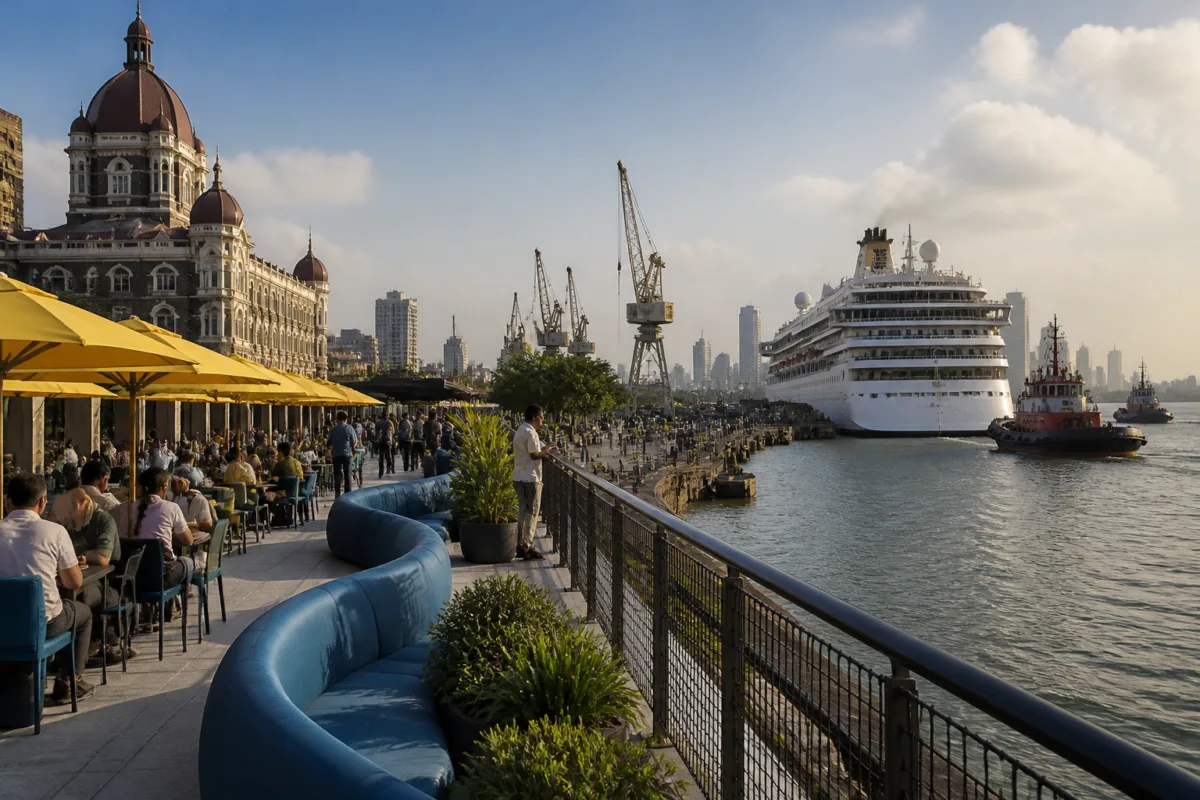
The opening of Ballard Pier Downtown at Mumbai’s International Cruise Terminal is more than the arrival of another restaurant-and-retail destination. It marks a carefully managed attempt to bring residents closer to a working harbour that has shaped the city for more than a century, while preserving the port’s operational, security and regulatory functions.
The Ballard Pier Downtown Experience Centre opened its gates on October 23 at the Mumbai International Cruise Terminal in Indira Dock, beside the historic Ballard Estate. Its two upper floors are being developed with restaurants, shops and a seaside sit-out, with additional outlets expected to open in phases over the following two months. The project is positioned as a waterfront experience for residents, not only as a facility for passengers boarding cruise ships.
That distinction matters because Mumbai’s eastern waterfront has traditionally been visible but not easily accessible. The old harbour was a place through which people travelled or worked, rather than a continuous public edge. Port gates, customs controls, security arrangements and industrial activity separated much of the shoreline from the city around it. Ballard Pier Downtown is therefore testing a different relationship between port land and urban life: one in which a working maritime facility also becomes a destination.
The project’s architecture deliberately connects the new visitor experience with the history of the site. The entrance uses fortress-style stone towers, while the development looks towards the maritime legacy of Ballard Pier, established in 1915. The area once received steamships, handled customs procedures and connected passengers and mail to inland destinations, including Delhi and Peshawar, through Ballard Pier Mole station. The railway tracks have disappeared, but the site’s connection with Mumbai’s commercial and transport history remains central to its identity.
Architect Rahul Mehta of RM Architects said the project was designed as an Indian waterfront rather than as a reproduction of a global waterfront model. The statement is important in a city where waterfront development is often discussed through comparisons with Singapore, London or other international destinations. At Ballard Pier, the design brief is tied to Mumbai’s port history, its dense urban setting and the visual presence of cruise liners, tugboats and working harbour infrastructure.
Inside the centre, escalators rise through a glass atrium towards sea-facing restaurants and cafes. A slide runs beside one escalator, adding a recreational feature to the circulation space. Outside, yellow parasols, curved blue seating and a seaside terrace face the harbour. Blue Frog is scheduled to open in December, while Barcelona-based cocktail bar Paradiso is also expected to arrive. Homegrown brands including Nicobar and Mulmul are among the retailers associated with the development.
These details show how the project is attempting to convert a port facility into a mixed-use urban destination. The waterfront is not being opened as an unrestricted promenade. Instead, public access is being introduced through a managed commercial precinct within a larger operational port environment. That model may allow investment and controlled visitor movement, but it also means that access to the harbour will remain shaped by security, customs and commercial considerations.
The institutional structure behind the project reinforces that point. J M Baxi Ports & Logistics, which operates 14 cargo terminals across India, is behind the venture and holds a 30-year concession from the Mumbai Port Authority. The Mumbai International Cruise Terminal began receiving cruise passengers in March 2025. Ballard Pier Downtown extends the use of the facility beyond embarkation and disembarkation, giving the terminal a visitor function even when a cruise ship is not in port.
M Angamuthu, chairperson of the Mumbai Port Authority, has described this as a change in the role of cruise terminals. Previously, their main responsibilities were to provide a berth, process passengers, move them between the ship and the city, and secure the facility between vessel calls. The emerging model adds a destination function: the terminal is expected to attract visitors independently of cruise operations.
That shift reflects a broader change in the way port authorities view waterfront land. A terminal that remains active only when ships arrive may have limited public visibility and limited urban economic activity. A facility that also hosts restaurants, shops, events and public-facing spaces can support a more continuous flow of visitors. At the same time, the port must retain land for cargo, passenger processing, safety and other everyday operations. The challenge is not simply to build beside the water, but to decide which parts of a working port can safely and practically be shared.
Mumbai’s waterfront-opening discussion predates Ballard Pier Downtown by more than a decade. In 2014, a Mumbai Port Trust committee proposed a transformation of the city’s 1,800-acre docklands that included public promenades, marinas, a cruise terminal, floating restaurants and an aquarium. The proposal captured a long-standing aspiration to reconnect the city with its eastern edge. More than ten years later, Ballard Pier provides a limited but visible example of that ambition becoming an operating destination.
The delay between the proposal and the new precinct also reveals why port-led waterfront transformation is complex. Angamuthu has said that customs restrictions and coastal regulations complicate public access, while the port continues to require much of its land for daily operations. Unlike an abandoned industrial site, a working dockland cannot be treated as an empty redevelopment parcel. Its land is tied to logistics, security, maritime regulation and national as well as city-level economic functions.
The result is likely to be a patchwork approach rather than a single uninterrupted waterfront. The Domestic Cruise Terminal and Ro Pax Terminal are already operational, according to the Mumbai Port Authority. The Bhaucha Dhakka Glass House Restaurant is being upgraded. A global tender has also been floated for the proposed $97-million Viksit Bharat Mumbai Marina, which is planned to include space for more than 424 yachts, a sailing school, a hotel and a convention centre.
Together, these projects indicate that the port’s future urban role is being built through several distinct facilities rather than one unified public promenade. Each project has its own operator, access conditions, revenue model and regulatory requirements. For citizens, that may produce new destinations along the harbour. It may not, however, create continuous public access comparable to a conventional city waterfront.
The economic case for this transition is partly linked to the growth of cruise traffic. Mumbai recorded 36 cruise calls and 32,060 passengers in 2013-14. By 2025-26, the figures had risen to 95 calls and 2.4 lakh passengers, according to the report. The increase gives the city a larger maritime visitor base, but passenger numbers alone do not guarantee that Mumbai will become a major cruise destination. Port charges and itineraries that make the city worth including in a voyage will influence how much traffic it attracts.
This is where Ballard Pier Downtown’s public-facing role becomes strategically relevant. A cruise terminal that is also a recognisable urban destination can offer visitors more than a point of arrival and departure. It can make the port visible to residents, create a stronger local identity for the terminal and support businesses around the waterfront. Aditi Kotak, director of Ballard Pier, said the precinct could help families experience the harbour and make cruising more familiar to Indian visitors.
The language of accessibility, however, needs to be understood in practical terms. The centre is open to people who want to spend an evening by the water, but the development is anchored in restaurants, retail, branded experiences and hospitality. The supplied report does not establish entry charges, affordability levels or how different income groups will use the space. Its public character is therefore best understood as access to a managed visitor precinct, rather than unrestricted access to all port land or the entire shoreline.
The project also includes an operational sustainability component. Practices adopted at J M Baxi’s other terminals, including zero liquid discharge and on-site composting, have been incorporated. A solar partnership is expected to meet half of the terminal’s energy needs. Women currently account for 50 per cent of the workforce, with a plan to increase that share to 70 per cent. These measures connect the visitor experience to the less visible systems that allow a large waterfront facility to function.
The employment and small-business implications are part of the port authority’s public justification for opening the site. Angamuthu has said the project can support jobs and small businesses, encourage residents to reconnect with the harbour and make Mumbai Port’s maritime heritage more visible. Whether those benefits spread beyond the immediate commercial precinct will depend on the businesses that are able to participate, the workforce created and the terms under which future waterfront spaces are developed.
Ballard Pier Downtown therefore represents both progress and limitation in Mumbai’s waterfront story. It converts a historically restricted harbour edge into a place where residents can dine, shop and look towards the sea. It also demonstrates that public access is being introduced through controlled, commercially managed spaces inside a working port, rather than through the wholesale conversion of docklands into open civic land.
The evidence confirms a clear transition: Mumbai’s cruise infrastructure is expanding, the port is experimenting with visitor-oriented uses and a long-standing ambition to reconnect citizens with the eastern waterfront has begun to produce tangible destinations. What remains uncertain is how inclusive these spaces will be, how continuously the waterfront can be accessed and how the balance between public use and port operations will be maintained as more projects move forward.

