


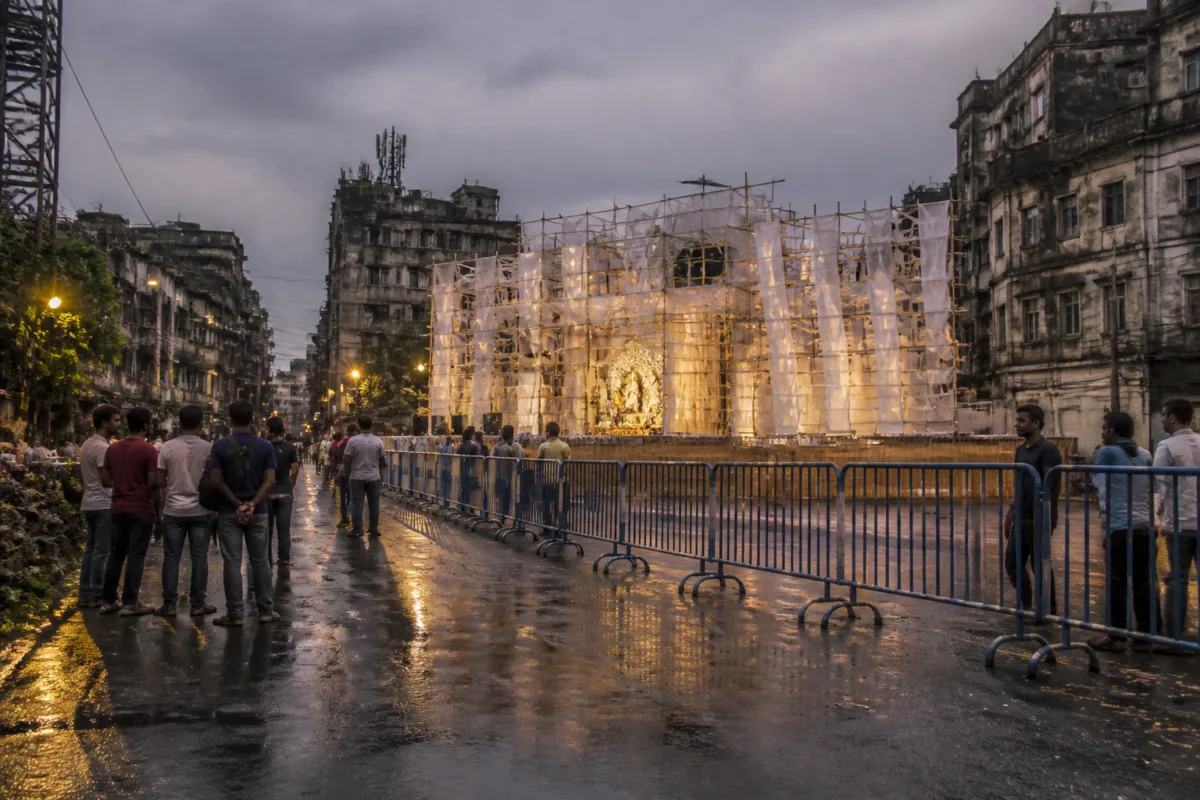
The Chorbagan stampede has not ended for the families who lost relatives. A week after the incident in Kolkata on October 17, bereaved households are confronting grief, disrupted futures and the everyday consequences of losing family members during what was meant to be a festive outing. Their accounts also expose the human scale of public-safety failures at crowded urban events, even though the available report does not establish what caused the surge or how crowd-control arrangements operated at the venue.
The families described by Times of India are spread across Kolkata and its suburbs. Their experiences differ, but they share a common rupture: a public celebration has become a permanent marker of loss. For Ram Sarkar of Chakdah, the death of his wife, Arati, has changed the meaning of Durga Puja. For Anukul Sarkar of Agarpara, the death of his 13-year-old son, Pranjal, has left the family surrounded by reminders of a future that will not take place. In Baranagar, 25-year-old Prithwish Ghosh lost both parents. In Kumartuli Park, Sourav Mondal is carrying guilt over suggesting the outing to his mother, Mithu.
These are not only private stories of bereavement. They show how a mass-crowd incident travels through the urban system and into homes, livelihoods and family responsibilities. The consequences are immediate for those who depended on the deceased, but they also persist through rituals, household routines, education plans and future financial decisions. The report does not provide information about compensation, rehabilitation, counselling or official assistance. That absence is significant because the families’ needs extend beyond the initial emergency response.
A stampede is experienced at street level as a sudden collapse of personal control. People who enter a public venue together may be separated within seconds; family members can lose sight of one another; and attempts to rescue others can leave survivors with lasting guilt. Anukul Sarkar’s account illustrates that contradiction. He said he managed to rescue several children caught in the surging crowd but could not save his own son. Sourav Mondal’s account shows another form of trauma: the effort to assign personal responsibility to a decision that, before the incident, appeared ordinary.
The available evidence does not show whether the crowd surge resulted from excessive footfall, a blocked exit, poor circulation, inadequate barriers, a sudden obstruction or another factor. It also does not establish the number of people present, the capacity of the pandal, the location of emergency routes or the response time of organisers and authorities. Those details are essential to understanding the incident institutionally. Without them, the public is left with the consequences but not a documented explanation of how the risk developed.
That distinction matters for urban governance. Festival venues are temporary spaces, but they function as highly concentrated public environments. For a limited period, a neighbourhood road, lane, open plot or built-up area may accommodate large numbers of people moving through narrow approaches and shared access points. The quality of safety management therefore depends on more than the structure of the pandal itself. It includes pedestrian circulation, entry and exit separation, emergency access, visibility, communication and coordination among organisers, police, civic agencies and medical responders.
The report’s family accounts make clear that visitors were making ordinary choices within a crowded city. Anukul Sarkar had organised the visit with relatives, friends and children. Pranjal was looking forward to a trip to Meghalaya the following Sunday. Prithwish Ghosh had completed his graduation and was preparing for competitive examinations. Ram Sarkar and Arati shared festival celebrations. These details reveal how public events are woven into the social life of the city. When safety fails, the damage is not confined to the venue or the moment of the incident; it reaches planned journeys, education, income, care arrangements and family identity.
The institutional question is what happens after the crowd has dispersed. Emergency action can address immediate injuries and rescue, but families may require several forms of continuing support. The supplied report does not say whether authorities have announced a structured assistance programme or whether affected households have been assigned officials to help them navigate documentation and claims. It also does not indicate whether the organisers or public agencies have published an account of the incident.
For urban administrations, post-incident accountability ordinarily has two distinct dimensions: support for those affected and reconstruction of the event. The first concerns the families’ material and emotional needs. The second concerns records, responsibilities and preventable conditions. Treating the event only as a moment of grief risks leaving the operational questions unanswered. Treating it only as an operational failure risks overlooking the long-term disruption faced by survivors and dependants.
The families’ testimonies also demonstrate why crowd safety cannot be evaluated only through the presence of police or the existence of an entry plan. A venue may appear organised under normal conditions and become unsafe when movement intensifies. Visitors may arrive in groups, children may be separated from adults, and people unfamiliar with the layout may not know where to move during an emergency. The report does not provide enough information to determine whether any of these conditions occurred at Chorbagan, but the personal accounts underline the consequences when a crowd becomes impossible to navigate.
There is also a communications challenge. Families and the wider public need a clear account of what happened, what measures were in place and what will change. In the absence of documented information, survivors can be left to interpret the incident through memory and guilt. Mondal’s statement shows how quickly responsibility can become personalised: he blamed himself for choosing the Chorbagan pandal instead of Sovabazar Rajbari. That feeling is understandable after a sudden death, but it cannot substitute for an evidence-based examination of the venue and the crowd conditions.
The available report contains no official statement, technical assessment, casualty figures, inquiry findings or details of future safety measures. Those limitations should not be filled with assumptions. They do, however, identify what a fuller public record would need to establish: the venue’s approved capacity, crowd estimates, access and exit arrangements, emergency routes, deployment responsibilities, medical preparedness, the sequence of the surge and the actions taken immediately afterwards. It would also need to clarify how families are being supported and whether lessons will be applied to other high-footfall events.
The wider urban lesson is that temporary public gatherings require permanent standards of accountability. Kolkata’s festival spaces are part of the city’s everyday geography, not isolated zones outside it. They connect residential streets, public transport routes, local businesses and neighbourhood movement. A failure inside one venue can therefore affect the functioning and confidence of a wider area. The Chorbagan families’ experiences show the cost in its most direct form: a visit to a pandal became the last shared outing for spouses, parents and children.
What the evidence confirms is the continuing human impact of the October 17 stampede. It does not yet explain the operational chain that led to the incident or show what authorities and organisers have done since. That distinction should guide the next stage of public discussion. The families have begun the difficult work of living with loss; the city’s institutions still need to establish, through documented findings and visible support, how the tragedy occurred and how similar risks will be addressed at future crowded events.

