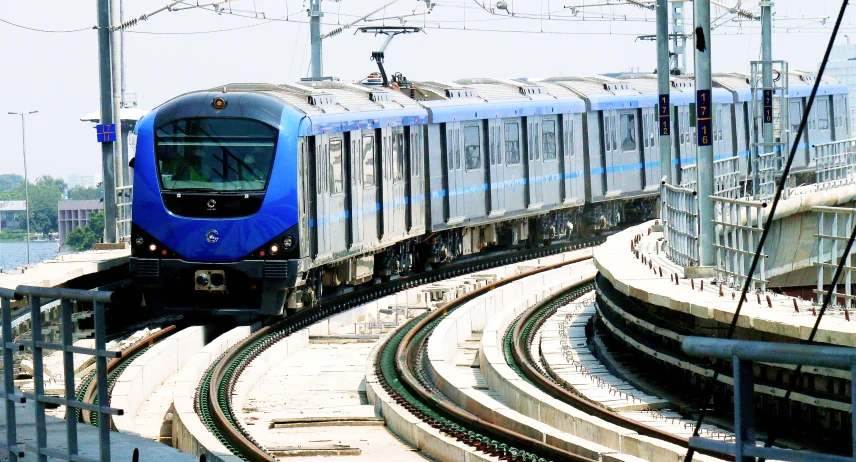
Chennai’s expanding southern corridor is set for a major public transport upgrade after the Union government cleared a new metro rail connection between the city’s airport and the Kilambakkam intercity bus terminus. The proposed corridor, estimated at nearly ₹9,000 crore, is expected to reshape mobility patterns in one of the region’s fastest-growing suburban belts while reducing pressure on already congested arterial roads.
The planned Chennai Airport to Kilambakkam Metro line will stretch roughly 15 kilometres and include around a dozen stations linking residential clusters, transport hubs and emerging commercial zones. Urban planners say the project reflects a broader shift in Chennai’s infrastructure strategy, where transport integration is becoming central to managing suburban expansion and long-distance commuter movement. Kilambakkam’s Kalaignar Centenary Bus Terminus was developed to decongest the city’s overstretched core transport nodes, but commuters have continued to face challenges in accessing the facility through reliable mass transit. At present, many passengers depend on private vehicles, taxis and overcrowded road-based transport services to reach the terminal, contributing to traffic bottlenecks along southern corridors.
Transport analysts believe the Chennai Airport to Kilambakkam Metro corridor could help create a more connected multi-modal transit network by linking air travel, suburban neighbourhoods and inter-state bus services within a single public transport ecosystem. Such integration is increasingly being viewed as essential for reducing travel time, lowering fuel consumption and limiting vehicular emissions in rapidly urbanising metropolitan regions.Officials associated with the project indicated that preliminary coordination meetings have already been conducted with airport authorities, highways agencies, water utility departments and other infrastructure bodies to finalise alignment plans and station-level engineering requirements. Land surveys and route demarcation exercises have also been completed ahead of the next approval stages.The proposed line is expected to pass through densely developing southern suburbs that have witnessed accelerated real estate activity over the past decade. Improved metro access could increase demand for mixed-use development around transit nodes, though urban development experts caution that such growth must be supported by affordable housing, pedestrian infrastructure and environmentally sensitive planning. Infrastructure economists note that Chennai’s mobility pressures are no longer confined to the city centre.
Employment hubs, educational institutions and residential projects have steadily expanded toward peripheral areas, making high-capacity public transport increasingly necessary for economic productivity and social inclusion.The Chennai Airport to Kilambakkam Metro project also arrives at a time when Indian cities are under pressure to adopt lower-carbon urban mobility systems. Expanding metro connectivity is being viewed not only as a transport intervention but also as part of broader climate resilience and sustainable urban development goals.Construction timelines are expected to become clearer after formal administrative procedures and funding mechanisms are completed. For daily commuters in southern Chennai, however, the project signals a long-awaited attempt to bridge a critical mobility gap between regional transit infrastructure and the city’s growing suburban population.