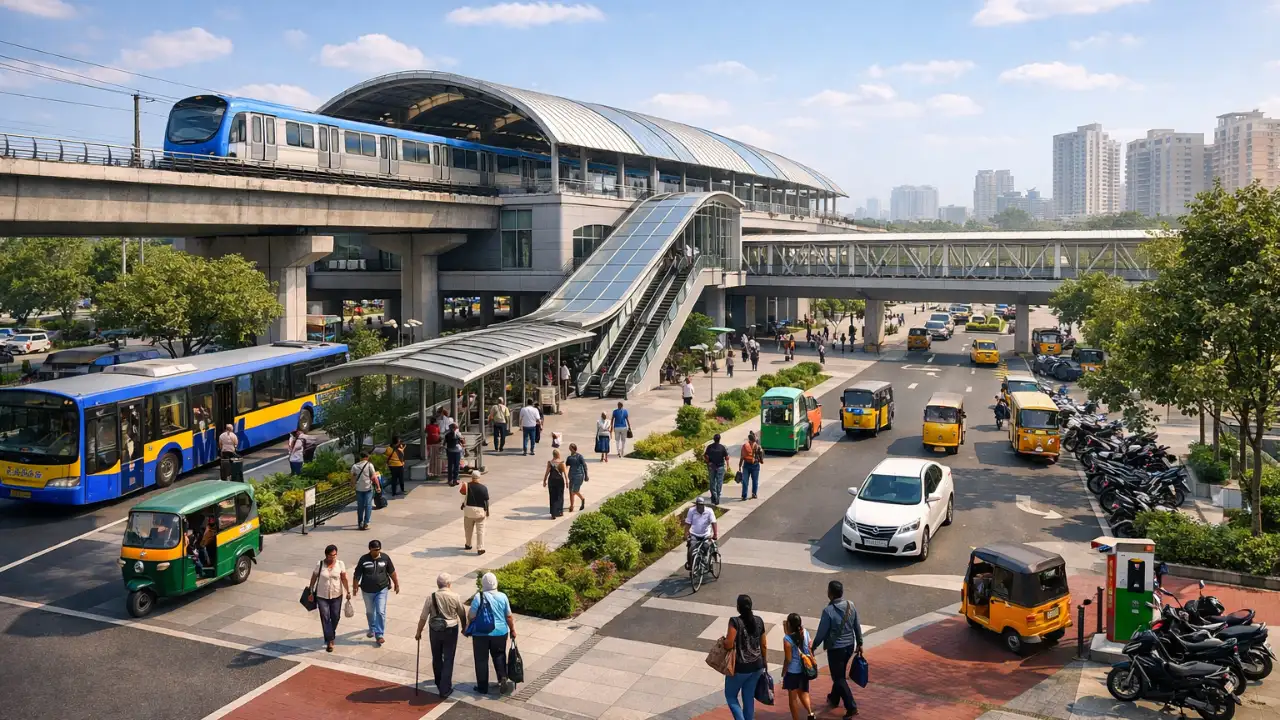
Chennai’s effort to build integrated urban mobility hubs at Vadapalani and Thirumangalam has encountered fresh delays after construction bids for the projects exceeded expected financial estimates, slowing two high-visibility transit-oriented developments intended to reshape commuter movement and commercial activity across the city.
The projects, led by Chennai Metro Rail Limited, are part of the wider Phase II metro expansion and are designed to combine public transport access with retail, office and civic infrastructure. Urban planners say such developments are increasingly critical for Indian cities seeking to reduce dependence on private vehicles while encouraging compact, mixed-use growth around mass transit corridors. According to officials familiar with the process, contractors submitted significantly higher-than-anticipated financial quotations during the first round of tendering, prompting authorities to cancel and restructure the bidding process. Revised bids for the Thirumangalam development have already been floated, while the Vadapalani package is expected to follow shortly after administrative clearances linked to the election period are lifted.
The delay, though described internally as limited, highlights a broader challenge facing large urban infrastructure projects across India: rising construction costs, volatile material prices and growing financing pressures are increasingly affecting timelines for public mobility projects. Infrastructure analysts note that transport-oriented commercial developments require careful balancing between public utility and long-term revenue generation, especially when land values and execution costs escalate simultaneously. At Thirumangalam, the proposed Metro commercial hub is expected to emerge as one of the most ambitious integrated station developments in Chennai’s expanding metro network. Planned along Corridor 5 connecting Madhavaram and Sholinganallur, the project aims to merge metro access with workspaces, shopping facilities and pedestrian-oriented infrastructure within a single urban complex. The design reflects a shift towards transit-linked urban growth, where commuters can access daily services without additional road travel.Urban mobility experts argue that such models can reduce congestion and emissions if supported by safe pedestrian access, last-mile connectivity and coordinated land-use planning. Chennai’s expanding metro network has increasingly been viewed as an opportunity to reshape dense traffic corridors into more walkable and economically productive urban districts.
The Vadapalani redevelopment carries equal significance from a commuter perspective. Located along the heavily used Arcot Road corridor, the proposed multi-modal facility seeks to modernise an overburdened bus depot handling thousands of daily passengers. Plans include organised boarding infrastructure, parking zones, commercial spaces and passenger amenities intended to streamline interchange between buses and metro services.Transport researchers say integrated hubs such as these will become essential as Chennai’s population density and commuting distances continue to increase. However, they caution that delays in execution can slow broader goals tied to sustainable mobility, lower transport emissions and equitable access to public infrastructure. With Chennai investing heavily in metro-led urban expansion, the coming months will test how quickly authorities can stabilise project costs while ensuring that large-scale transit infrastructure remains financially viable, commuter-friendly and environmentally responsive.