


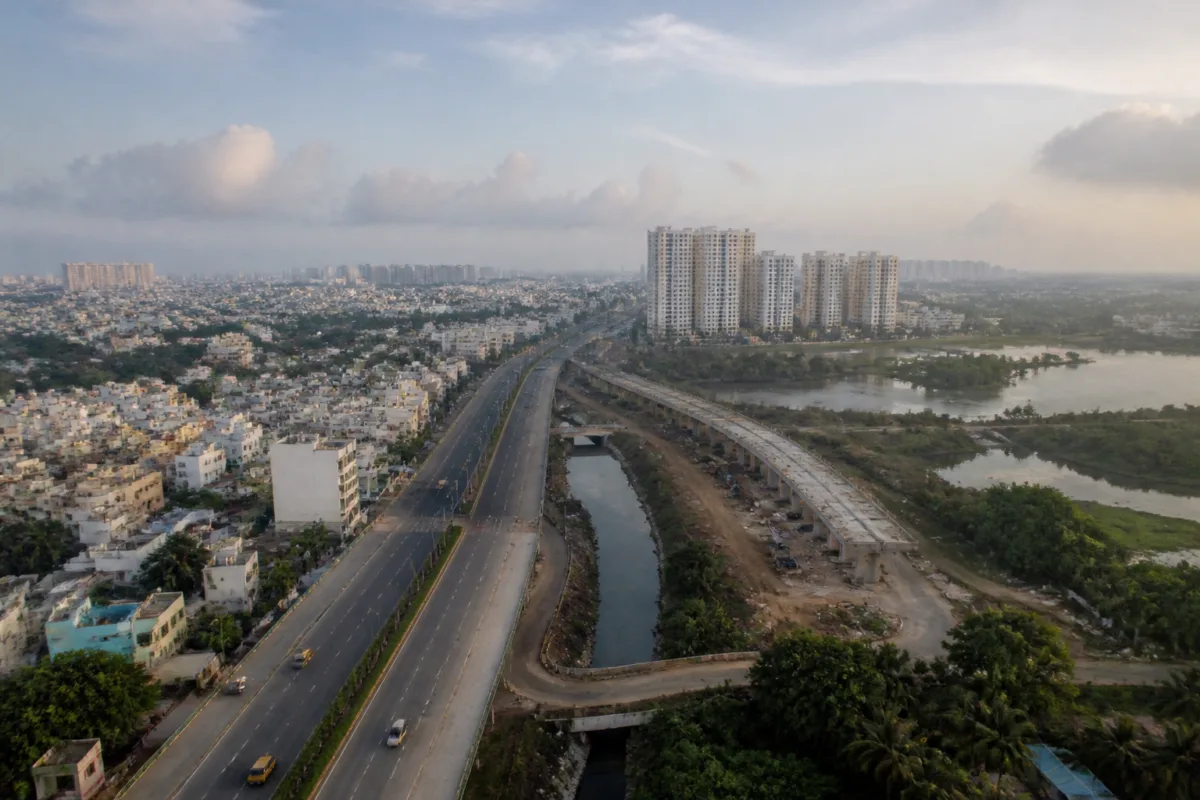
Tamil Nadu has sanctioned ₹45.5 crore to prepare a Comprehensive and Integrated Master Plan for the expanded Chennai Metropolitan Area (CMA), according to a government order reported by MagicBricks. The plan will cover 5,904 sq km and is intended to establish a coordinated framework for housing, transport, infrastructure and sustainable urban growth across Chennai and its surrounding districts.
The Chennai Metropolitan Development Authority (CMDA) will appoint an internationally reputed planning consultant through global competitive bidding. The allocation will be released over three financial years: ₹10 crore in 2026-27, ₹22 crore in 2027-28 and ₹13.50 crore in 2028-29.
The planning exercise follows the expansion of the CMA in October 2022 from 1,189.5 sq km to 5,904 sq km. The enlarged metropolitan area includes contiguous areas in Kancheepuram, Tiruvallur, Chengalpattu and Ranipet districts. The source report says the expanded region includes the existing metropolitan planning area, about 1,617 sq km under various local planning authorities and approximately 3,098 sq km that had previously remained outside a formal planning framework.
This expansion has increased the need for a common regional framework covering areas governed by multiple local authorities and administrative jurisdictions. Without such coordination, decisions on land use, transport links, housing growth, drainage and social infrastructure can remain divided between separate agencies and planning areas.
The proposed master plan will examine housing and real estate, transport connectivity, economic development, long-term water security, flood management, social infrastructure, environmental protection and digital infrastructure. It will also consider studies prepared by CMDA, the Chennai Unified Metropolitan Transport Authority and other government agencies. These include work on transportation, logistics, employment and the Comprehensive Flood Control Master Plan for Chennai’s urbanised river basins.
Flood management and water security are particularly significant in a metropolitan region that includes rapidly urbanising areas beyond the established city. The source material does not provide details of proposed projects or specific flood-control interventions. However, its inclusion of river-basin studies and water security among the plan’s focus areas indicates that the new framework is expected to connect land-use decisions with environmental and infrastructure constraints.
The CMDA will act as the nodal technical and coordinating agency. The government order also provides for three oversight bodies. A Tender Scrutiny Committee will examine consultant bids, an Expert Review Committee will assess submissions, and a High-Level Steering Committee headed by the Chief Secretary will provide strategic direction and coordinate between departments.
The expanded-area plan will be coordinated with the Third Master Plan for the existing 1,189 sq km CMA. That plan is being prepared for the 2027-2046 period. Together, the two exercises are intended to provide a wider planning framework for Chennai and its surrounding districts, although the reported sanction relates to preparation of the expanded-area plan rather than implementation of specific infrastructure projects.
For residents and landowners, the immediate significance is therefore institutional and regulatory rather than the delivery of a completed road, transit line or housing project. The eventual plan could influence how future development is organised across the metropolitan region, but the source report does not specify final land-use proposals, project locations or implementation timelines beyond the three-year funding schedule.

