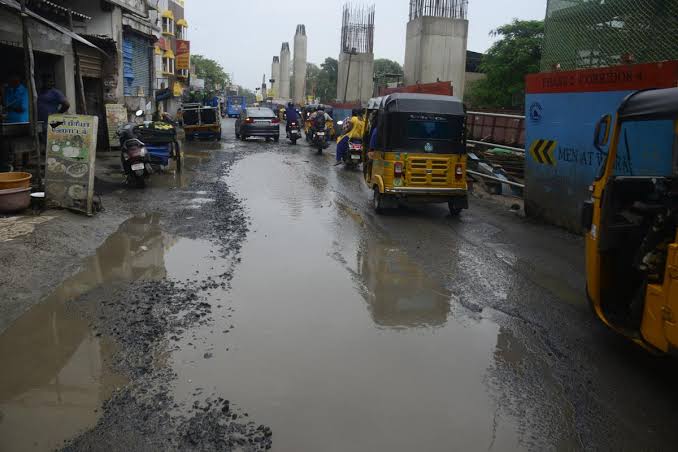
Chennai Arcot Road Needs Urgent Repairs Amid Metro Work
A key section of Arcot Road between Vadapalani and Kodambakkam is continuing to face damaged and uneven road surfaces as Chennai Metro Rail’s Phase II works reshape the corridor. The deterioration is adding to congestion and pedestrian difficulties on one of the city’s busiest urban routes, highlighting a familiar gap between major infrastructure construction and basic street maintenance.
The affected stretch forms part of Corridor 4, which runs from Poonamallee Bypass to Lighthouse. The 26.1-km corridor is among the major components of Chennai’s 118.9-km Phase II network. While the first 14.6-km operational section from Poonamallee Bypass to Vadapalani received safety clearance earlier this year, construction continues further east towards the city centre. For daily users, however, the immediate concern is less about the eventual metro network and more about the condition of the street beneath it. Multiple portions of Arcot Road have worn surfaces, uneven patches and restricted pedestrian space. Construction vehicles, material and debris can further reduce the effective road width, increasing friction between buses, cars, two-wheelers and pedestrians.
The problem becomes more serious during short spells of rain. Uneven surfaces can retain water and reduce visibility of potholes, while loose material creates additional risks for two-wheeler users. Congestion also has an economic cost, particularly on a corridor carrying workers, shoppers, school traffic and commercial vehicles throughout the day.The Arcot Road damage also raises a broader question about how large infrastructure projects manage temporary disruption. Metro construction inevitably occupies road space, but maintaining safe and usable streets around construction zones is a core part of project delivery. For pedestrians, especially older people, children and those with mobility constraints, a narrow or broken footpath can turn a short journey into a significant obstacle. CMRL has indicated that road restoration will be undertaken on the affected stretch. Earlier reporting also noted that funds had been earmarked for relaying portions of Arcot Road, although implementation has not kept pace with the deterioration.
Urban infrastructure experts say restoration should not be treated as a final-stage cosmetic exercise. Drainage, pedestrian continuity, road strength and construction-site management need to be coordinated before traffic conditions deteriorate further. The Arcot Road damage is therefore more than a road-maintenance issue. It tests whether Chennai can deliver major mass-transit infrastructure without shifting the short-term costs of construction onto everyday street users. As Corridor 4 advances, timely restoration and safer pedestrian access will be essential to ensure the benefits of the metro are not undermined by the streets surrounding it.