


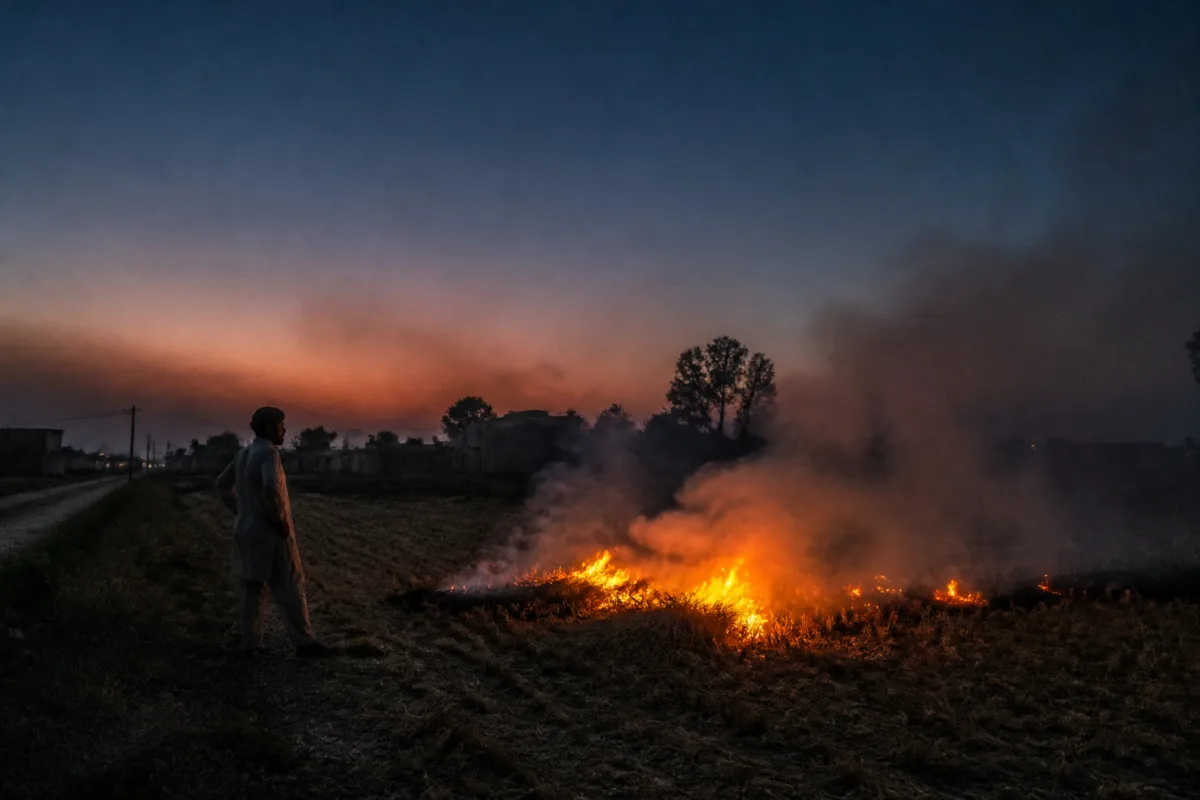
Punjab stubble fires have not disappeared; according to a Times of India ground report, many are being pushed into the evening hours, when satellite observations and on-ground enforcement are perceived to be weaker. The shift exposes a central weakness in the way agricultural burning is monitored: a reduction in detected fires may not always mean a comparable reduction in actual burning.
During a three-day tour of several districts, including villages in Amritsar and Jalandhar, the Times of India reported that most of the fires observed by its journalists were lit after 5pm. Farmers, farm union representatives and agriculture department officials were aware that evening fires were less likely to be detected by satellites or intercepted by field staff. The report also found that only a small fraction of farmers appeared to have set fields on fire so far this season.
The findings matter because Punjab’s stubble-burning debate is built around a chain of observation, enforcement and accountability. Satellites identify active fires, agencies use those observations to calculate fire counts, and local officials are expected to respond through inspections, fines or other measures. If fires are deliberately timed between observation windows, the first link in that chain becomes less reliable. The official count may then reflect the monitoring system’s reach as much as the actual scale of burning.
The Times of India cited reports, including a study by the NGO iFOREST last year, which said Indian agencies use data from US satellites to calculate active fire counts. According to the report, polar-orbiting satellites pass over India at approximately 10.30am, 1.30pm and 1.30am. This leaves a 12-hour period without observations. Farmers interviewed during the tour appeared to understand this gap as a practical opportunity to avoid detection.
The result is not necessarily a complete absence of monitoring. Satellite data can still identify fires when a satellite passes overhead, and agencies may use other forms of information or field checks. But the reported timing of the fires shows that a system designed around periodic observations can create blind intervals. The issue is particularly important when public debate treats detected active fires as a direct and complete measure of burning on the ground.
The report’s most revealing detail came from the way farmers described the system. A young farmer in Amritsar district, standing near a field that had just been set ablaze, asked whether it was acceptable to start fires after 5pm. He said he had leftover stubble and did not know what else to do with it. His account points to two realities operating at the same time: farmers may be responding to a real residue-management problem, while also adapting their actions to the enforcement system intended to prevent burning.
That distinction is important for urban readers because the consequences of agricultural burning are often discussed through Delhi’s winter air-quality crisis. However, the supplied report does not establish a new measure of Punjab’s contribution to Delhi’s pollution. Instead, it records a disagreement over that relationship. Sarwan Singh Pandher, an office-bearer of the Punjab Kisan Mazdoor Sangharsh Committee, said farm fires had decreased significantly and argued that stubble-burning was primarily a Punjab issue rather than a Delhi issue. He also said local pollution sources in and around Delhi contributed to deteriorating air quality there.
These claims require separation from the report’s observed facts. The Times of India documented evening fires and cited people who said the practice had become more common over the past two or three years. It did not provide a new emissions inventory or establish how much these fires contributed to Delhi’s air pollution during the period covered. That limitation matters because the political and administrative response to stubble burning often depends on the assumed size of its contribution to regional pollution.
The governance problem is therefore broader than the question of whether fire counts are rising or falling. It involves how a state measures a dispersed rural activity, how quickly field officials can respond, and whether the alternatives available to farmers are practical at the end of the paddy harvest. A system that relies heavily on detection without resolving residue management can encourage concealment rather than compliance.
The report suggests that enforcement is shaped not only by technology but also by working hours. An agriculture department official in Jalandhar district, speaking anonymously, said the chances of a farmer being fined were lower in the evening because most officials had left for home. This account cannot be treated as an official policy statement, but it identifies a possible operational gap between the timing of agricultural activity and the timing of administrative presence.
That gap is particularly significant because field burning is not a fixed-time event. Once farmers understand when monitoring is weakest and officials are least likely to be present, the activity can move into a narrow window. The report said several people in the field had noticed this pattern for the past two or three years. It also quoted Pandher as saying that, in some cases, village sarpanches advised farmers to burn stubble quietly in the evening.
This shifts the enforcement challenge from locating fires to understanding behaviour. A satellite may register a fire only when it is visible during an overpass. A local administration may know that burning is occurring but lack the staff, equipment or operational arrangements to respond after standard working hours. Village-level advice can then reinforce a practice that is not formally permitted but is perceived as manageable if conducted discreetly.
The numbers available in the report illustrate both the value and the limits of the existing evidence. There were three days of field observation, satellite overpasses at three stated times, a 12-hour observation gap, and references to a pattern developing over two to three years. The report also described the number of farmers burning so far this season as a small fraction of the state’s farming population. These figures establish a direction of concern but do not provide a complete estimate of the total area burned, the number of fires missed by satellites or the resulting emissions.
That absence of measurement is itself an institutional issue. If the state uses active-fire counts to assess progress, it needs to know how detection conditions affect those counts. A fall in detected fires could mean fewer fields are being burned, smaller fires are being lit, fires are being shifted to periods without observation, or some combination of these factors. The supplied material does not determine which explanation accounts for the largest share of the decline.
For urban governance, this matters because air-quality management is divided across administrative boundaries. Punjab’s crop-residue practices, Delhi’s local pollution sources and the monitoring systems used by national and state agencies are connected, but responsibility remains distributed. Each institution may report accurately within its own mandate while the public receives an incomplete picture of the regional system.
The enforcement model also has a citizen-facing dimension. Farmers interviewed by the Times of India said they had leftover stubble and lacked an adequate solution. That does not remove responsibility for illegal burning, but it indicates why punitive monitoring alone may not change behaviour. When residue disposal is difficult, expensive or unavailable at the required time, the enforcement system becomes a contest between field practices and detection capacity.
The report does not provide details of the availability, cost or use of machinery and other residue-management options in the districts visited. It therefore cannot establish whether farmers lacked access to alternatives, whether available measures were unaffordable, or whether implementation failures were local or statewide. Those questions remain central to evaluating Punjab’s response but require evidence beyond the supplied material.
What the report does establish is a warning about interpreting apparent progress. Punjab may be recording fewer detected fires, and farmers and union representatives say burning has declined. At the same time, the fires observed during the field visit were concentrated in the evening, and multiple people described awareness of the monitoring gap. The evidence points to a system in which reported improvement and altered behaviour can coexist.
The next stage of scrutiny should therefore focus on whether official fire counts are being tested against ground observations, how agencies cover evening hours, and what residue-management support is available when farmers need it. Until those links are documented, a lower satellite count should be read as evidence of fewer detected fires—not automatically as proof that the underlying practice has reduced by the same measure.

