


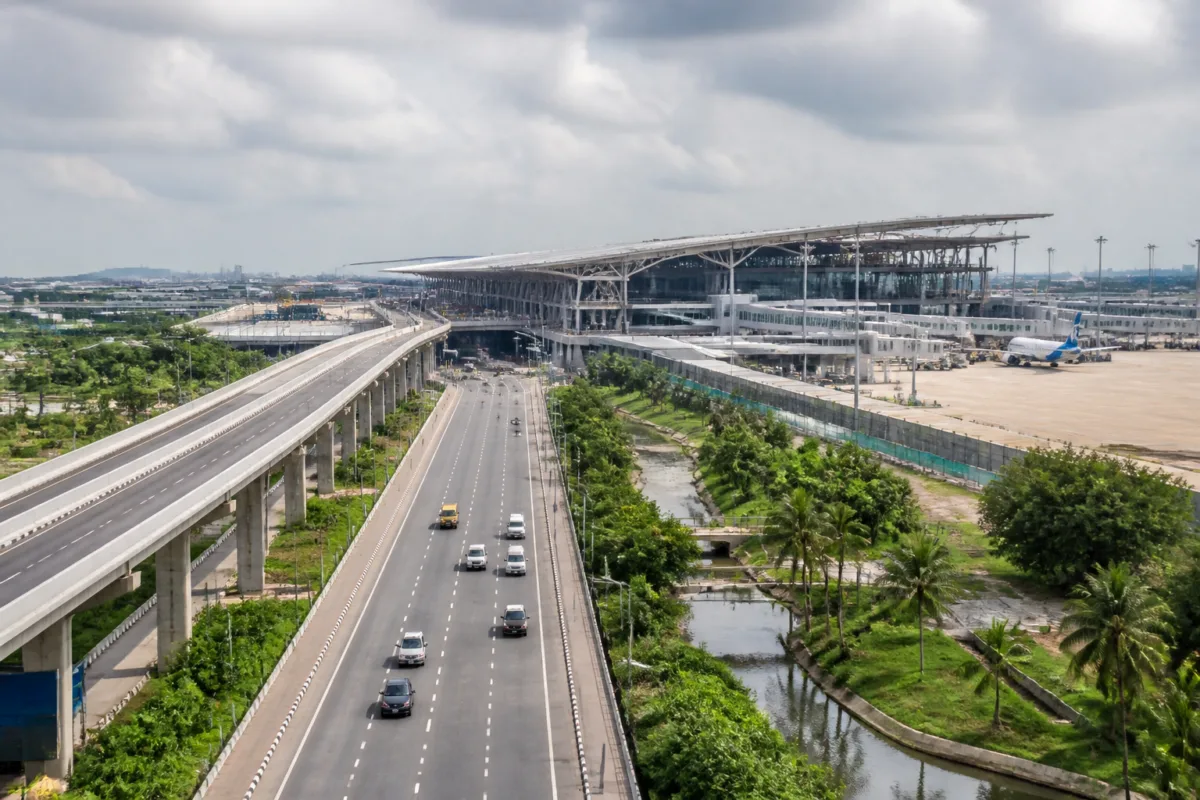
Tamil Nadu’s plan to expand Chennai airport with a fifth terminal is becoming less a question of adding buildings and more a test of whether the city can connect major infrastructure without creating new bottlenecks. With the proposed T5 expected to handle 20 million passengers a year, officials are examining a metro link, an underground monorail and new road connections to existing terminals and regional highways.
The expansion has gained urgency after the state scrapped the proposed second airport at Parandur. That decision revived an earlier Airports Authority of India proposal for a satellite terminal within the existing Chennai airport complex. T5 is planned on the western side of the airport, between the runways, with a road connection to the Tambaram–Maduravoyal bypass. The state has said it will support both the terminal expansion and the links needed to make it function.
The immediate institutional task is to determine what kind of connection T5 needs. Officials are studying a second link to GST Road and the existing airport terminals, allowing passengers to move between T5 and the current facilities without taking a long road detour. The choices under consideration are significant because each would create a different operating model for the airport: a rail-based link could support passenger transfers, an underground monorail would be a specialised internal connection, while a road could serve passengers, service vehicles and freight but add to surface traffic.
Chennai airport director M Raja Kishore told the Times of India that adequate links to the existing terminals could push the airport’s saturation point to 2050, providing time to develop a second airport. He said T5 would be designed to handle 20 million passengers annually. The terminal’s design remains at an early stage, and work is expected to begin in earnest after completion of the T3 integrated terminal.
The proposed terminal would also alter the airport’s operational capacity. According to the airport director, the number of parking bays would rise from 84 to 124, while aerobridges would increase from 17 to 42. These figures indicate that the proposal is not only about passenger-floor space. Aircraft parking and boarding infrastructure will also need to expand for T5 to deliver its planned capacity.
However, the report does not establish a construction start date, completion schedule or final cost. Those gaps matter because the transport links are still being assessed, and the terminal design itself is not complete. The eventual capacity of T5 will depend not only on the terminal structure but also on whether passengers, aircraft, baggage, staff, cargo and emergency services can move efficiently across the airport site.
Tamil Nadu Industrial Development Corporation, or TIDCO, has been assigned responsibility for preparing the detailed project report. Officials from TIDCO, the National Highways Authority of India and the Water Resources Department met to determine which agency should prepare the report. Chennai Metro Rail Ltd was also considered, but TIDCO was selected. The agencies are now working out the terms of reference, and officials said bids for a consultant could be invited by November.
That administrative arrangement reveals the infrastructure problem behind the announcement. T5 cannot be planned as an isolated airport project. It involves the state’s industrial development agency, the national highways authority, the water resources administration and the metro system. The report will have to bring together airport operations, road geometry, public transport, cargo movement and river management. Each agency controls a different part of the access system, but passengers will experience the result as one journey.
The metro proposal is also being reworked. Chennai Metro’s earlier plan to extend a line from the airport to the proposed Parandur site through Tiruneermalai and Sriperumbudur will now be reconsidered with T5 as the endpoint. This change reflects the shift in the state’s airport strategy: a line originally associated with a second airport site may instead serve an expanded airport within the city’s existing aviation complex.
The road alternative has a wider regional dimension. The National Highways Authority of India has proposed a four- or six-lane expressway from T5 to the Tambaram–Maduravoyal bypass. The proposal would include a cloverleaf interchange at Tharapakkam and a connection to the Outer Ring Road. Officials said the alignment could also speed cargo movement from the Sriperumbudur industrial belt.
This cargo component is important because the proposed connection would serve more than airport passengers. A road designed to move freight from the industrial belt would have different requirements from a passenger access road, including junction capacity, vehicle segregation and reliable travel times. The available report does not specify how passenger traffic and cargo traffic would be managed together, but it places both functions within the same connectivity discussion.
The proposed connection to GST Road is intended to solve another operational weakness. Passengers using T5 would need a direct route to the existing terminals, while travellers arriving at T5 would need a quicker route towards the city. Without such a link, the new terminal could increase airport capacity while making transfers slower and more dependent on roads outside the airport perimeter. The state is therefore studying access and internal interchange together rather than treating the terminal as a standalone building.
The environmental and flood-management question is equally central. The Water Resources Department is studying whether pillars required for a proposed connection across the Adyar river could obstruct water flow and increase flooding in nearby areas. Urban planner Pavithra Sriram told the Times of India that environmental factors should be incorporated because pillars in water bodies could have a negative impact.
This issue places a physical limit on the connectivity choices being considered. A shorter route between T5 and other parts of the airport may not automatically be the safest or most resilient route if it affects a river or waterway. The report does not establish whether an elevated structure across the Adyar will be selected, or what alternative alignments are available. It does show that the transport plan cannot be finalised without assessing its effect on drainage and flood conditions.
The institutional sequence is therefore as important as the terminal announcement. TIDCO must prepare the detailed project report; the highways authority is studying an expressway; the metro plan may be redirected; and the Water Resources Department is examining river impacts. The consultant’s terms of reference will determine how these questions are brought together, including whether the final proposal compares metro, monorail and road options on common measures such as capacity, interchange convenience, construction impact and environmental risk.
The available passenger and aircraft figures provide the clearest measure of the proposed expansion. T5 is planned for 20 million passengers a year, while airport parking bays would rise from 84 to 124 and aerobridges from 17 to 42. The airport director’s assessment that connectivity could extend the existing airport’s saturation point to 2050 gives the project a long planning horizon, although the report does not provide the traffic forecasts or modelling behind that estimate.
That limitation is significant. A capacity claim is meaningful only when linked to a defined development schedule, passenger forecast and operating plan. At present, the report confirms the scale of the proposed terminal and the broad options being examined, but not the final transport mode, investment requirement, land arrangements or delivery timeline. Those details will emerge through the detailed project report and subsequent design process.
Chennai’s airport expansion now presents a structural choice. The state can add terminal capacity within the existing airport, but that capacity will depend on whether access roads, public transport, internal transfers, cargo routes and water systems are planned as one network. The Parandur decision has brought the city airport back to the centre of the state’s aviation strategy; it has also made the question of connectivity unavoidable.
The next milestones are the preparation of TIDCO’s detailed project report, the appointment of a consultant, the reworking of the metro extension and the assessment of the road and underground monorail options. The Water Resources Department’s findings on river obstruction and flood risk will also be relevant before the final alignment is chosen. Until those studies are completed, T5 remains a defined capacity proposal with its most important connections still under examination.

