


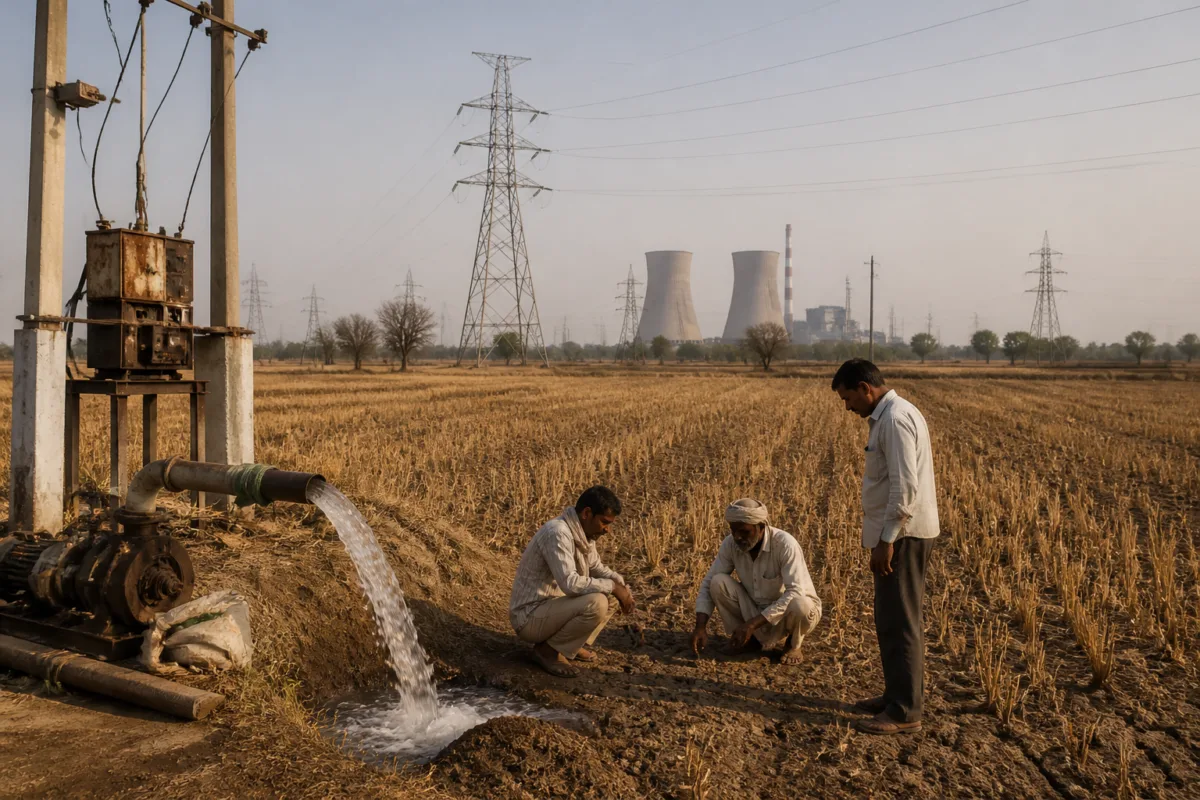
Farmers in drought-hit parts of Chandrapur district are reporting major crop losses after receiving only about 12 hours of grid electricity, despite the district generating thousands of megawatts for Maharashtra, including Mumbai. Growers in Sindewahi are asking the state government for round-the-clock power to operate irrigation pumps and protect the remaining kharif crop.
Chandrapur has four major thermal power plants with a combined generation capacity of around 5,000 MW. Chandrapur Super Thermal Power Station alone has an operating capacity of 2,920 MW. Farmers in Sindewahi, however, told the Times of India that their access to electricity remains inadequate for irrigation amid acute water scarcity.
Mangesh Gahane, a farmer in the area, said paddy cultivated on eight of his 10 acres had been largely destroyed. He said solar panels were not producing enough electricity to operate water pumps for sufficiently long periods, creating a sharp contrast between the district’s role as a power producer and the conditions faced by local cultivators.
Other farmers said the limits of solar generation were particularly visible in winter, when sunlight weakens and generation effectively stops by around 4 pm. Nirmal Gajbe and other farmers said pumps were then left idle while fields remained dry. Paddy has been the principal crop affected, but farmers also reported damage to cotton. Some said they might be unable to recover their cultivation expenses.
The electricity dispute is unfolding alongside a wider drought emergency. Chandrapur recorded around 316 mm of rainfall against a normal level of about 1,040 mm, a deficit of roughly 30% to 35%, according to sources cited in the report. The state government has declared all 15 talukas in the district drought-hit under Triggers 1 and 2.
Crop-damage assessments covering lakhs of hectares are reportedly close to completion. The government has announced compensation of Rs 5,000 for eligible farmers. It has also offered land-revenue and examination-fee waivers, crop-loan restructuring, suspension of agricultural loan recovery and electricity-bill relief for irrigation pumps, including connections above 7.5 horsepower.
The reported relief measures also include a bar on disconnecting agricultural electricity connections in water-scarce villages. Water tankers, relaxation under the Employment Guarantee Scheme and local water-conservation works such as Vanrai bandharas have been initiated, while dedicated fodder camps and livestock-management measures have also been taken, according to a source cited by the report.
Farmers say these measures do not resolve the immediate need for dependable electricity to draw and distribute the water that remains available. They want the state to provide continuous grid supply so they can save surviving crops and prepare for the next agricultural season.
Shiv Sena leader and former deputy chairperson of the Maharashtra Legislative Council Neelam Gorhe, who recently interacted with farmers in the Sindewahi belt, indicated that she would raise the issue with the government. The next steps will depend on the state’s response to the demand for 24-hour agricultural power and the completion of crop-loss assessments.

