


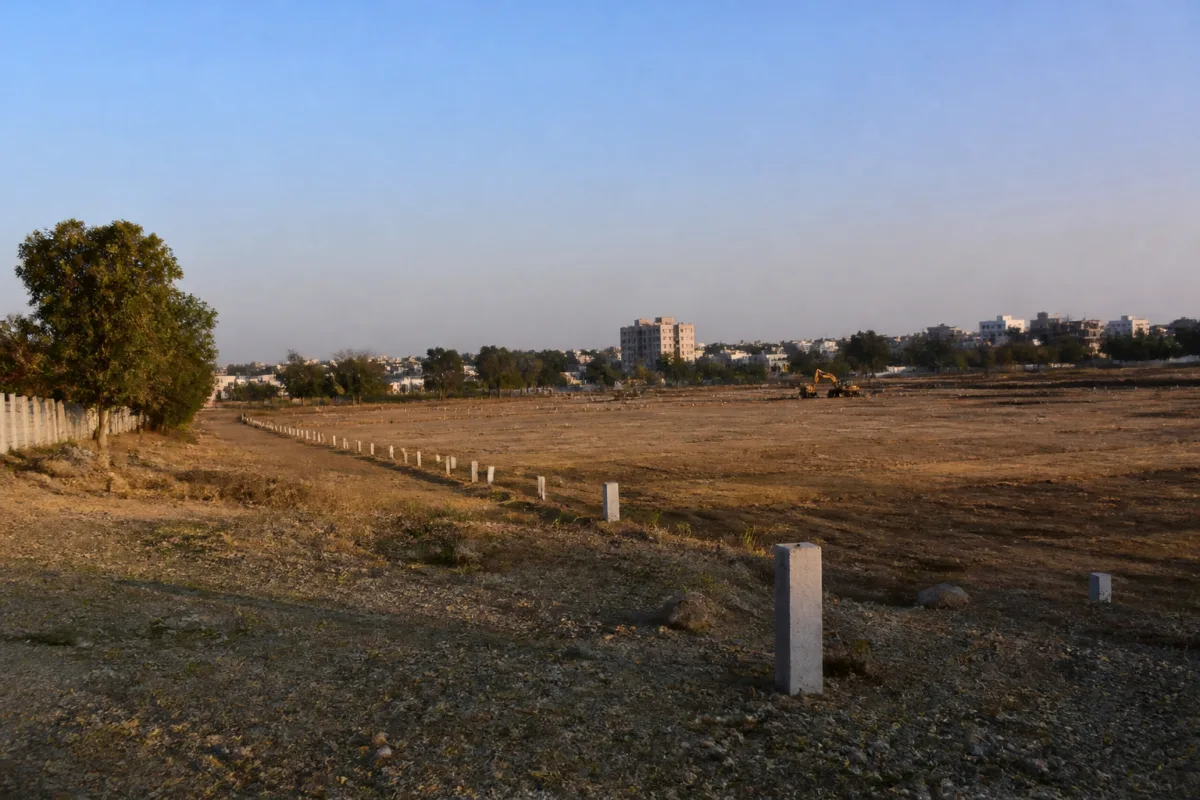
The proposed Chandrapur sports complex has received a political push, but the project remains dependent on the administrative process that will determine whether a reserved site and a Rs 137 crore plan become functioning public infrastructure. Chief minister Devendra Fadnavis has assured MLA Sudhir Mungantiwar of a special meeting to expedite approval for the Veer Baburao Shedmake Sports Complex at Datala, on the outskirts of Chandrapur.
The reported assurance followed Mungantiwar’s meeting with Fadnavis at the chief minister’s official residence in Mumbai, where the MLA submitted a memorandum seeking early clearance. The project is planned under the New Chandrapur Development Plan, with around 16 acres reserved at Datala for the proposed facility.
That sequence is important. The project has moved beyond the stage of being only a land reservation or local proposal, but it has not yet reached construction. The immediate decision is administrative approval, not an inauguration, tender award or confirmed completion schedule. Until that approval is secured, the proposed cost, land reservation and intended facilities describe a project in preparation rather than an operational sports asset.
## What the Chandrapur sports complex is intended to do
The facility is envisioned as a state-of-the-art sports infrastructure hub for Chandrapur and the wider eastern Vidarbha region. According to the report, its purpose is to provide training and competition facilities for emerging athletes, with particular attention to young people from rural and tribal areas.
This gives the project a wider urban role than that of a standalone stadium. A sports complex on the outskirts of a city becomes part of the region’s public infrastructure network: its value depends not only on the buildings constructed on the site, but also on who can reach them, how regularly they can be used and whether the facilities support training as well as occasional events.
The available information does not specify the complex’s individual sporting facilities, capacity, operating model, transport connections or maintenance arrangements. It also does not establish whether the Rs 137 crore estimate covers only construction or includes equipment, site development and other project components. These details will become significant if the proposal proceeds to approval and implementation.
For now, the clearest stated objective is to create a dedicated platform for local talent. Chandrapur’s proposed facility is being positioned as a regional asset rather than a neighbourhood-level ground, with the potential to serve athletes from across eastern Vidarbha. The report, however, does not provide an expected number of users or a defined catchment area.
## The approval stage is the central administrative test
The chief minister’s proposed special meeting indicates that the immediate obstacle is procedural. A memorandum has been submitted and an assurance has been given to expedite administrative approval, but the report does not say that the approval has already been granted. This distinction matters for public projects because land reservation and political support do not by themselves authorise expenditure or construction.
The next stage will determine how the project is translated from an announced ambition into an implementable plan. The supplied report does not identify the department that will own or operate the complex, the agency responsible for construction, the source of funds or the proposed procurement route. It also does not mention a detailed project report, tender, construction deadline or phased implementation plan.
These omissions do not negate the project’s stated public purpose. They show instead where the proposal currently stands in the infrastructure cycle. A reserved 16-acre site establishes a spatial basis for development. A stated project cost provides an initial financial scale. The request for early administrative clearance signals the need for the relevant state machinery to validate the proposal and move it into the next stage.
The institutional question is particularly important for a sports facility intended to serve rural and tribal athletes. A complex can provide high-quality physical infrastructure while still being difficult to use if access, coaching, scheduling and maintenance are not addressed. The current report confirms the inclusion objective, but does not provide operating details that would show how that objective will be delivered.
## Mission Shaurya and Mission Olympics 2036
Mungantiwar linked the proposal to initiatives aimed at developing tribal sporting talent. The report refers to Mission Shaurya, under which five tribal youths scaled Mount Everest, and Mission Olympics 2036, which is intended to prepare tribal children for national and international sporting competitions.
The connection gives the proposed complex a broader policy narrative. It is not being presented only as a construction project, but as a physical platform for a talent-development effort. That link could help define the eventual use of the facility, particularly if training programmes, competitions and athlete support are integrated into its operating plan.
At the same time, the available material does not state how either initiative would be connected administratively or financially to the proposed complex. It does not identify the sports disciplines involved, the number of children expected to participate, the coaching structure or the performance measures that would be used. Those questions remain open and cannot be answered from the announcement alone.
The reference to tribal athletes is nevertheless central to understanding why the project has been given regional significance. The facility is intended to address a geographic and social access gap by creating a dedicated venue near Chandrapur rather than requiring local talent to rely entirely on infrastructure elsewhere. Whether it achieves that purpose will depend on the final design and operating framework, which have not yet been disclosed.
## Why location and scale matter
The proposed site is at Datala, on the outskirts of Chandrapur, and covers around 16 acres. That provides a substantial land parcel for a multi-use sports facility, but an outskirts location also makes connectivity an important implementation consideration. The supplied report does not mention public transport, road access, parking or travel arrangements for athletes from rural and tribal communities.
Those details are not secondary to the project’s stated mission. If the complex is meant to serve a wider eastern Vidarbha region, its effective reach will be shaped by the time and cost required to reach Datala. Similarly, if it is designed for competitions, the city will need arrangements for spectators, teams and event operations. None of these arrangements has been specified at the proposal stage.
The Rs 137 crore figure also signals a sizeable public investment, but the report offers no comparison with other sports projects and no breakdown of the proposed expenditure. Without such information, it is not possible to assess whether the estimate reflects the full cost of delivering a functional complex or only an initial construction projection.
That makes the approval process the point at which the project’s public claims will need to be matched with a defined scope. The government’s decision will need to establish what is being built on the 16-acre site, how the cost has been calculated and which institution will be accountable for delivery and use.
## The bigger urban question
Chandrapur’s proposal highlights a recurring challenge in public infrastructure: the distance between announcing an asset and making it usable. The project has a named site, an estimated cost, a regional purpose and reported political backing. It still requires the administrative steps that convert those elements into an approved and executable programme.
For urban residents and aspiring athletes, the difference will be measured in access to actual courts, fields, training spaces and competitions. For the state, the project’s success will depend on whether the final facility serves more than ceremonial or occasional use. The announcement provides evidence of intent, but not yet of delivery capacity.
The next developments to watch are the special meeting mentioned by the chief minister, the grant of administrative approval, the final project scope and the identification of the implementing and operating agencies. The report does not provide a construction timeline or confirm a tender process. Until those milestones are disclosed, the Veer Baburao Shedmake Sports Complex remains a proposed regional sports hub awaiting formal clearance.

