


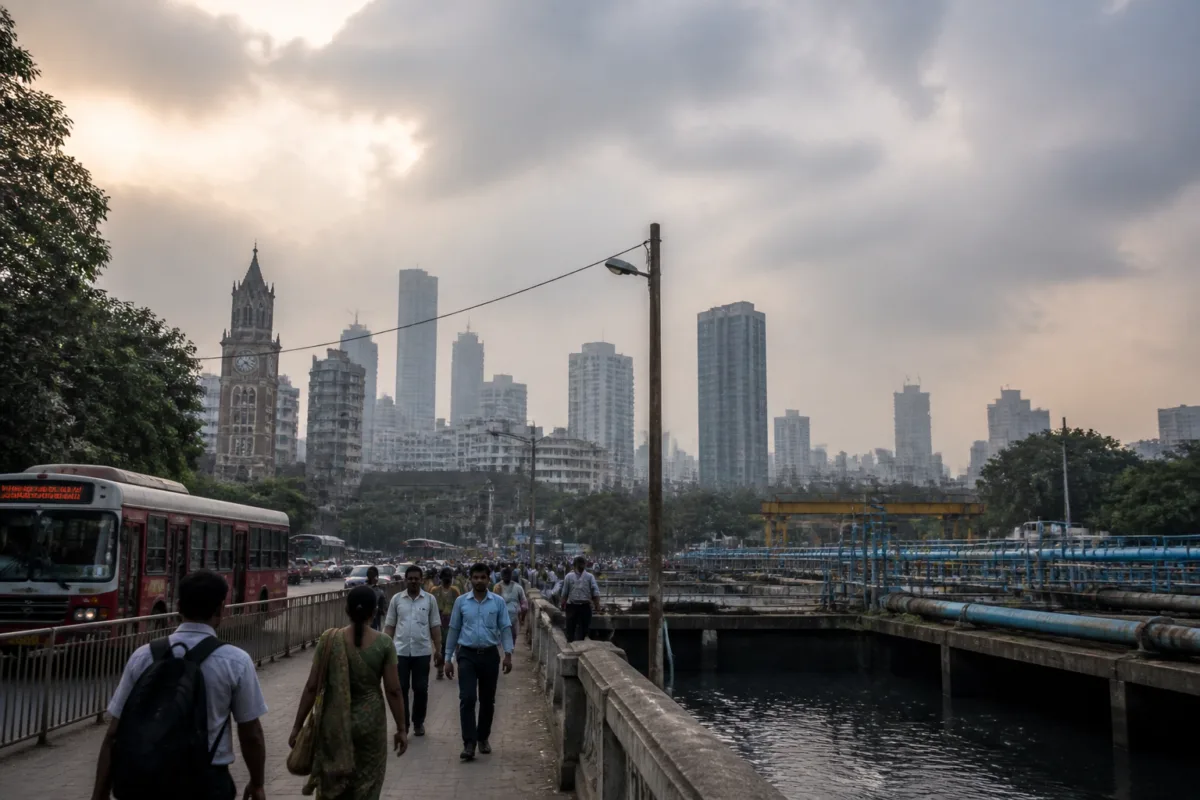
Aaditya Thackeray’s renewed demand for a Council of Climate Change comes as Mumbai prepares to host the Earthshot Prize Summit and Awards on November 16 and 17, followed by Mumbai Climate Week in February 2027. His proposal is not only about creating another intergovernmental forum. It raises a more fundamental urban question: who is responsible for coordinating climate action when the causes and consequences of environmental decline cut across nearly every department of government?
Speaking ahead of the Mumbai events, Thackeray accused the Union government of data fudging and greenwashing, alleging that citizens were still being denied basic requirements such as clean air, safe water and reliable access to food. Mid-Day reported his remarks with inputs from IANS. The allegations are political claims and are not independently established in the supplied material, but they point to a governance problem that is central to urban climate policy: climate outcomes are often produced by decisions made by departments that may not be governed as part of a single climate framework.
The proposal is therefore significant because it seeks to move climate action away from isolated programmes and towards a standing institutional arrangement. Thackeray suggested that a national Council of Climate Change should be headed by the Prime Minister and include state ministers responsible for forests and environment, along with representatives of Union ministries dealing with urban and rural development, energy, agriculture, industry and roads. The proposed membership reflects how climate pressures are experienced in cities. Air pollution, water stress, land use, transport emissions, construction, energy consumption and industrial activity do not sit within one administrative department.
Under the proposal, the council would meet every quarter to review verified data, targets and real-time progress on climate action. That emphasis on regular review is important because climate plans can otherwise remain documents rather than operating systems for government. The supplied report does not establish whether the Centre has accepted the proposal, whether a formal draft has been prepared or how such a council would be legally constituted. Its immediate importance lies in the institutional gap it attempts to address.
Thackeray also called for parallel State Councils of Climate Change headed by chief ministers. These councils would bring together departments involved in regional climate action plans and monitor their implementation. The model would create a two-level structure: a national forum for coordination between the Union and states, and state-level bodies responsible for connecting climate plans to departmental decisions and local conditions.
That distinction matters for cities such as Mumbai. Municipal climate action is affected by decisions on roads, buildings, energy, waste, water supply, land use and public health. A city plan can identify risks, but implementation depends on institutions with separate mandates, budgets and reporting systems. Thackeray referred to his tenure as Maharashtra’s environment and climate change minister, during which the state drafted climate action plans for Mumbai and several other cities. He argued that such plans should be formulated and neutrally audited by independent, internationally reputed organisations in a transparent manner.
The demand for independent auditing highlights another weakness in climate governance: the difference between announcing a target and demonstrating progress. The report does not provide specific emissions data, pollution measurements or performance results for Mumbai or Maharashtra. It does, however, record Thackeray’s argument that weak data integrity can make India’s position on global climate indices appear better than it is. Since that allegation is attributed to him, it should not be treated as an established finding. The broader administrative issue remains clear: without trusted data, governments cannot reliably compare targets with outcomes or determine whether a climate plan is working.
Data is also central to the proposed council’s design. Quarterly meetings would be meaningful only if departments use common definitions, consistent measurement methods and publicly traceable indicators. The supplied material does not specify which indicators would be adopted. Thackeray’s formulation refers generally to verified data, targets and real-time progress, leaving open questions about what would be measured, who would verify it and how poor performance would trigger corrective action.
The proposal also places climate action within the daily economics of urban life. Thackeray said citizens who pay direct and indirect taxes may still have to spend additionally on air and water purifiers and on alternative sources of food. These remarks were presented as part of his criticism of environmental governance, rather than as independently verified estimates of household costs. They nevertheless identify a familiar policy tension: when public systems fail to provide basic environmental security, households with the means to do so purchase private protection, while those without that means remain more exposed.
He further argued that environmental degradation was becoming an economic threat, with businesses and organisations relocating from polluted regions and resulting job losses. The supplied article does not provide examples, migration figures or evidence linking particular business relocations directly to pollution. The claim therefore remains an attributed warning rather than a demonstrated trend within the available material. Its significance is that climate policy is being framed not only as a public health responsibility but also as a question of employment, competitiveness and the ability of cities to retain economic activity.
The proposal’s department list also reveals why climate governance is difficult. Urban development controls the physical expansion and infrastructure of cities. Energy policy affects the emissions intensity of buildings, industry and transport. Agriculture influences food systems and rural livelihoods, while roads and industrial policy shape mobility, logistics and production. Rural and urban development are similarly connected through migration, resource demand and regional economic change. A council that brings these departments together could, in principle, address the connections that individual schemes cannot see. The supplied material does not establish whether existing intergovernmental mechanisms already perform some of these functions or how the proposed body would avoid overlapping with them.
Mumbai’s role as host of the Earthshot Prize Summit and Awards gives the proposal additional public visibility. The summit is scheduled for November 16 and 17, while Mumbai Climate Week is planned for February 2027. These events create an international setting in which the city’s climate ambitions will be discussed. They also sharpen the distinction between visibility and implementation. Hosting climate-focused events can draw attention to a city, but the effectiveness of climate governance ultimately depends on the quality of plans, the reliability of data, the allocation of responsibility and the ability to track delivery.
Thackeray’s reference to Maharashtra’s city climate action plans points to an existing planning layer that would need to be connected to any new national or state council. The report does not list the plans’ targets, budgets or implementation records, so no conclusion can be drawn here about their performance. What can be established is that the proposed councils are intended to function above individual city plans, linking them to broader state and national coordination. That raises practical questions about how municipal bodies would participate and whether city-level data would feed into the proposed review process.
The most important issue is accountability. A council headed by the Prime Minister and supported by state ministers could provide political authority, but authority alone would not guarantee implementation. The proposal, as reported, includes meetings, verified data, targets and real-time monitoring. It does not set out enforcement powers, funding arrangements, statutory status or consequences for departments that miss targets. These details would determine whether the council became a coordination platform with measurable influence or another layer of intergovernmental discussion.
The debate also exposes the limits of treating climate policy as the responsibility of environment departments alone. Thackeray’s proposed structure includes ministries that shape the built environment and urban systems. That is consistent with the way citizens experience climate risk: through the quality of air and water, the reliability of infrastructure, the location of jobs, the cost of private protection and the safety of everyday movement. The article does not establish how these outcomes should be prioritised, but it shows why a narrow environmental mandate may not match the scale of the urban problem.
What is confirmed is that a senior Maharashtra political leader has renewed a demand for national and state climate councils, with quarterly reviews, verified data, targets and cross-department participation. What remains uncertain is whether the Union government will consider the proposal, whether any formal institutional process will follow, and how the suggested councils would relate to existing climate plans and government departments. Those are the developments to watch as Mumbai moves from hosting climate events to debating how climate action should be governed.

