


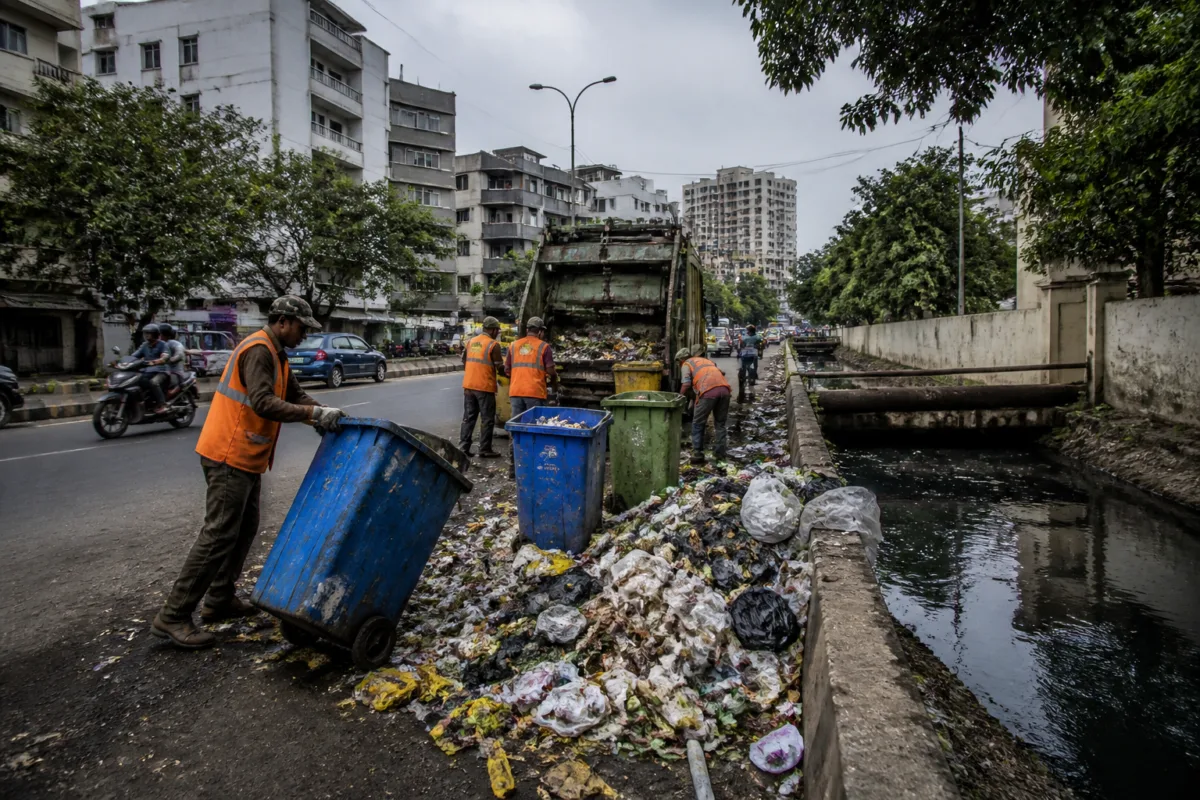
Pune’s fall in the Swachh Survekshan rankings is more than a setback in a national cleanliness competition. It exposes a difficult municipal question: why have large allocations and repeated tenders for sanitation, waste management and pollution control not produced a visible, sustained improvement in the city’s public environment?
According to a report by Punekar News, Pune has dropped from 10th to 27th among cities with a population of more than one lakh. In the category of cities with more than 10 lakh residents, it has fallen from eighth position last year to 12th this year. The city has also ranked 18th among 50 cities in the Swachh Vayu Survekshan, which assesses efforts to improve air quality and control pollution.
The rankings matter because they offer one of the few national frameworks through which the performance of urban cleanliness systems is compared. They do not measure only whether a road appears clean on the day of an inspection. The source report says the assessment has increasingly included requirements such as 100% treatment of sewage generated in the city and protection of water bodies from pollution. These criteria shift the focus from visible sweeping and public toilets to the full chain of urban environmental management.
That shift is important for Pune. Municipal cleanliness depends on several connected systems: waste collection, segregation, transportation, processing, disposal, drainage, sewage treatment, river and lake protection, public toilet maintenance and citizen participation. A city can spend heavily on one part of this chain and still perform poorly if another part remains weak. The latest ranking, as reported, suggests that the city’s challenge may not simply be a shortage of expenditure, but whether expenditure is producing complete and verifiable service outcomes.
The report refers to ₹281 crore allocated by the Central Government for measures to control air pollution in Pune. It also says the Pune Municipal Corporation has issued tenders worth hundreds of crores over several years for sanitation, waste management and processing infrastructure. These figures create an accountability question, but they do not by themselves establish how the money was spent, which projects were completed, or what measurable changes were recorded.
That distinction is central to understanding municipal finance. Budget allocations and tender values are inputs. Clean streets, functioning processing capacity, treated sewage and healthier water bodies are outputs or outcomes. The distance between the two is where implementation is decided. It includes contract design, monitoring, inter-agency coordination, operation and maintenance, enforcement, data quality and the ability to keep services functioning after a project is inaugurated.
The source report connects Pune’s ranking decline with persistent garbage-related problems and concerns about the effectiveness of sanitation and waste-processing infrastructure. It also states that the PMC continues to face difficulty meeting the requirements related to sewage treatment and pollution-free water bodies. If those claims are accurate, they point to a system in which waste management cannot be treated separately from water and wastewater management.
Pune’s urban environmental performance is therefore tied to infrastructure that may be less visible than collection vehicles or cleaned streets. Sewage treatment plants, trunk sewers, local drainage networks, pumping arrangements, processing facilities and disposal sites determine whether waste and wastewater are safely managed. Weakness in any one of these systems can affect rivers, lakes, neighbourhoods and public health, even when selected public spaces receive intensive cleaning.
The report also raises concerns about the timing of municipal cleanliness drives. It says special efforts are sometimes intensified during the survey period, including improvements at locations selected for inspection and upgrades to public toilets such as the provision of toilet paper, mirrors, air dryers and round-the-clock water supply. The underlying issue is not whether such improvements are useful. It is whether they are maintained throughout the year and available across the city rather than concentrated around assessment locations.
This is the difference between event-based compliance and routine municipal service delivery. A survey can encourage cities to improve facilities, but a ranking is a limited proxy if conditions change sharply after the assessment. The more durable test is whether a resident encounters reliable waste collection, clean public toilets, functioning drainage and unpolluted water bodies on an ordinary day, including in areas that receive less administrative attention.
Citizen participation presents another institutional problem. The source report says questions have been raised over whether municipal employees are being directed to register participation in the citizen feedback process instead of relying entirely on resident responses. This is presented as a concern in the report, not as an established finding supported by a published verification document. If participation data is intended to measure public experience, its credibility depends on the independence and representativeness of the responses.
The issue extends beyond survey methodology. Citizen feedback can be useful only when it is linked to service correction. Residents may report overflowing bins, irregular collection, damaged toilets or polluted water, but the administrative value of that information depends on whether complaints are recorded, assigned, resolved and audited. A high participation figure without a transparent response system would provide limited evidence of better municipal performance.
Pune’s ranking history adds significance to the latest result. The city had generally remained among the top five or top 10 cleanest cities in earlier assessments, although its position fluctuated and it had regained ground on some occasions. The latest result places it outside the top 10 in both population categories mentioned in the report. That pattern indicates a decline relative to the benchmark used by the survey, but the supplied material does not establish the exact causes or quantify Pune’s score against other cities.
The increasingly stringent assessment criteria may be one explanation. As the framework expands from visible cleanliness to sewage treatment, water-body protection, air quality and citizen engagement, cities are judged on a wider urban system. A municipality may continue to perform some traditional sanitation functions while losing ground because its wastewater, pollution-control or environmental management systems remain incomplete.
The separate Swachh Vayu Survekshan ranking reinforces this broader reading. Pune’s 18th position among 50 cities places air quality within the same discussion as solid waste and sanitation. The report links this result to questions about the implementation and impact of pollution-control measures and the use of the ₹281 crore allocation. However, the supplied material does not provide the city’s air-quality indicators, project-level expenditure, emissions sources or performance targets, so the ranking alone cannot identify which interventions succeeded or failed.
This limitation is important when interpreting municipal rankings. A position in a table signals relative performance, but it does not automatically explain causation. To assess the effect of public spending, readers would need project-wise allocations, completion status, operating data, treatment capacity, actual volumes processed, water-quality results and the duration for which facilities remained functional. None of those details is provided in the source report.
The governance question is consequently larger than whether Pune should recover a particular rank. The city needs systems that are continuously measured, publicly reported and maintained across neighbourhoods. That requires coordination between the PMC and other agencies responsible for water, sewage, pollution control and environmental management. It also requires procurement processes that track service quality rather than only contract award and expenditure.
The ranking decline does not prove that every municipal investment has failed. Nor does it establish that survey-period efforts or citizen feedback records were manipulated. What it does, based on the reported results and concerns, is create a clear requirement for greater transparency about the relationship between money spent, infrastructure delivered and conditions experienced by residents.
Pune’s immediate challenge is therefore not simply to improve its position in the next Swachh Survekshan. It is to demonstrate that cleanliness, sewage treatment, waste processing, water-body protection and air-quality measures operate as year-round public services. The next meaningful evidence will be the PMC’s project-level account of spending and outcomes, along with verifiable information on treatment, processing, pollution control and service continuity beyond the survey period.

