


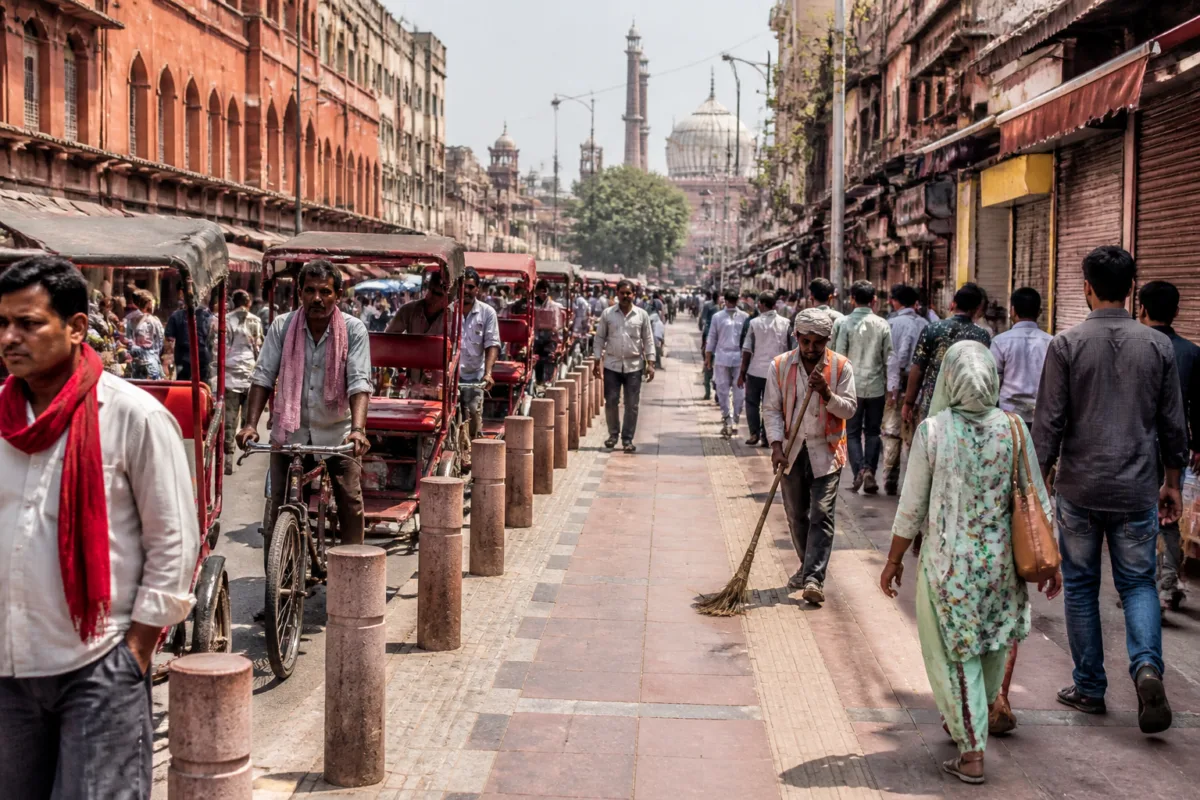
Delhi’s latest plan for Chandni Chowk combines traffic regulation, encroachment removal, sanitation upgrades, public-realm repairs and heritage-led redevelopment in an attempt to improve the functioning of one of Old Delhi’s busiest commercial districts.
Chief Minister Rekha Gupta announced the directions during a review meeting of the Indraprastha Virasat Punervikas Nigam on Friday, according to a report by MagicBricks. The meeting was attended by Urban Development Minister Ashish Sood, Chandni Chowk MP Praveen Khandelwal, representatives of local business and residential communities and senior government officials.
The proposed measures cover the 1.3-km redeveloped stretch of Chandni Chowk and its surrounding transport and commercial environment. They are aimed at problems that affect both movement through the market and the quality of its public spaces.
A central issue is the regulation of cycle rickshaws. The earlier redevelopment plan had envisaged around 400 cycle rickshaws on the stretch, while their number has reportedly increased to more than 1,000. The government has directed the Municipal Corporation of Delhi to regulate the fleet and explore improvements to rickshaw design.
The report links the proposed regulation to congestion and pedestrian movement around shops, showrooms and wholesale markets. However, it does not specify the new permitted number of rickshaws, the operating zones, the enforcement mechanism or how access for deliveries and mobility-dependent users would be managed.
Encroachments and unauthorised occupation of footpaths and public spaces are another focus. The Delhi Police, MCD and Public Works Department have been directed to coordinate action against such uses. A joint enforcement team is also expected to monitor illegal parking and unauthorised vehicles.
For Chandni Chowk, the enforcement question is closely tied to the quality of the pedestrian environment. Removing obstructions could reopen walking space and improve access to businesses, but the report does not set out a rehabilitation or relocation process for affected vendors and other users of public areas. It also does not provide a schedule for enforcement activity.
The plan includes additional public toilets, with a specific focus on facilities for women, and the renovation of four existing public toilet facilities along the redeveloped stretch. Around 120 sanitation workers have reportedly been deployed in three shifts. These measures are intended to support shoppers, tourists, residents and people visiting the area for business.
The proposed infrastructure work includes repairing damaged flooring and pedestrian walkways, improving roads and drainage, replacing damaged bollards, installing additional benches, maintaining planters and green spaces, and cleaning and developing the central green strip. The PWD is developing an integrated facility-management system covering infrastructure maintenance, horticulture, mechanised cleaning and security.
This shifts the emphasis from a one-time streetscape intervention to ongoing management of the public realm. The success of such a system would depend on clearly assigned responsibilities, regular maintenance and a way to track whether complaints are resolved. The report identifies these proposed functions but does not provide service standards, operating costs or a monitoring framework.
A QR-code-based grievance system is also proposed. Traders, residents and visitors would be able to scan codes placed at designated locations to report damaged pavements, sanitation problems, poorly maintained public facilities and other civic issues. The mechanism could give the district a more visible channel for reporting local faults, although the report does not identify the platform operator, response timelines or escalation procedure.
The government is separately considering the conversion of the historic Town Hall into a heritage centre. The building is described as an important landmark representing Chandni Chowk’s architectural and administrative history. A heritage centre could add a formal visitor destination to the market, while strengthening the area’s identity as a historic commercial district. The report also links the proposal to potential benefits for surrounding retail, hospitality and tourism-related businesses, but provides no approved design, conservation plan or project timeline.
The wider traffic agenda extends beyond Chandni Chowk. The government has directed the Transport Department to expedite the operationalisation of Burari ISBT and take action against unauthorised buses and illegal parking around Kashmere Gate ISBT and Old Delhi Railway Station. These directions indicate that congestion in the market is being considered alongside pressure on nearby interchanges and railway access points.
Taken together, the proposals address several connected layers of urban management: the movement of people and rickshaws, the use of footpaths and roads, public sanitation, maintenance of streets and landscape, citizen reporting and the reuse of a heritage building. That breadth is significant for a traditional market where transport, commerce, tourism and historic structures occupy the same tightly constrained area.
The immediate public-interest question is not only whether the proposed upgrades are announced, but how they will be implemented without weakening access to the market or displacing the activities that sustain it. The available report confirms the government’s directions and proposals, but not their funding, delivery schedule, enforcement safeguards or measurable outcomes. Those details will determine whether Chandni Chowk receives a durable management system or another round of improvements without consistent upkeep.

