


Karnataka is exploring Australian water-management technology to modernise ageing irrigation canals, reduce water losses and improve delivery efficiency, following a meeting between state Water Resources Minister N. Cheluvarayaswamy and an Australian delegation in Bengaluru on Monday.
The delegation, led by Steven Connolly, Acting Consul-General of Australia in Bengaluru, and Murray Spence, Trade and Investment Commissioner at Austrade, held discussions with the minister at Vikas Soudha. The meeting focused on strengthening bilateral cooperation in water-management technologies under the Australia-India Economic Cooperation and Trade Agreement.
According to the report, the minister said another meeting would be held within two months to take final decisions on projects that could be adopted in Karnataka. He also said he would visit Australia to study its water-trading model. No final project approval, investment amount or implementation timetable was announced in the report.
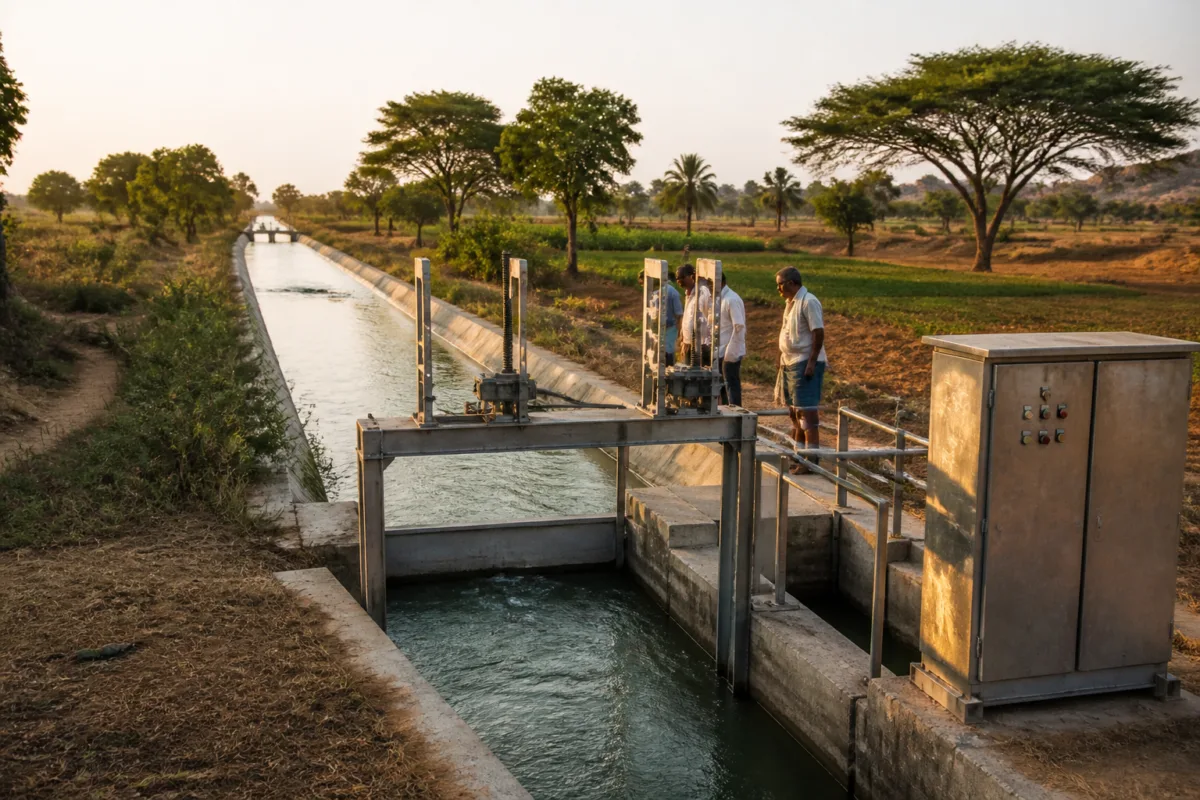
The state is considering technologies including SCADA-based automated control systems to replace manually operated canal gates, pipeline networks linked to micro-irrigation, satellite-based monitoring of evaporation and soil-moisture analysis. The government also discussed using lift irrigation to fill tanks and strengthening water-user associations.
Cheluvarayaswamy referred to work on the Narayanpur Left Bank Canal in north Karnataka, where Australian company Rubicon Water and Indian partner Medha Ventures have been involved. The minister praised what he described as water savings and improved delivery to farmers at the tail end of the canal, and expressed interest in examining the project’s data before considering whether similar approaches could be extended to the Tungabhadra, Cauvery, Ghataprabha and Malaprabha basins.
The minister told the delegation that Karnataka’s irrigation efficiency in older canals was limited to between 35% and 40% because of seepage, evaporation and unauthorised use. These figures were presented during the meeting and were not supported by additional data in the report.
The discussions also covered local manufacturing and technical training. The minister proposed that Australian companies, including Rubicon, manufacture equipment locally under the ‘Make-in-Karnataka’ framework to reduce capital and maintenance costs. Training for water-resources engineers and farmer representatives through institutions such as Australia’s Murray-Darling Basin Authority was also discussed.
The state offered to facilitate land allocation and approvals for Australian companies through Karnataka Udyog Mitra’s single-window system. The minister also said joint ventures with local companies could receive preference in tenders, while manufacturers of smart meters and Internet of Things sensors could be considered for capital subsidies and stamp-duty exemptions. Pilot projects in selected canals were also discussed.
The proposed approach links irrigation infrastructure with farm productivity and water conservation. Its eventual impact will depend on the quality of the Narayanpur project data, the cost and maintenance requirements of automated systems, the role of local water-user groups and whether the state converts the discussions into approved, funded projects.

