


The Chakan infrastructure plan approved by Maharashtra Chief Minister Devendra Fadnavis places a growing question at the centre of Pune’s urban expansion: can industrial employment districts be made functional when roads, drainage, public transport, utilities and traffic enforcement are managed by multiple agencies? The combined plans for Chakan and Hinjewadi, valued at Rs 1,826 crore, attempt to address that problem through a mix of physical works, data-led traffic management and inter-agency coordination.
The announcement covers a Rs 1,400 crore plan for Chakan and a separate Rs 426 crore plan for traffic management in Hinjewadi. The proposals were presented at a meeting at Sahyadri Guest House attended by state officials, including the Minister of State for Urban Development Madhuri Misal, Chief Secretary Rajesh Agrawal and other departmental secretaries. Pune District Collector Jitendra Dudi presented the plans, according to the report by Navbharat Times.
The proposed work is significant because Chakan is not simply a local industrial estate. It is connected to Pune and Pimpri-Chinchwad through daily worker and freight movements, while Hinjewadi has become one of the region’s most important employment clusters. In both areas, economic activity has expanded faster than the supporting urban systems. The result is visible in recurring congestion, unsafe pedestrian movement, waterlogging, inadequate parking and pressure on electricity and waste services.
The plan’s central institutional challenge is that no single agency controls the entire problem. The Maharashtra Industrial Development Corporation, Pune Metropolitan Region Development Authority, Public Works Department, Zilla Parishad and other agencies will have to coordinate funding, land, roads, drainage and operating systems in Chakan. The chief minister’s direction, as reported, is for departments to align their funds and systems rather than implement isolated projects.
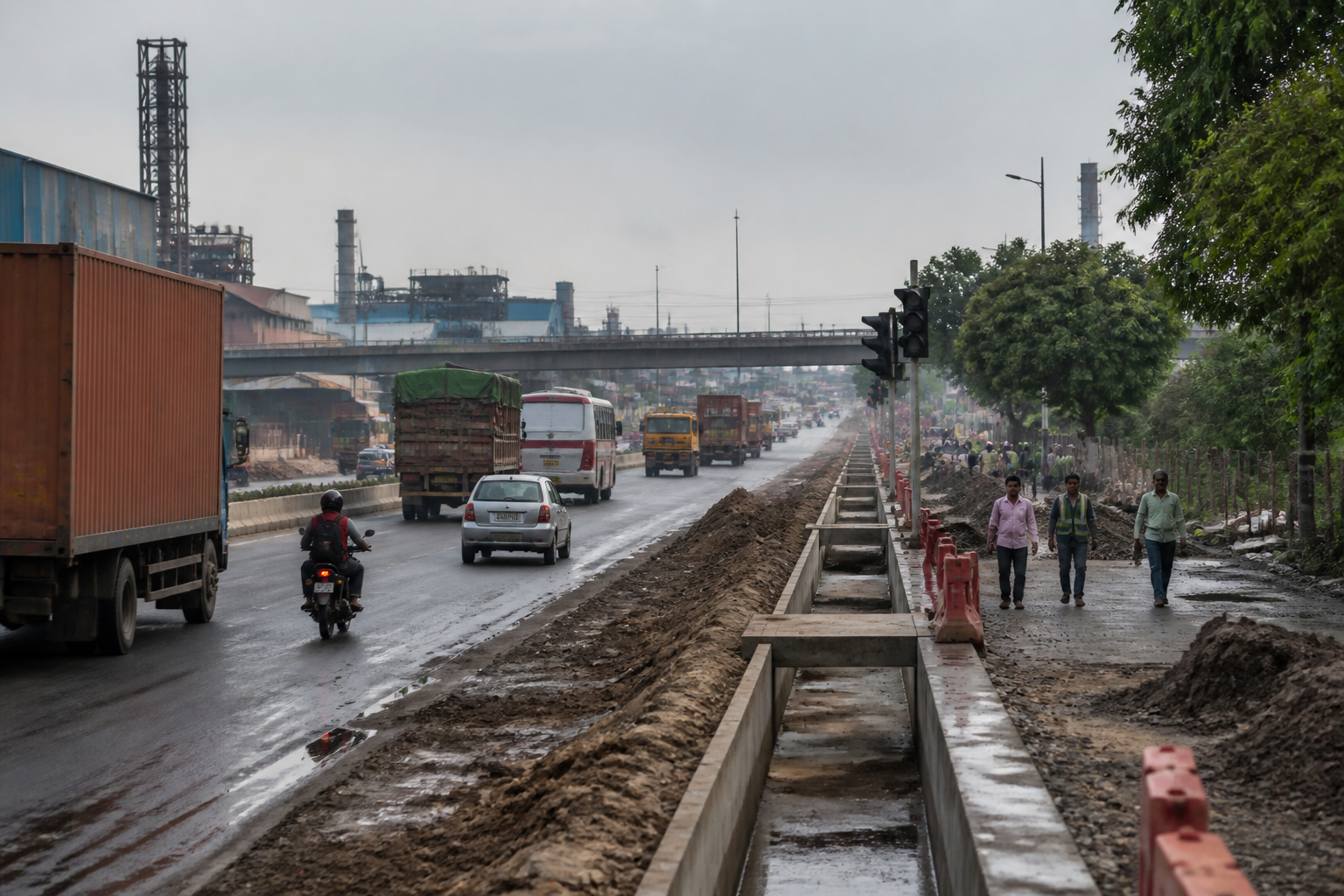
That coordination requirement is especially important for drainage. Chakan’s industrial area has about 78 kilometres of natural drains, sections of which have reportedly been encroached upon. The blocked water routes have contributed to flooding inside industrial units, traffic disruption and interruptions to business operations during heavy rain. The proposed response includes clearing the natural drains, constructing roadside stormwater channels, increasing the capacity of culverts and bridges, and creating water-storage arrangements where required.
The drainage proposal also reveals the limits of treating flooding as only a road engineering problem. If natural drainage corridors are blocked, widening a road or adding a new surface drain may shift water rather than resolve the underlying issue. The plan therefore includes identifying and restoring drain alignments based on an irrigation department survey. The report says 70 to 80 per cent of the action to remove encroachments has been completed, while remaining obstructions will be addressed in phases. The target is to clear the natural drains and complete the water-discharge system by June 2027.
A further 38 kilometres of roadside stormwater drains are proposed. The effectiveness of this network will depend on whether it is connected to the natural drainage system, maintained before each monsoon and protected from future encroachment. The supplied report does not establish the maintenance arrangements or enforcement mechanism, but those details will determine whether the capital works remain functional after construction.
Road planning is being based on an assessment of Chakan’s 498-kilometre road network. Roads were evaluated using traffic volume, industrial importance, freight movement, road condition, waterlogging, safety and connectivity. The first phase will improve about 75 kilometres. The proposed improvements include pedestrian paths, stormwater drainage, traffic facilities and safety measures. Officials have said the first phase is intended to use the available right of way and will not require land acquisition, although encroachments will have to be removed.
This focus on the right of way is relevant to the industrial character of Chakan. The same corridor often has to accommodate trucks, buses, two-wheelers, pedestrians and drainage infrastructure. Without clear space allocation, every new movement demand competes with existing road capacity. The plan also proposes reserved space beneath roads for utility lines, which could reduce the need to repeatedly excavate carriageways for service repairs if it is implemented consistently across agencies.
Worker safety is another important part of the proposal. The survey reportedly found accident risks on roads without footpaths or safe crossings, particularly after industrial shifts end, when large numbers of workers walk along busy routes. Footpaths, crossings and traffic-control measures are proposed on selected roads, while pedestrian facilities are also to be incorporated into the proposed flyover on the National Highway.
The reference to workers matters because industrial infrastructure is often designed around freight efficiency and vehicle movement, while the daily journey of employees is treated as a secondary concern. In Chakan, the plan recognises that the industrial area functions through both goods and labour mobility. A road system that moves trucks but leaves workers to cross or walk along high-speed corridors remains incomplete, even if its vehicle capacity improves.
Public transport is proposed as a way to reduce the number of private vehicles entering Chakan from Pune and Pimpri-Chinchwad. The report says traffic and big-data inputs have been used to prepare a route-wise bus plan for workers travelling to the industrial area. The plan estimates a requirement for about 500 additional buses from different locations. It also expects expanded bus services to reduce private vehicle use and congestion.
The 500-bus requirement is among the plan’s most consequential operational elements because it shifts the response from road expansion to travel-demand management. However, the available report does not specify the operating agencies, routes, service frequency, funding structure or target implementation date for the bus network. These details will be necessary to assess whether the proposal can match shift timings and the dispersed origins of industrial workers.
Traffic technology forms a third component of the Chakan response. Six important junctions are proposed for scientific redesign, including changes to turning arrangements and correction of unauthorised dividers on the National Highway. The plan also includes artificial-intelligence-based traffic signals, cameras, radar, number-plate recognition and a central control room. An Intelligent Traffic Management System has reportedly been approved for Chakan, Talegaon and Hinjewadi.
Technology can improve signal coordination and enforcement, but it cannot compensate for missing road space, poor junction geometry or unmanaged parking. The proposal’s success will therefore depend on how the digital systems are connected to physical redesign and daily enforcement. The report says 100 Maharashtra Security Force personnel are expected to be made available for Chakan traffic management from October 1, with coordination between the traffic police and the command-and-control centre.
Freight parking is another pressure point. The industrial area does not have sufficient parking for heavy vehicles, leading trucks to stand on roads and reduce usable capacity. MIDC has made parking available at five locations, and the plan includes measures to increase their use. Moving trucks into designated facilities could improve traffic flow, but it will also depend on access, pricing, enforcement and whether drivers can use the facilities without losing operational time. The report does not provide those operating details.
The infrastructure package extends beyond mobility and drainage. Chakan’s water-supply scheme is targeted for completion in 2027, while a proposal has been made to transfer the existing water-supply arrangement operated by the Chakan Industries Association to the Maharashtra Jeevan Pradhikaran. Electricity shortages are described as having been addressed in the short term. MIDC has provided land for a 100 MVA substation, with work planned to begin in December.
Waste management is to be organised through a centralised processing centre for waste from 14 villages and two municipal councils. Tenders have reportedly been prepared through the Pune Metropolitan Region Development Authority, with collection and processing planned on a fee-based model. The system is targeted to begin within eight to 10 months. This is an important administrative shift because industrial areas often sit across multiple village and municipal boundaries, making routine waste collection difficult when responsibility is unclear.
Hinjewadi’s separate Rs 426 crore plan reflects a similar pattern, although its immediate emphasis is traffic congestion. Six acres of land have been made available to address electricity-supply issues, while the deployment of 100 Maharashtra Security Force personnel is under process for traffic and other management requirements. Waste collection in Hinjewadi is proposed through either the Pimpri-Chinchwad Municipal Corporation or the Pune Municipal Corporation.
The two plans therefore represent more than a list of construction projects. They are an attempt to manage employment districts whose economic importance crosses administrative borders. Chakan’s roads, drains and utilities involve industrial, regional, district and local institutions. Hinjewadi’s traffic and waste systems similarly require coordination between regional development bodies, municipal corporations, police authorities and infrastructure providers.
The evidence supplied confirms the scale of the proposed response and identifies the major service gaps, but it does not yet establish the detailed financing, contracting arrangements, agency-wise responsibilities or performance indicators for every project. It also remains unclear how the government will measure reductions in flooding, travel time, crashes, private vehicle use and roadside truck parking.
The next test will be implementation. Work is expected to begin in December, with the government targeting visible improvement in Chakan’s traffic and drainage conditions before the following monsoon and completion of natural-drain restoration by June 2027. Whether the package succeeds will depend on the coordination of agencies that have historically managed separate pieces of the same urban system.
