


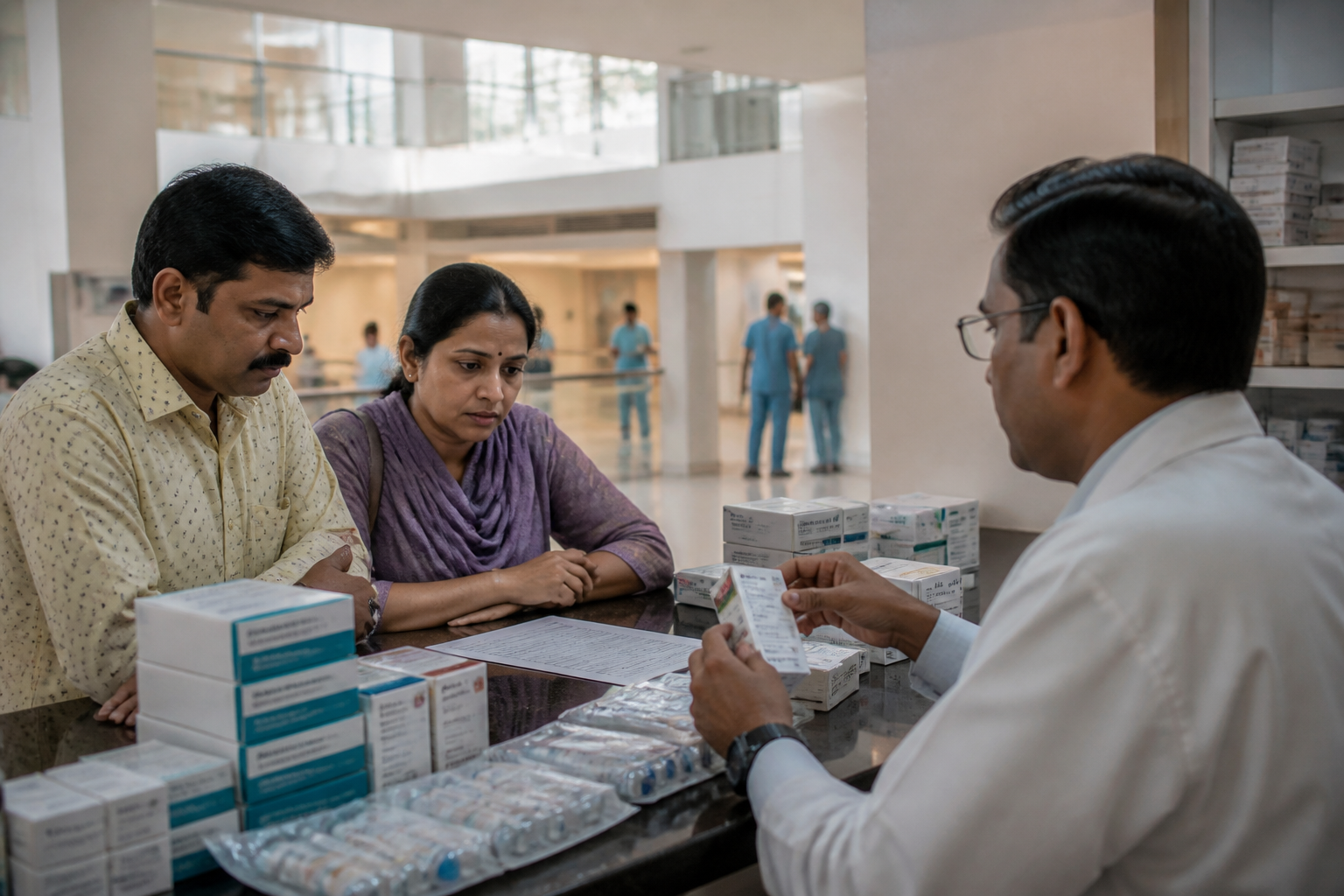
Karnataka’s investigation into cancer drug pricing has identified a wide gap between what hospitals may pay for high-cost medicines and consumables and what patients are billed. The state government says its inspections found markups ranging from 10 times to more than 52 times the actual procurement cost, turning a state-level enforcement exercise into a broader question about how India regulates hospital pharmacy billing.
The findings were disclosed by the Office of the Commissioner, Food Safety and Drug Administration, in a press note issued on October 1. The department said inspections at hospitals treating cancer patients had revealed pricing anomalies involving medicines supplied at discounted institutional rates but billed to patients at or near the printed Maximum Retail Price, or MRP.
The Karnataka government has listed 253 drugs where it identified extreme differences between landing cost and MRP. The Health and Family Welfare Minister, in a letter dated September 23, 2026, sought intervention from the Union Health Minister and asked the Centre to consider national measures against what the state described as exorbitant patient billing.
The issue is not limited to the printed price on a medicine pack. It concerns the gap between several stages of the supply chain: the price at which a pharmaceutical company supplies a product to a hospital, the MRP fixed by the manufacturer, and the amount ultimately charged to the patient. When institutional discounts are not transparently passed through, patients may have no way of knowing whether the bill reflects the hospital’s actual acquisition cost or the maximum permissible retail price.
That information gap becomes particularly consequential in cancer care, where treatment can require repeated purchases of high-value medicines, medical devices and consumables. The Karnataka FDA said its verification drive covered more than 768 consumable items and 189 high-cost drugs. The inspections took place on September 25 and 26 at wholesale premises, hospitals and other establishments in Bengaluru and district locations across the state.
The department’s preliminary observations indicate substantial differences between landing cost, MRP and actual sale price. The findings are to be brought to the notice of the Central Government. Karnataka has also said that the verification exercise will continue in phases, with the next phase focusing on anti-retroviral drugs, higher-generation and critical antibiotics, medical devices, and hospital consumables with substantial financial implications for patients.
The regulatory structure described by the state helps explain why such gaps can arise. Under the Drugs Price Control Order, scheduled drugs are subject to a ceiling price fixed by the National Pharmaceutical Pricing Authority, with a 16 per cent retailer margin. For non-scheduled drugs, however, there is no cap on the retailer margin, leaving the manufacturer’s printed MRP as the principal upper limit.
Medical devices and consumables occupy an even less tightly controlled area. The Karnataka government said price control is limited and that most devices are not covered by the Drugs Price Control Order. Hospital pharmacies also do not have a specific regulation requiring them to pass institutional discounts on to patients. In practice, this creates a regulatory distinction between the price of the product and the fairness or transparency of the final hospital bill.
The state’s demands therefore go beyond action against individual billing practices. Karnataka has asked the Centre to require hospitals to display both the landing cost and MRP on patient bills. It has also sought an expansion of the list of drugs covered by price control, regulation of trade margins on essential high-value medicines and consumables, and a revision of the Drugs Price Control Order, 2013.
Other requests include forming an inter-ministerial expert group, conducting a national data study, rationalising trade margins, making cost-to-MRP transparency mandatory, expanding the National List of Essential Medicines, and treating all forms of back-end consideration as part of the acquisition cost. The state has additionally proposed an audit and enforcement mechanism.
These proposals point to an institutional problem: the affordability of a medicine cannot be assessed only by examining its MRP. A product may be formally within the permitted price framework while still producing a large patient burden if hospitals acquire it at a substantially lower institutional price and bill it close to the printed maximum. Without disclosure of the acquisition price, regulators and patients may be unable to distinguish legitimate hospital costs from margins embedded in the billing process.
The Karnataka findings also show why enforcement requires information across the entire supply chain. The FDA’s exercise involved wholesale premises, hospitals and other establishments rather than examining only retail medicine outlets. This approach allows authorities to compare procurement records, supply prices, printed MRPs and actual sale prices. The department’s decision to extend the exercise to other categories suggests that the state is treating the issue as a wider pricing and billing question rather than a narrow cancer-drug investigation.
However, the findings released so far are preliminary. The press note identifies the number of products inspected and the scale of the reported price differences, but it does not establish that every hospital or every product in the inspected categories followed the same billing practice. It also does not specify the names of the hospitals, companies or individual medicines associated with each markup. The state’s evidence is therefore an important enforcement signal, while the full regulatory and hospital-level implications will depend on the continuing verification exercise and any action that follows.
The governance challenge is divided between state and Union institutions. Karnataka’s Food Safety and Drug Administration can conduct inspections within the state and communicate its findings, while national price-control rules, the Drugs Price Control Order and the National List of Essential Medicines fall within the broader Central regulatory framework. The state’s letter to the Union Health Minister reflects this division: Karnataka has identified the problem locally but is asking for changes that would apply nationally.
The distinction matters because hospital medicine billing often sits between different regulatory domains. Drug prices may be governed through national rules, hospitals may operate under state-level oversight, and devices and consumables may not receive the same degree of price regulation as scheduled medicines. The result is a fragmented accountability structure in which the patient sees one bill, but the underlying prices are shaped by several institutions and commercial relationships.
Karnataka’s proposed transparency requirement would address one part of that fragmentation. Showing the landing cost alongside the MRP would not, by itself, determine the final amount that a hospital is entitled to charge. It would, however, make the relationship between procurement and billing visible. That could give patients, auditors and regulators a clearer basis for examining whether hospital charges reflect documented costs, permitted margins and disclosed services.
The state has described affordability of essential and life-saving healthcare as a matter of serious public importance and said it will take measures available within its jurisdiction to protect patients from unjustified financial burdens. The immediate evidence comes from 253 drugs with identified pricing anomalies, more than 768 consumable items and 189 high-cost drugs examined during the first verification drive.
The larger urban question is how patients access specialised healthcare in cities where hospitals, pharmacies, distributors and regulators operate within a dense and commercially complex system. Bengaluru and district locations are the first settings identified in the exercise, but Karnataka’s request for a national study indicates that the state sees the problem as potentially wider than its own inspections.
What the evidence confirms at this stage is that large differences can exist between institutional procurement costs, printed MRPs and patient billing for high-cost medicines and consumables. What remains to be established is the product-wise, hospital-wise and transaction-wise basis of those differences, and what enforcement or policy changes will follow. The next phases of Karnataka’s verification exercise and the Central Government’s response to the state’s proposals will determine whether the findings lead to mandatory disclosure, wider price controls or a new audit framework for hospital billing.
