


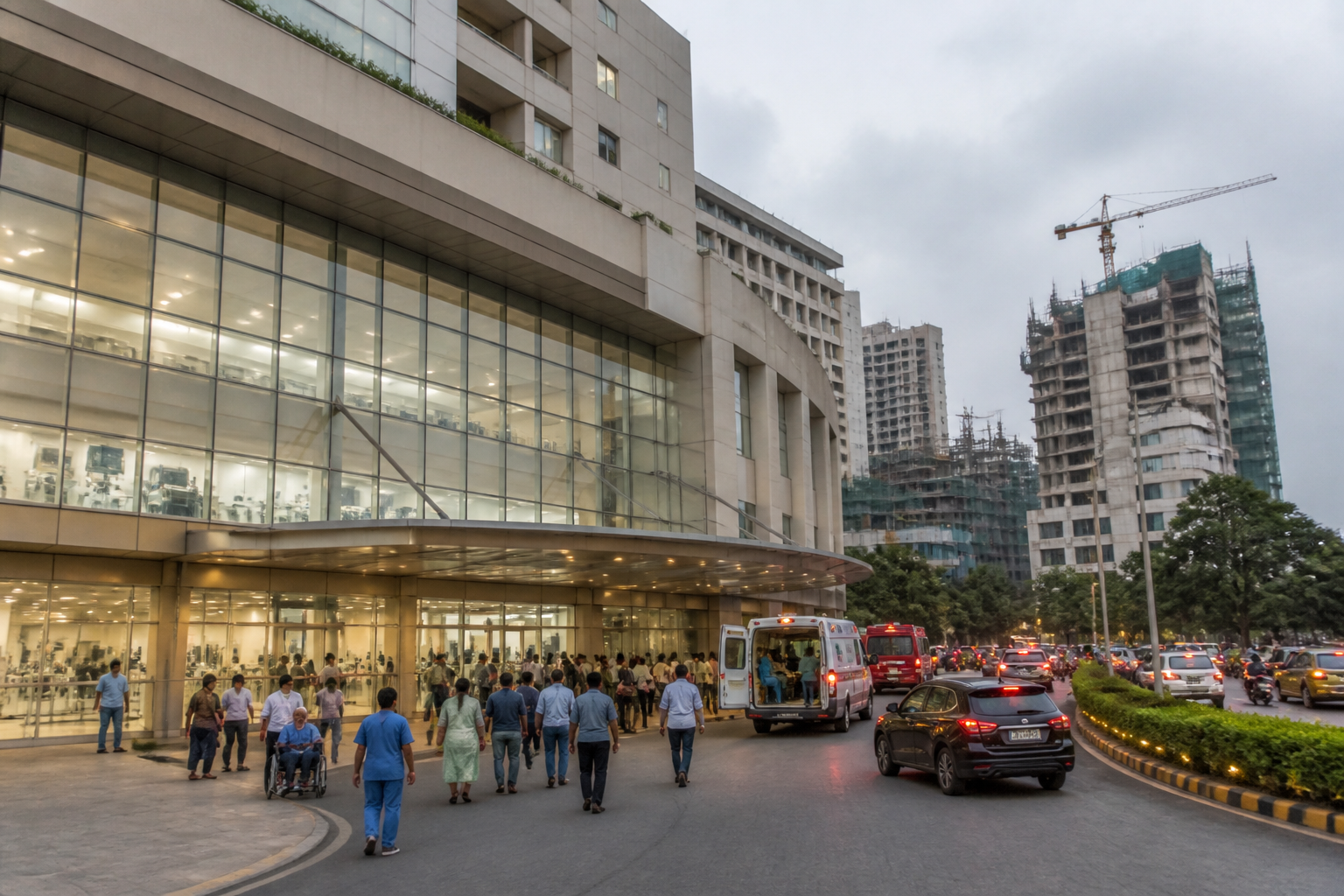
India’s hospital sector is attracting roughly $10 billion from global private-equity investors, but the capital-led expansion is creating a difficult urban question: can new hospitals and advanced treatment capacity grow without making essential care unaffordable for the people who need it? The answer is increasingly tied not only to medical demand, but also to ownership, hospital pricing, insurance rules and the financial expectations built into healthcare infrastructure.
Blackstone, KKR, TPG, General Atlantic and other global investors have spent about $10 billion acquiring stakes in Indian hospital chains over the past five years, according to data compiled by EY and cited in a Bloomberg report published by Hindustan Times. The money has supported new facilities, expensive medical technology and consolidation among hospitals. It has also made India one of the world’s most active markets for private-equity-backed hospital expansion.
The investment is responding to a real infrastructure deficit. India has about 1.3 hospital beds per 1,000 people, according to the report, a level described as far below that of many developed economies. Policymakers identified around 600 hospital projects requiring approximately $32 billion of investment in 2021. These figures point to a substantial gap between the healthcare infrastructure available and the capacity required as incomes rise, life expectancy improves and demand for cancer care, cardiac treatment and other specialised services increases.
That shortage makes private capital attractive. Hospitals require heavy upfront investment in land, buildings, equipment, specialist staff and support systems. A fragmented market of standalone hospitals also offers investors the opportunity to combine facilities into larger networks with broader specialist services. The financial logic is straightforward: more beds, higher utilisation, specialised procedures and national or regional scale can create stronger revenue and improve returns on capital.
But hospitals are not ordinary infrastructure assets. A road or commercial building can be assessed primarily through usage, construction cost and revenue. Hospital expansion involves decisions about which procedures are offered, what technologies are installed, how doctors are compensated, which patients are admitted and how bills are paid. The investment model therefore reaches directly into the relationship between citizens, hospitals and insurers.
The report cites the example of Baby Memorial, a Kerala-based hospital operator in which KKR invested in July 2024. The operator had about 1,000 beds at the time. Within two years, it had exceeded its pretax earnings target and reached 6 billion rupees, or $62.6 million, in fiscal 2026, largely driven by acquisitions, according to a person familiar with the matter who was not named because of privacy concerns. In August, KKR agreed to acquire the Indian operations of Swedish hospital chain Medicover AB for $1.4 billion. The deal is expected to nearly double the number of hospital beds owned by KKR in southern India to 10,000.
These transactions illustrate how the sector is changing from a collection of individual hospitals into a consolidation-driven network. KKR had earlier backed entrepreneur Abhay Soi’s Radiant Life Care and helped merge it with listed Max Healthcare Institute. Its 2022 exit from Max Healthcare was described by the industry as a successful hospital investment. Public listings and secondary share sales have also provided private-equity firms with clearer routes to exit and recycle capital into new acquisitions.
Other investors have recorded substantial gains. Temasek Holdings generated roughly a tenfold return on its 2017 investment in Manipal Health Enterprises after a partial stake sale during the hospital operator’s initial public offering in July, according to VCCircle data cited in the report. The investment produced an internal rate of return of about 30%, the report said.
The financial performance of hospital chains is now colliding with concerns about affordability. Crisil expects private hospitals’ revenue in India to grow by as much as 15% in fiscal 2027, supported by their ability to treat more patients and an increase of up to 7% in average revenue per occupied bed. Higher revenue may indicate that infrastructure is being used more intensively. It can also reflect the rising cost of each episode of care.
A parliamentary committee cited in the report warned in August that an “unchecked influx of foreign capital” was facilitating the acquisition of cost-effective midsize hospitals by larger corporate groups. It recommended reconsidering foreign investment rules for healthcare, examining price caps and creating a regulator for hospitals. The concern is not that investment has no value. It is that consolidation may alter the incentives governing prices, procedures and access before the regulatory system has caught up.
The committee also reported that medical inflation had reached as much as 13% annually. Treatment at private hospitals costs, on average, five to 10 times as much as treatment in the public system, with some of the largest gaps reported in cancer care, cardiac treatment, kidney failure and maternity services. These are not marginal services. They are areas in which families often have limited ability to delay treatment or compare providers on price.
The divide between the public and private systems also gives the private hospital market considerable pricing power in specialised care. Where public facilities lack beds, equipment or specialists, patients may have few practical alternatives. A hospital’s listed price is therefore not simply a commercial choice; it can become the price of access to a service that is unavailable elsewhere in the same city or region.
The insurance system has become the second major pressure point. Insurers argue that private providers, including private-equity-backed chains, are inflating bills and directing patients towards costly procedures. Hospitals respond that delayed payments and inadequate reimbursement rates are squeezing operating margins. Both sides are therefore presenting their own cost pressures as the central problem, while patients encounter the dispute only when a claim is partly rejected or a bill exceeds the available cover.
The report describes the case of Poonam A., a 40-year-old business consultant in Mumbai who sought robot-assisted surgery at a private hospital earlier this year. She paid an annual premium of about 21,000 rupees for a policy with 1.5 million rupees in base coverage and additional provisions that could increase the benefit. Her insurer refused to reimburse the portion of the bill associated with the robotic component, according to claims documents reviewed by Bloomberg. She ultimately paid the shortfall herself.
The case exposes a gap between insurance as a financial product and insurance as usable protection. A patient may possess a policy with a substantial headline coverage amount, yet still discover that a specific technology, procedure or component of treatment is outside the insurer’s reimbursement terms. By the time the insurer reviews the claim, the diagnosis and treatment plan may already have been determined by the hospital and treating team.
Acko General Insurance chief executive Animesh Das described the resulting contest as a question of who owns the patient relationship. Hospitals determine treatment pathways and generate bills; insurers decide what they will reimburse; patients bear the consequences when the two systems disagree. Bhabatosh Mishra, chief operating officer of Niva Bupa Health Insurance, said insurers need evidence-based treatment protocols to decide what care should be covered. He also said some robotic procedures can cost significantly more than conventional alternatives without delivering proportionately better outcomes.
Hospitals, however, argue that newer technologies, implants and surgical techniques can improve outcomes even when they increase costs. This is where infrastructure expansion becomes a governance problem. A new hospital may increase capacity, but the value of that capacity depends on whether the services are clinically justified, transparently priced and financially accessible to the population around it.
The Insurance Regulatory and Development Authority of India has responded to wider friction with new rules on cashless treatment and standardised authorisation procedures, according to the report. Those measures address the claims process, but they do not by themselves settle the larger question of how much hospitals should charge or which treatments insurers must cover.
The debate also involves the investment climate. EQT Group chair Jean Eric Salata said regulatory intervention in healthcare pricing would undermine India’s investment climate and could discourage further investment. EQT holds significant stakes in Indira IVF and Asian Institute of Gastroenterology. Representatives of Blackstone, KKR, TPG, Temasek and General Atlantic either declined to comment or did not respond to requests, while the insurance regulator and the Ministry of Health and Family Welfare did not respond to requests seeking comment on insurer-hospital disputes and their implications for healthcare financing.
India is therefore trying to solve two linked but sometimes conflicting infrastructure problems. It needs more hospitals, more beds and more specialised capacity. It also needs a financing system that allows households to use that capacity without being exposed to unpredictable costs. Private capital can help build and consolidate hospitals, but the same model can make affordability more difficult if returns depend on rising revenue per occupied bed, high-margin procedures and acquisitions in specialised care.
The central policy question is not whether India should permit private investment in hospitals. The evidence in the report shows why that investment has become necessary. The more difficult question is how ownership, pricing, treatment protocols, insurance reimbursement and public capacity should interact as the market expands.
For cities, the consequences are immediate. Hospital networks are becoming part of the urban infrastructure on which residents depend, particularly for cancer, cardiac, maternity and other specialised services. The quality of that infrastructure cannot be measured only by the number of beds added or the amount of capital invested. It must also be assessed through who can afford to use it, what insurers pay for and how much households must pay when the system disagrees.
The available evidence confirms that India’s hospital market is expanding rapidly and attracting significant international capital. It also shows that medical inflation, private-public price differences and disputes over advanced procedures are intensifying scrutiny. The developments that require monitoring are the proposed review of foreign investment rules, possible price caps, the creation of a hospital regulator, the implementation of cashless-treatment rules and whether future hospital expansion improves access without transferring more costs to patients.
