


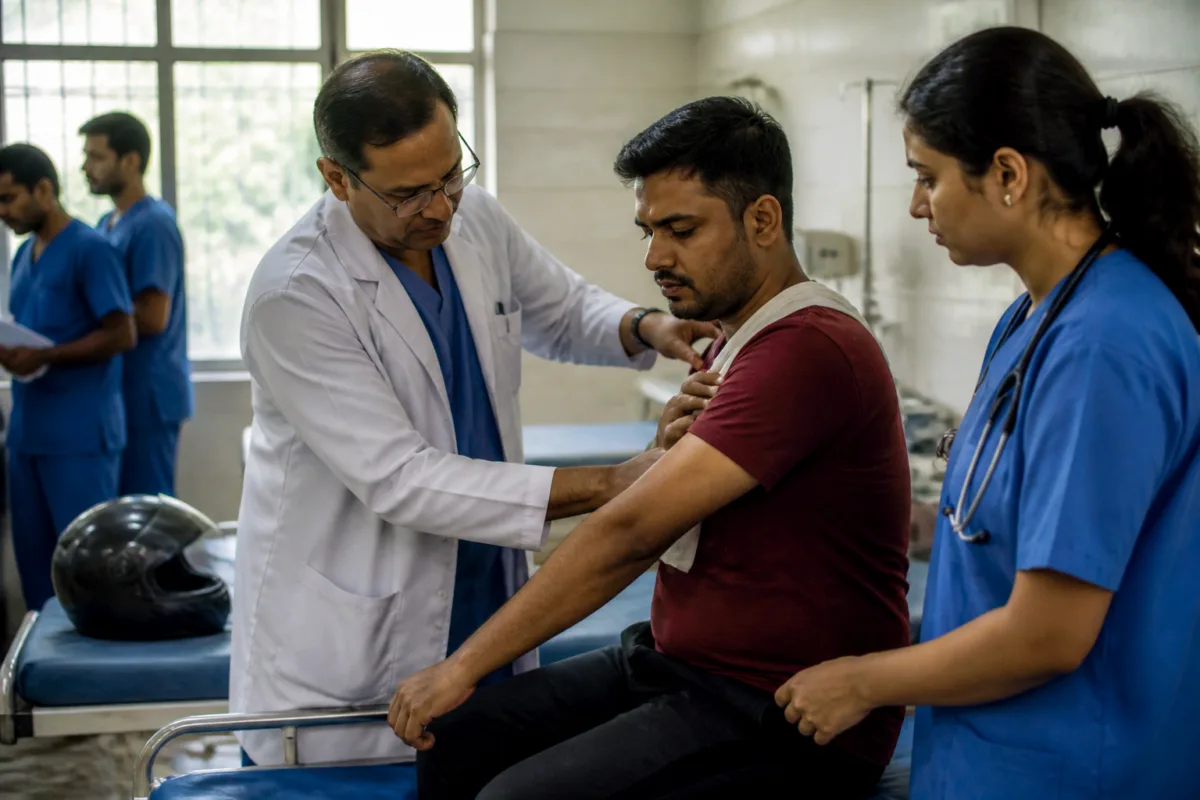
Road crashes are usually measured through deaths, fractures and visible trauma. At AIIMS Bhopal, however, doctors are drawing attention to a less visible consequence: injuries to the brachial plexus, the network of nerves that connects the spinal cord to the shoulder, arm and hand. According to Dr Abhinav Singh, assistant professor in the department of burns and plastic surgery, road traffic accidents account for 43% of cases requiring brachial plexus surgery at the institute.
The figure places nerve damage within the larger road-safety problem. A crash can leave a person with no obvious fracture but with severe weakness or loss of movement in an arm. For patients and families, that changes the meaning of recovery. The injury can affect the ability to use the hand, move the arm and carry out daily activities, while treatment may require reconstruction followed by rehabilitation.
The source report does not provide the total number of brachial plexus surgeries at AIIMS Bhopal, the period covered by the 43% figure, or a comparison with other hospitals. The percentage therefore cannot be read as a measure of the overall share of road-crash injuries in Bhopal. It is, more specifically, an indication from one specialist and one institution of how frequently road traffic accidents appear among patients requiring this particular form of surgery.
That distinction matters. Injury data often reflects the way a health system records and treats cases, rather than the complete burden of harm across a city. A hospital-based percentage can show an important pattern without explaining how many people with similar injuries never reach a specialist centre, receive treatment elsewhere, or remain outside formal surgical records. The AIIMS Bhopal figure is consequently best understood as a clinical signal, not a citywide road-injury survey.
Still, the clinical signal is significant because brachial plexus injuries can be difficult to recognise in the immediate aftermath of a crash. Dr Singh said two-wheeler accidents are among the situations in which the nerves may be damaged. The mechanism described is a forceful movement in which the neck and shoulder are pushed in opposite directions, stretching, compressing or tearing the nerves.
This mechanism explains why the damage may not resemble the injuries most commonly associated with a collision. A fracture is visible on imaging and can be immobilised or surgically repaired. Nerve damage may instead present as weakness, reduced movement or loss of function in the limb. The consequences may become clearer as the initial trauma subsides, placing importance on clinical assessment when an accident victim cannot move the arm normally.
For an urban health system, this creates a link between road engineering, emergency response and specialised care. Preventing a collision is the first layer of protection. The next is ensuring that injuries are recognised and referred appropriately. The final layer involves access to reconstruction and rehabilitation for patients whose nerves have been stretched, compressed or torn.
The AIIMS Bhopal account focuses on that third layer but also points back to the first two. Dr Singh advised people experiencing weakness or reduced arm movement after an accident or another injury to seek prompt medical attention. He said early diagnosis could improve the chances of functional recovery. The statement does not establish a uniform outcome for all patients, but it identifies time-sensitive assessment as an important part of managing the injury.
The institutional development highlighted in the report is Dr Singh’s recent fellowship under Dr PS Bhandari, described in an institute press release as one of India’s leading brachial plexus surgery specialists. AIIMS Bhopal said the training is expected to strengthen expertise in managing these injuries. That is relevant beyond an individual doctor’s qualification: specialised capability determines whether patients can receive assessment and reconstruction close to where they live or must seek expertise elsewhere.
The report does not specify the number of specialists currently available, the hospital’s surgical capacity, waiting times, rehabilitation facilities or referral arrangements. It also does not state whether the new expertise will alter the number of patients treated, the time between injury and surgery, or functional outcomes. Those are the operational indicators needed to understand how a specialist service changes access in practice.
The policy landscape around this issue is therefore broader than a single medical department. Road safety is generally treated as a transport and enforcement concern, while nerve reconstruction is handled within specialised healthcare. The patient’s experience cuts across both systems. A crash may occur on a city road, be managed initially through emergency services, and then require specialist diagnosis, surgery and long-term rehabilitation.
That institutional chain can be difficult for patients to navigate. The supplied report does not describe the referral process at AIIMS Bhopal or identify the agencies responsible for emergency transport and post-crash coordination. It does, however, show why road-crash reporting based only on immediate fatalities or fractures can understate the consequences that hospitals manage later.
The 43% figure also raises a question about how urban road safety is evaluated. If reporting focuses on whether a person survived a crash, it may miss whether the person regained movement in an arm, returned to work or could resume ordinary activities. Dr Singh specifically connected these injuries to daily functioning, describing the possibility of an arm and hand becoming almost paralysed. That makes functional recovery an important dimension of the urban road-injury burden, even though the report supplies no outcome data.
The same caution applies to the reference to bad roads in the source headline. The article establishes a connection between road traffic accidents and brachial plexus surgery cases, particularly among two-wheeler users. It does not provide evidence attributing the injuries to specific road defects, locations or maintenance failures. Without such evidence, the material supports a road-safety and trauma-care analysis, but not a conclusion that poor road conditions caused the reported surgeries.
The report also mentions other possible causes of brachial plexus injuries, including fractures, nerve damage during surgery and, in extreme cases, prolonged poor workplace posture contributing to nerve compression or injury. This wider clinical context prevents the 43% road-crash figure from being interpreted as the total universe of causes. It indicates that the injuries treated by specialists arise through several pathways, with road traffic accidents forming the largest identified share in the information supplied.
For city administrators, the practical lesson is not that one percentage can describe the entire road system. It is that the consequences of mobility failures extend into specialised clinical services. For hospitals, the issue is whether patients with reduced arm movement are identified early and connected to the appropriate expertise. For citizens, the immediate information is simpler: weakness or reduced movement after an accident should not be dismissed as an ordinary symptom that will necessarily resolve on its own.
What the evidence confirms is limited but important. AIIMS Bhopal’s Dr Singh says road traffic accidents account for 43% of brachial plexus surgery cases at the institute, and that these injuries can severely affect arm and hand movement. The hospital has also highlighted additional specialist training in brachial plexus surgery. What remains unclear is the size of the patient population, the time period behind the percentage, the distribution of cases across Bhopal and the treatment outcomes after reconstruction and rehabilitation.
Those missing details determine whether the figure becomes a one-time clinical observation or part of a longer-term road-injury trend. Future reporting would need hospital case numbers, time-series data, referral information and recovery outcomes to establish that pattern. Until then, the AIIMS Bhopal account offers a useful reminder that the cost of a road crash is not always visible at the scene: for some survivors, the central challenge begins with whether the nerves controlling an arm and hand can be restored.

