


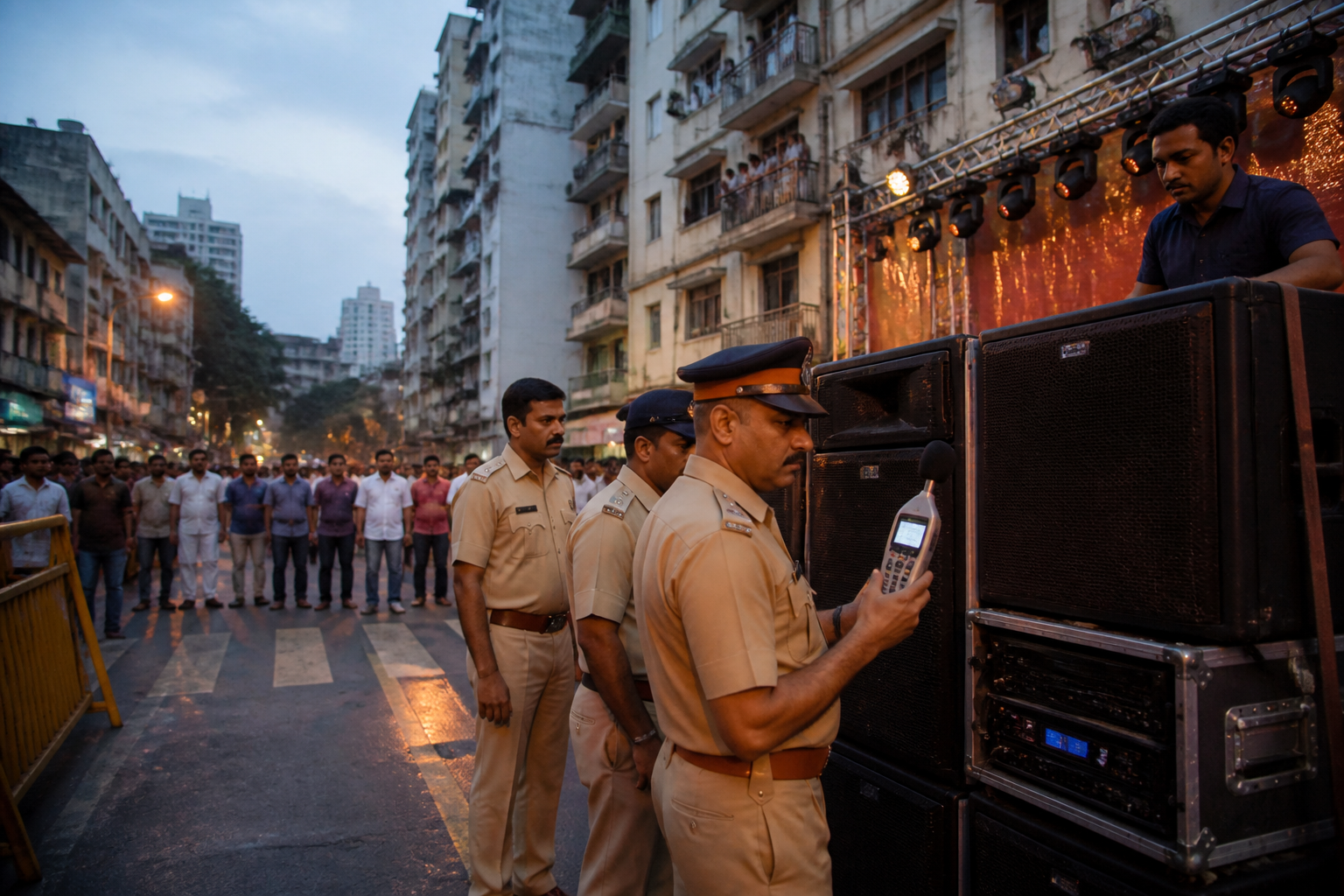
The Bombay High Court’s latest directions on festival noise pollution do more than restrict crackers, DJs and high-intensity lights on public roads. They expose a longstanding urban governance problem in Mumbai: the city has rules governing sound, but citizens continue to experience festivals as periods when those rules are rarely enforced.
A bench of Justices Girish Kulkarni and Neela Gokhale took suo motu cognisance of noise pollution during festivals and heard the matter after directing the state’s Advocate General and other respondents to appear. According to the report, the court has now prohibited the bursting of crackers on public roads and open spaces during festivals, and imposed restrictions on DJs, laser beams and high-intensity lighting used during processions.
The directions are significant because they shift the question from whether noise pollution is regulated to whether urban authorities are capable of enforcing those regulations at scale. Mumbai’s festivals occupy roads, junctions, neighbourhood lanes and open spaces. The resulting conflict is not limited to decibel levels. It concerns how public land is temporarily controlled, who bears the cost of that occupation, and whether residents have any practical means of protecting their right to rest, study and access essential services.
India’s Noise Pollution (Regulation and Control) Rules, 2000 already restrict the use of loudspeakers and public-address systems between 10 pm and 6 am. The report also notes that the state government may relax the night-time restriction until midnight on certain festival days. Hospitals, educational institutions, courts and religious places are identified as silence-zone locations within a 100-metre radius under the rules. Yet the court’s intervention indicates that the existence of a legal framework has not translated into predictable enforcement on the ground.
The court’s concern is therefore institutional as much as environmental. Earlier orders of the Supreme Court and high courts have addressed festival noise, loudspeakers and public celebrations. The source report says the court repeatedly referred during the hearing to the failure of previous directions to produce lasting compliance. The latest proceedings were initiated against the background of continuing complaints about loud music, amplified instruments and crackers during festivals and processions.
The new directions introduce financial and operational conditions for permissions. Festival committees seeking permission to use loudspeakers must deposit a security amount of Rs 1 lakh, while individuals must deposit Rs 50,000. The amount can be forfeited if the noise rules are violated. The measure attempts to correct a weakness in the existing enforcement model, in which equipment may be seized or a relatively small penalty imposed after residents have already faced hours of disturbance, while organisers may later resume activities.
The court has also directed that permitted sound systems be checked for decibel levels and that equipment be seized immediately when violations are found. Organisers must install a visible decibel meter at the venue and use an internal sound limiter in the sound system. Designated officials are expected to record sound levels periodically and maintain those records. These requirements could create an enforcement trail where earlier complaints often ended without publicly visible evidence of what was measured, by whom and what action followed.
The directions also require festival committees and procession organisers to display permission details, including the name, address and mobile number of the responsible person. Police and municipal officials are expected to brief organisers about the rules before a procession begins. Where multiple committees seek permission within the same municipal ward, authorities have been directed to assess the cumulative impact on noise levels through a scientific study before granting approval.
That cumulative approach is particularly relevant to Mumbai’s dense neighbourhoods. A single sound system may appear manageable when assessed in isolation, but several permitted events operating within the same ward can create overlapping noise. The court’s direction recognises that urban exposure is shaped by concentration, timing and proximity, not only by the compliance of one individual organiser. It also places responsibility on authorities to examine the combined effect of permissions they issue.
The order’s restrictions on crackers and laser lighting extend the matter beyond conventional noise regulation. The source report connects festival periods with air pollution and poor air quality in Mumbai, particularly around September and October, when dust and other pollutants already affect the city. Crackers add both sound and air pollution, while high-intensity beams and lighting can create safety concerns during processions and affect drivers, pedestrians and residents near routes.
The court was told by Advocate General Milind Sathe that rules were being implemented properly, while also pointing to staffing constraints in the police force. The bench did not accept an account that presented enforcement as broadly satisfactory. It questioned why Mumbai could not adopt measures similar to those attributed in the report to Nagpur Police Commissioner Vishwas Nangare Patil, including restrictions on DJs, Dolby sound systems, lasers and dim lights.
This exchange illustrates the difference between administrative capacity and administrative responsibility. Police shortages may limit the number of personnel available for festival deployment, but the court’s directions focus on designing a permission system that makes compliance measurable before an event begins. Visible decibel meters, sound limiters, named responsible persons, deposits and documented inspections are intended to reduce dependence on discretionary intervention after violations occur.
The deeper urban issue is the unequal distribution of festival impacts. The source report says the court referred to patients, senior citizens and students who face disturbance from loud music and crackers. A relatively small number of organisers can impose noise and air pollution on thousands or even lakhs of residents who have not consented to the activity. In a dense city, that imbalance becomes sharper because homes, hospitals, schools, commercial streets and event routes frequently exist within short distances of one another.
The court also contrasted festival noise with the Wari pilgrimage, where large numbers of devotees participate amid cymbals and traditional instruments without the same level of amplified sound described in Mumbai’s celebrations. The comparison is not a ruling on the cultural value of festivals. It underlines the court’s distinction between collective celebration and the use of technology that magnifies sound across neighbourhoods.
The legal framework now faces a practical test. Mumbai’s police, municipal authorities and the Maharashtra Pollution Control Board will have to coordinate permissions, inspections, measurement and action. The order places particular importance on the stage before an event: identifying responsible persons, setting conditions, studying cumulative impact and ensuring that sound equipment contains limiters. It also requires authorities to act during events by checking levels and seizing equipment where violations are found.
The unresolved question is whether these directions will become routine administrative practice or remain another set of instructions invoked during litigation. The report notes that noise-control laws and judicial orders have existed for years, while implementation has often been inconsistent. The effectiveness of the latest order will therefore depend less on the wording of the restrictions than on whether every permission, measurement, seizure and forfeiture is recorded and applied consistently across neighbourhoods and organisers.
What the court has confirmed is that festival noise is not merely a dispute between residents and event organisers. It is a question of public health, access to public space, municipal permission and police accountability. What remains to be established is how the authorities will operationalise the directions across Mumbai’s wards, how cumulative noise will be assessed, and whether the promised enforcement will be visible during the next major festival cycle.
