


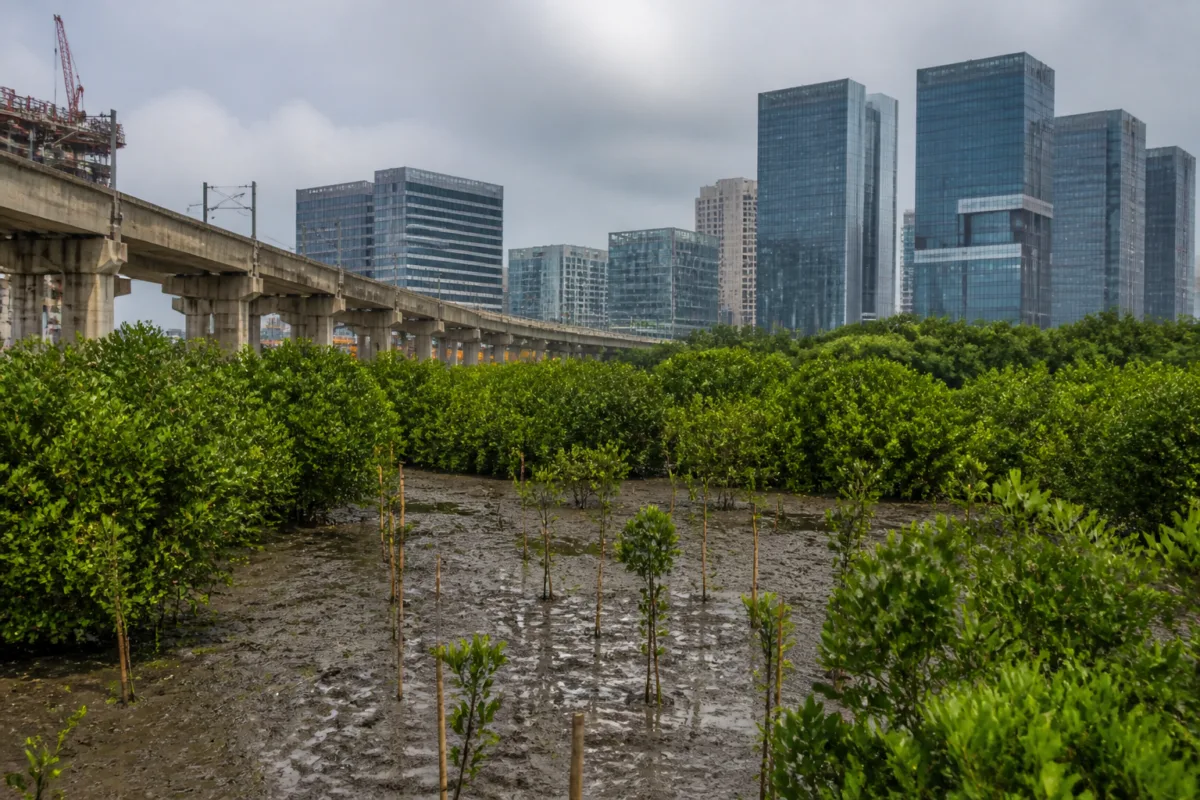
The Bombay High Court has questioned whether compensatory plantation for infrastructure projects in Maharashtra is being carried out as a genuine ecological measure or merely recorded as a condition in official paperwork.
A bench comprising Chief Justice Mahesh Chandra Tripathi and Justice Advait Sethna made the observations while hearing a petition by the Mumbai Metropolitan Region Development Authority (MMRDA). The authority is seeking permission to divert 0.2869 hectares of mangrove forest land for an elevated Automated Rapid Transit System (ARTS) proposed in Mumbai’s Bandra-Kurla Complex.
The court stressed that development and environmental protection must proceed together. It noted that newly planted saplings cannot immediately replace the ecological value of mature trees and mangroves, which may take several years to develop.
The proposed 8.85-km ARTS is described as a driverless electric pod-car network intended to improve last-mile connectivity in BKC, a major commercial district that faces regular traffic congestion. According to the report, MMRDA has maintained that no mangroves would be felled for the project, although six trees would be affected by its alignment.
MMRDA has offered to plant 100 trees as compensation. However, the bench questioned why compensatory measures had not been initiated when the project was first conceptualised, instead of being addressed only when permission was sought to affect existing green cover.
“Once we give permission then efforts are taken for plantation. That would take years,” the court observed, according to the report. It also said that rehabilitation of the environment must move simultaneously with development and that plantation commitments should translate into genuine work on the ground rather than remain assurances in official documents.
The state government cited a shortage of suitable saline land as one reason for delays in mangrove plantation. Maharashtra Advocate General Milind Sathe also told the court that saplings were planted during the pre-monsoon period to improve their chances of survival.
The court has asked the state government to provide concrete data for the previous five years. The information is to include the total extent of green cover, the area of green cover lost and the survival rates of planted saplings. That data is expected to help the bench assess whether compensatory afforestation is producing effective restoration before deciding MMRDA’s request.
The hearing places emphasis on outcomes rather than plantation commitments alone. A numerical promise to plant trees does not, by itself, establish that lost ecological functions have been restored, particularly where the affected landscape includes mangroves or mature trees. The court’s request for survival data could therefore make monitoring and maintenance evidence central to future clearance decisions, although the report does not indicate that any final rule has been issued.
The High Court has not yet passed a final order on MMRDA’s plea. The matter is scheduled for further hearing on November 30.

