


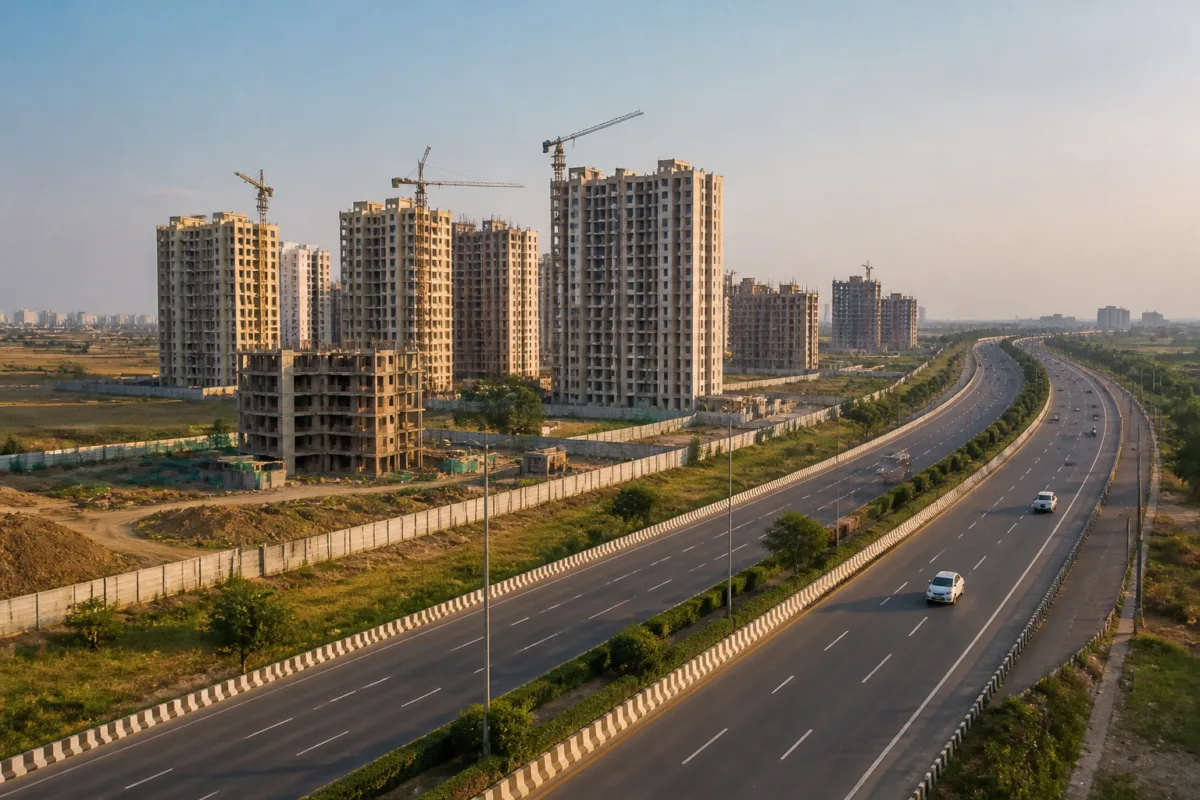
Average apartment prices along the Yamuna Expressway have risen from ₹3,700 per sq ft in 2022 to ₹9,500 per sq ft in 2026, according to a Square Yards report, putting the corridor at the centre of a fast-changing real-estate market in the National Capital Region.
The increase represents a 157% rise over four years, with the report estimating a compound annual growth rate of about 27%. Prices were recorded at ₹5,000 per sq ft in 2023, ₹8,000 in 2024 and ₹8,900 in 2025 before reaching the current average.
Square Yards describes the corridor as an “affordability bridge” between emerging locations and established markets such as Noida and Gurugram. However, the price gap is narrowing as transport infrastructure, the newly launched Noida International Airport and industrial investment raise expectations of stronger employment and housing demand.
The report examined the 165-km, six-lane, access-controlled Yamuna Expressway, which connects Greater Noida with Agra. Operational since 2012, the expressway has reduced the reported Noida–Agra journey to about 100 minutes from nearly four hours. The corridor passes through six districts in Uttar Pradesh and falls under the Yamuna Expressway Industrial Development Authority.
Around 200 residential projects are under way in the corridor, according to Square Yards. The market includes apartments priced between ₹75 lakh and ₹5 crore, along with plotted developments and premium villas. The report estimates rental yields at about 2.20% a year, indicating that the market’s current appeal is based more on expected capital growth and future urbanisation than on rental income alone.
The report projects the corridor’s population could reach 3.5 million by 2031. It links this potential growth to an airport-led ecosystem that could include commercial, logistics, industrial and institutional activity. Square Yards has also estimated that Noida International Airport could create 5,000 direct jobs over the next five years.
Existing and recently developed connectivity cited in the report includes the Ganga Expressway and the Delhi–Faridabad–Ballabgarh–Palwal Expressway. Proposed projects include a Delhi Metro extension to the airport, the Ghaziabad–Jewar Regional Rapid Transit System and an orbital rail corridor. These projects remain future connectivity proposals in the report and should not be treated as operational services.
The market is also showing signs of a possible shift beyond short-term speculation. A separate Square Yards report said demand was gradually moving towards end users, supported by employment opportunities, integrated townships and improved liveability. The evidence presented, however, remains largely market-report based rather than a comprehensive assessment of completed occupation, public transport access or civic service capacity.
Square Yards cautioned that infrastructure gaps and uneven development between sectors could constrain near-term occupancy and investment. Delays in infrastructure or industrial projects, policy changes and shifts in demand could also affect returns. The report said timely execution would be critical to the corridor’s development as a major NCR residential destination.
For residents and prospective buyers, the price rise signals both improving market confidence and higher entry costs. Whether the Yamuna Expressway becomes a functioning employment-led urban corridor will depend on the delivery of transport links, jobs, public services and occupied neighbourhoods—not only on announced projects or rising land values.

