


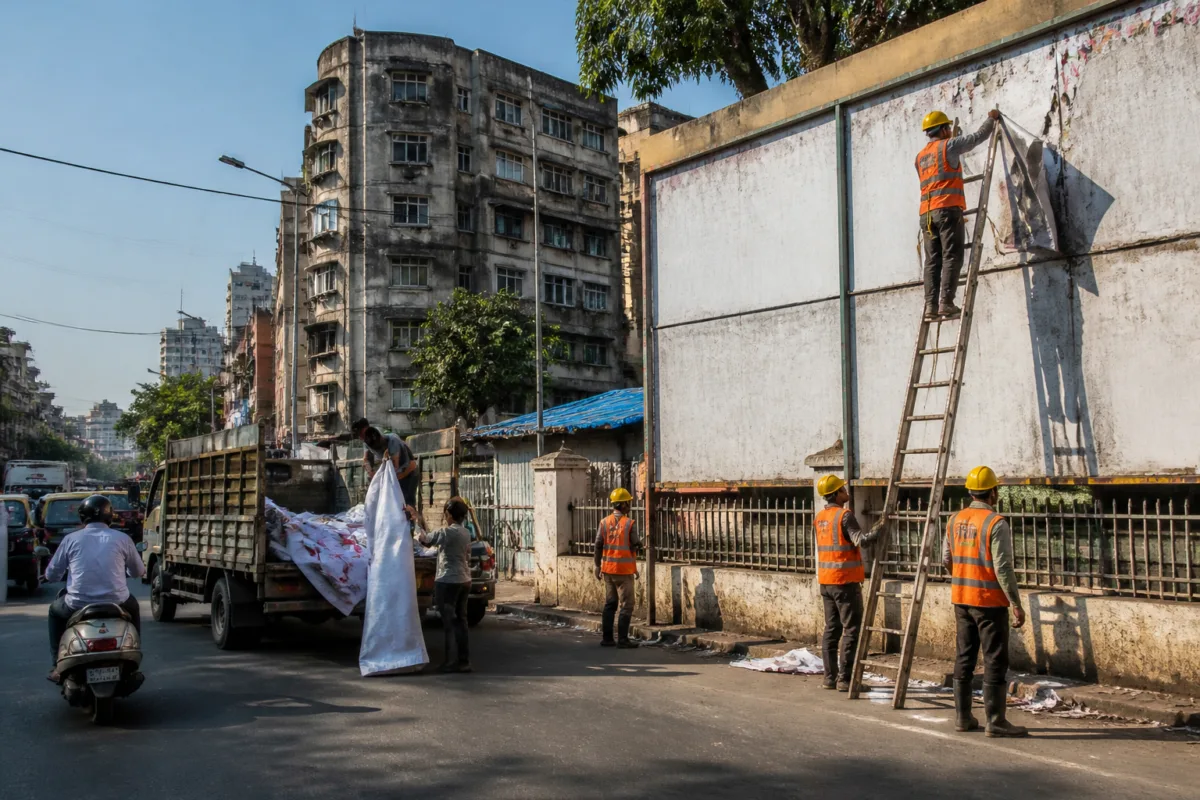
The BMC banner removal drive has cleared 12,396 unauthorised banners, boards, posters, flags and other displays across Mumbai, but the much smaller number of FIRs and prosecution complaints points to a wider enforcement question: how effectively can the city convert removal action into accountability?
The Brihanmumbai Municipal Corporation’s Licence Department recorded the removals during a five-week drive conducted between October 8 and November 12, 2026. According to the department’s report, the civic body also sent 145 letters to police stations seeking action against those responsible. Only 15 FIRs or prosecution complaints were registered during the period.
The figures make the campaign more than a seasonal clean-up exercise. They offer a snapshot of how Mumbai manages unauthorised claims on public-facing urban space, where political, religious, social and commercial messaging competes for visibility on roads, walls, structures and neighbourhood streets. The removals show the scale of the problem; the police correspondence and case figures show the administrative distance between taking down a display and identifying or prosecuting the person behind it.
The largest category was banners, with 7,640 removed during the drive. This included 4,540 religious or social banners, 1,959 political banners and 1,141 commercial banners. Boards accounted for another 3,869 removals, comprising 1,958 religious or social boards, 1,506 political boards and 405 commercial boards.
Posters made up 657 removals. Of these, 510 were classified as religious or social posters, 126 as political posters and 21 as commercial posters. The department also removed 219 flags and recorded 11 instances of wall defacement.
The classification is significant because it shows that unauthorised displays are not limited to one type of urban activity. Religious and social material formed the largest share of banners, boards and posters, while political displays represented a substantial second category. Commercial advertising was smaller in the report’s totals, but it remained part of the same enforcement system. For the civic administration, this means that regulating visual clutter involves dealing with multiple types of organisers and different forms of local influence.
The drive also reveals how enforcement intensity changes over time. The highest number of removals was recorded on October 21, when 1,756 displays were cleared in a single day. These included 665 religious or social banners, 397 religious or social boards and 251 political banners. The civic body recorded 1,321 removals on October 22 and 930 on October 23.
The concentration of action around those dates coincided with the Diwali period, according to the department’s report. After the campaign began with 684 removals on October 8, daily figures largely ranged between 250 and 520. The lowest count was recorded on October 31, when 89 displays were removed. The latest entry in the report, dated November 12, recorded 668 removals, including 149 political banners, 205 religious or social banners and 100 religious or social boards.
This pattern raises an important administrative distinction between a drive and a permanent enforcement system. A concentrated campaign can produce a high number of removals in a short period, particularly when civic teams are directed to act across the city. But the continuing presence of new unauthorised displays depends on what happens between drives: whether permissions are checked before installation, whether violations are recorded consistently, and whether responsibility can be traced after a display is removed.
The supplied report does not establish how many of the 12,396 displays had been installed after earlier removals, nor does it state how many organisers were identified. It also does not provide the number of complaints that led to the 145 letters sent to police stations. Those missing details matter because the raw removal count measures municipal action, while the number of repeat violations and identified offenders would show whether the action is changing behaviour.
The gap between police correspondence and registered cases is the clearest institutional signal in the figures. The Licence Department sent 145 letters to police stations, including 32 on October 19, 17 on October 14, and 12 each on October 21 and October 26. Yet just 15 FIRs or prosecution complaints were registered. Ten of these were filed on November 4, four on the first day of the campaign, October 8, and one on November 2.
The report does not explain why the number of cases remained comparatively low. It does, however, show that the civic body’s administrative action and the police response were not matched numerically. That difference could reflect the time required to establish responsibility, differences in the threshold for registering cases, incomplete information in complaints, or other procedural factors. The available material does not identify which explanation applies, so the figures should be read as an enforcement gap rather than proof of a particular institutional failure.
Wall defacement provides another view of the city’s public-space enforcement problem. The department recorded 11 instances during the reporting period. Eight were reported on October 13, while one each was recorded on October 14, November 3 and November 5. Unlike a removable banner or board, wall defacement directly alters a building edge or public surface. Its treatment requires not only removal or cleaning but also a determination of who caused the damage and whether the act can be linked to a specific organisation or campaign.
Mumbai’s streetscape is managed through overlapping responsibilities. The BMC Licence Department can identify and remove unauthorised displays within the civic framework, while police stations become relevant when the civic body seeks action against those responsible. The 145 letters therefore represent a handover or coordination point between municipal enforcement and criminal or prosecutorial procedures. The 15 registered cases indicate the number of matters that reached that stage during the reported period, but the report does not provide their outcomes.
That institutional structure affects how residents experience enforcement. A banner may be removed quickly from a road, junction or public-facing building, yet the organiser may remain unidentified. If the process ends with removal, the immediate visual obstruction disappears but the underlying incentive to install unauthorised material may remain. If responsibility is established and repeat violations are tracked, the same action can become part of a deterrence mechanism. The report’s figures confirm the first stage at scale; they do not yet show the strength of the second.
The numbers also demonstrate why public-space regulation cannot be assessed through a single headline total. The 12,396 removals communicate operational capacity. The category breakdown shows which kinds of displays occupy the most space. The day-wise figures show when enforcement was most intense. The 145 letters indicate the volume of referrals to the police. The 15 cases show how many referrals resulted in registered FIRs or prosecution complaints. Each number measures a different part of the administrative chain.
The campaign’s five-week duration and its peak during the Diwali period suggest that the BMC was responding to a particularly visible increase in displays around a major festive window. But the report does not establish whether the seasonal concentration was exceptional compared with previous years or whether it reflects a recurring pattern. Without comparative figures from earlier drives, the city cannot yet determine whether the campaign represents an improvement in compliance, a temporary clearance, or a repetition of a familiar cycle.
The most important unanswered question is what happens after November 12. The BMC’s report records the latest removals and the cases registered during the drive, but it does not provide a follow-up measure for repeat installations, pending police action or prosecution outcomes. Those indicators would help distinguish between a successful enforcement programme and a high-volume removal operation with limited downstream consequences.
The available evidence confirms that Mumbai’s unauthorised-display problem is large, diverse and administratively distributed. It also confirms that municipal removal is occurring at a far greater scale than registered criminal or prosecution action. What remains uncertain is whether that difference reflects normal procedural filtering or a persistent weakness in accountability. Future reporting will need to track repeat violations, police action and case outcomes to establish whether the BMC’s campaign changes the way public space is used after the teams leave.

