


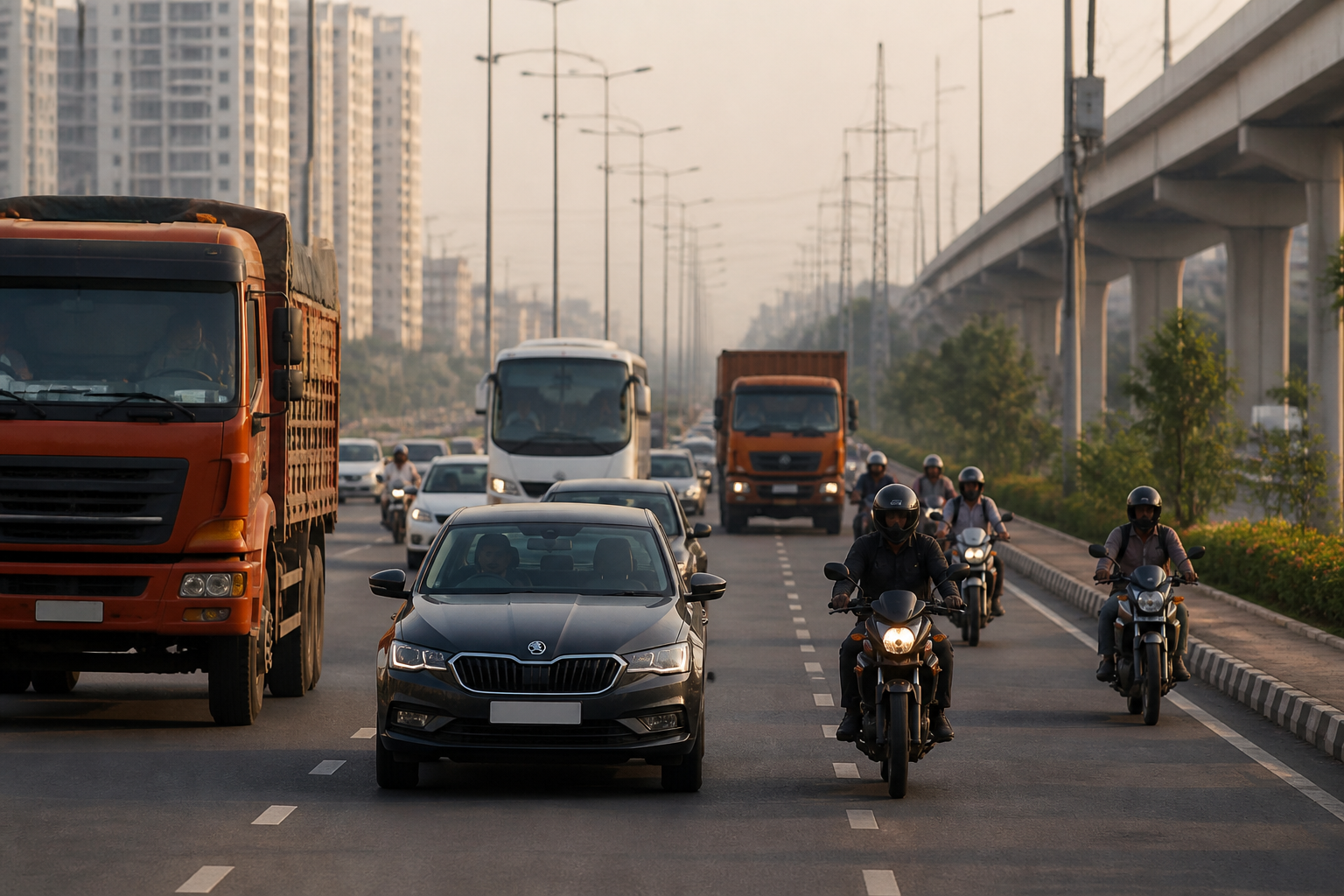
India’s next vehicle-emissions regime is still being drafted, but the industrial consequences are already taking shape. Bharat Stage 7 could create an estimated annual opportunity of nearly ₹10,000 crore for auto-component manufacturers as stricter pollution standards increase the value of exhaust-treatment systems, sensors, dosing equipment and electronic controls.
The opportunity is not evenly distributed across the vehicle market. Heavy trucks and buses are expected to generate the highest incremental content per vehicle, while two-wheelers could become important because of their enormous annual volumes. Passenger vehicles would fall between those two extremes, with diesel models requiring more complex systems than petrol, CNG and hybrid vehicles.
The regulatory framework remains unfinished. Road Transport and Highways Secretary V Umashankar said at the SIAM Annual Convention in New Delhi on September 3 that consultations were nearing completion and that a draft could be issued within a couple of months. Until the government specifies the emission limits, testing procedures, monitoring requirements, vehicle categories and implementation dates, the ₹10,000-crore estimate remains directional rather than a settled market forecast.
That uncertainty is central to understanding the opportunity. Bharat Stage 7 is expected to draw from Europe’s Euro 7 regime, but India will determine its own regulatory design. The final value for suppliers will depend particularly on whether the rules expand real-driving emissions testing, introduce more extensive onboard monitoring and apply new requirements to two-wheelers.
The largest share of the projected opportunity is expected to come from exhaust and after-treatment systems. These could account for about 40-45 per cent of the total, equivalent to approximately ₹3,000-4,500 crore annually. The category includes systems that reduce pollutants after combustion and could require more sophisticated catalysts, filters and related components under tighter standards.
Sensors and monitoring controls could represent another 25-30 per cent, or roughly ₹2,000-3,000 crore. Fluid-dosing systems are estimated at 15-20 per cent, equivalent to ₹1,200-2,000 crore, while precision engine and valve hardware could contribute 10-15 per cent, or ₹800-1,500 crore. These estimates describe the potential distribution of new content, not guaranteed revenue for individual companies.
The per-vehicle economics explain why commercial vehicles are likely to be the most valuable applications. Heavy trucks and buses could see additional component content of ₹75,000-1 lakh per vehicle. Medium commercial vehicles could add ₹30,000-40,000, while light commercial vehicles could add ₹15,000-20,000. Their engines, operating conditions and existing emissions systems require more extensive after-treatment and electronic control than smaller vehicles.
Diesel passenger vehicles could see an incremental content increase of ₹12,000-16,000 through more advanced selective catalytic reduction systems and nitrogen-oxide monitoring. Petrol, CNG and hybrid passenger vehicles could add an estimated ₹3,000-4,000 through components such as particulate filters and sensors. The difference reflects the fact that diesel systems already use more elaborate pollution-control hardware, including particulate filters and selective catalytic reduction.
Two-wheelers present a different calculation. The estimated additional content per vehicle is only ₹750-1,130, far below the figure for heavy commercial vehicles. However, annual two-wheeler volumes exceed two crore units, making the segment significant in aggregate. The final regulatory treatment of motorcycles and scooters could therefore materially change the total market opportunity for sensors, monitoring equipment and controls.
This is also where the debate over real-driving emissions becomes most consequential. The Society of Indian Automobile Manufacturers, supported by the Japanese industry body JAMA, wants two-wheelers excluded from the initial RDE testing framework. The industry’s argument focuses on the equipment required for testing. Portable Emissions Measurement Systems include gas cylinders, power packs and analysers and can weigh more than 100 kilograms.
A test setup weighing that much can be accommodated by a car or commercial vehicle more easily than by a lightweight motorcycle. On a commuter motorcycle, the equipment could function like a permanent heavy passenger, increasing the engine load and potentially distorting tailpipe measurements. The industry’s position is therefore that the testing method must account for the physical characteristics of two-wheelers before they are brought within the same framework.
The regulatory choice would have a direct effect on suppliers. If two-wheelers face broader real-driving emissions, monitoring and control requirements, the segment could generate a larger share of the projected component opportunity. If those requirements are deferred, the initial market for such systems would be concentrated more heavily in commercial vehicles and passenger cars.
Several companies are positioned in the component categories likely to benefit. Sharda Motor Industries and Tenneco Clean Air India have exposure to exhaust and after-treatment assemblies. Eberspächer and Cummins are relevant to heavy-duty applications, while Bosch, Uno Minda, Continental and Sensata have exposure to sensors and monitoring systems. Bosch and Cummins also participate in dosing systems. The eventual commercial impact will depend on technical specifications, localisation, sourcing decisions and the timing of vehicle-model upgrades.
The vehicle manufacturers most exposed to higher-value diesel applications include companies with diesel-heavy portfolios such as Mahindra and Tata Motors, as well as diesel offerings from Hyundai, Kia and Toyota. This does not mean that each manufacturer will face the same compliance cost or generate the same supplier demand. The effect will vary according to engine platforms, fleet mix, technology choices and the final BS7 requirements.
Bharat Stage 7 will also arrive alongside other regulatory changes. The regime is expected to overlap with tighter Corporate Average Fuel Economy III requirements and India’s transition to Worldwide Harmonised Light Vehicles Test emissions testing from April 2027. These programmes address related but distinct aspects of vehicle performance and compliance. Together, they could require manufacturers and suppliers to manage several technical and certification tracks at the same time.
The overlap matters because emissions regulation is no longer limited to a single laboratory certification event. Real-driving requirements, onboard monitoring and fuel-economy rules can increase the number of components, software controls, calibration exercises and validation procedures needed before a vehicle reaches the market. For suppliers, that could raise the value of specialised technology. For manufacturers, it could increase engineering and compliance complexity.
However, the available evidence does not establish the final cost to consumers, the precise investment required from manufacturers or the effect on vehicle prices. It also does not establish how quickly domestic suppliers could scale production or how much of the potential value would accrue to Indian manufacturers rather than international technology providers. Those questions will remain open until the government publishes the draft and industry participants respond to it.
The ₹10,000-crore estimate should therefore be read as a measure of possible incremental content across the vehicle market, not as a guaranteed addition to the industry’s annual turnover. Its reliability will depend on the final emission limits, the testing cycle, the vehicles covered and the implementation schedule. As Randheer Singh of ForeSee Advisors indicated, a more precise assessment will be possible only after those elements are clarified.
The larger urban and transport question is how India manages the transition from broad emissions standards to compliance systems that reflect how vehicles actually operate. Commercial vehicles, passenger cars and two-wheelers have different physical characteristics, usage patterns and pollution-control needs. A single regulatory ambition may therefore require different testing and technology pathways across categories.
For cities, the outcome will influence the emissions performance of the vehicles that move people and goods, although the supplied material does not quantify the resulting change in urban air quality. For the automotive industry, it will determine where new value is created: in after-treatment hardware, sensors, dosing, engine controls or the production systems needed to support them. For policymakers, the immediate task is to settle the rules without leaving the market uncertain for manufacturers, suppliers and testing agencies.
What is confirmed is that consultations are nearing completion and that the government expects to release a draft in the coming months. What remains uncertain is the final architecture of Bharat Stage 7, including RDE requirements, two-wheeler coverage, monitoring provisions, emission limits and implementation dates. Those details will determine whether the projected ₹10,000-crore opportunity becomes a broad-based expansion for component makers or a more concentrated market centred on heavy vehicles and advanced diesel systems.
