


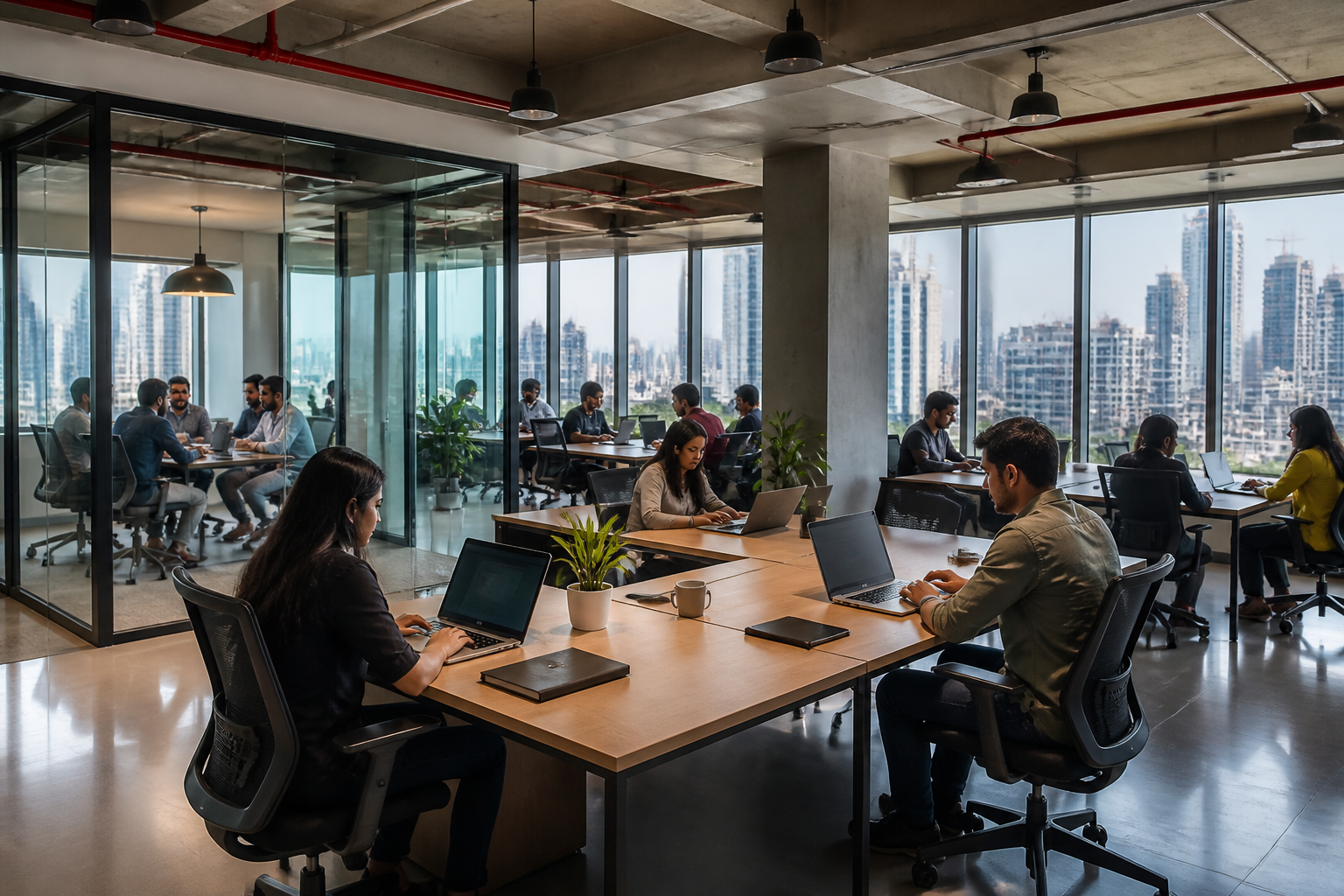
The latest office-market data from Mumbai and Pune points to a broader shift in how multinational companies are occupying space in Indian cities. Instead of committing immediately to wholly owned or independently leased corporate offices, more companies are taking seats in flexible-office and coworking facilities. The change is visible in the first half of 2026, when coworking operators leased 191,306 seats across eight major Indian cities, a 68 per cent increase over the same period a year earlier.
The figures, cited from a Cushman & Wakefield report covering January to June 2026, do not suggest that conventional offices are disappearing. They show that flexible space is becoming a more significant part of the office market, particularly for global capability centres, or GCCs. Flexible-office transactions accounted for 20 per cent of total office-space transactions across the cities covered, while GCCs represented 44 per cent of flexible-office activity. Their share had been 37 per cent in the first half of 2025.
That combination matters because GCCs are not a small, isolated segment of the commercial property market. They are the Indian operating centres of global companies, often housing technology, finance, engineering, analytics and other specialised functions. The supplied report attributes the increased demand for coworking and flexible offices partly to the continuing preference of global companies for India as a GCC location. As investment in these centres has grown, their requirements are increasingly being reflected in the way office space is leased and managed.
The shift also changes the meaning of office expansion in a city. In the traditional model, a company’s arrival could be associated with a large, dedicated premises, a long lease and a substantial fit-out programme. Flexible offices separate some of those decisions. A company can begin operations with managed workspaces, add or reduce seats, and use an existing office platform rather than develop every part of the workplace independently. The report describes these facilities as effective, flexible and managed office solutions, with GCCs showing the strongest preference.
Mumbai recorded the sharpest increase among the two Maharashtra markets highlighted in the report. Flexible-office operators leased 25,820 seats in the city during the first half of 2026, compared with 11,226 seats in the corresponding period of 2025. That represents a 130 per cent increase. Pune recorded 20,900 seats, up from 16,352, a 27 per cent rise.
The contrast between the two cities is significant. Mumbai’s growth rate was much higher, but Pune’s absolute volume remained substantial. Together, the two markets accounted for 46,720 seats in the six-month period. The data does not establish whether this growth came from new companies entering the cities, existing companies expanding, or organisations transferring staff from conventional offices into flexible premises. It does, however, show that both metropolitan markets are participating in the expansion of managed office space.
Pune’s position is closely linked to its established role as an information-technology, engineering, automotive and business-services centre. The supplied material does not provide a sector-wise breakdown of demand in Pune, so it would be premature to attribute the increase to any single industry. The broader GCC trend offers context: if global companies are expanding Indian operations, cities with existing talent pools and established business districts can absorb that demand through multiple office formats.
Mumbai, meanwhile, has a different commercial structure and a much larger concentration of corporate, financial and professional activity. The 130 per cent increase in flexible-office seats suggests that the format is gaining ground even in a mature office market. The data alone cannot determine whether this represents a temporary leasing cycle or a durable change in occupier behaviour. It does indicate that flexible offices are no longer confined to start-ups or small businesses. Large multinational occupiers and GCCs are now an important part of the demand base.
The national figures reinforce that point. Bengaluru remained the largest flexible-office market among the eight cities, with 57,487 seats leased in the first half of 2026. That was a 31.8 per cent increase over the previous year and gave the city a 30 per cent share of total activity. Hyderabad followed with 40,451 seats, a 170 per cent rise, while Delhi recorded 21,970 seats, up 152 per cent.
The remaining markets also recorded growth, although at different levels. Chennai reached 16,297 seats, an increase of 3.6 per cent. Kolkata recorded 3,454 seats, up 48 per cent. Ahmedabad posted the highest percentage increase, rising from 735 seats to 4,927, or 570 per cent. Percentage growth in a smaller market can be amplified by a low starting base, so Ahmedabad’s rate should not be read as evidence that it has overtaken the larger office centres. Its figures do show that flexible-office supply and demand are spreading beyond the established metropolitan leaders.
Taken together, the numbers show a market with two distinct patterns. The first is concentration: Bengaluru, Hyderabad, Mumbai, Delhi and Pune account for most of the reported seats. The second is acceleration in emerging or previously smaller markets, where a lower base allows large percentage increases. Flexible offices therefore appear to be expanding both within established employment centres and into cities seeking a larger share of corporate investment.
The 20 per cent share of total office transactions is perhaps the most important figure in the report. It places flexible offices within the mainstream of commercial leasing rather than treating them as a peripheral product. Yet the figure should be read carefully. The available material does not specify whether transactions refer to leased seats, area, lease registrations or another measure, nor does it provide the total office market by city. Without that methodology, comparisons across markets remain indicative rather than exhaustive.
The rise of flexible offices also has implications for the physical planning of business districts. Demand may increasingly be distributed across managed-office buildings rather than concentrated in a single corporate campus. That can affect the way landlords design floor plates, provide shared amenities and structure lease terms. It may also alter the timing of fit-outs and the relationship between office operators and building owners. These implications follow from the operating model described in the report, but the supplied data does not quantify their effect on vacancy, rents, construction or transport demand.
For cities, the important institutional question is whether office infrastructure can support more variable patterns of occupancy. A flexible-office market can allow companies to expand quickly, but the workers using those spaces still require reliable public transport, roads, power, digital connectivity and other urban services. The report is focused on office transactions and does not assess these systems. As a result, it cannot establish whether infrastructure capacity is keeping pace with the reported increase in seats.
The same limitation applies to housing and commuting. More office seats do not automatically translate into an equivalent number of new residents, because seats may be used in shifts, by hybrid workers or by companies relocating existing employees. Nor does the data reveal where workers live or how they travel. Those questions will matter for Pune and Mumbai, where office growth intersects with housing costs, congestion and the availability of mass transit.
The policy landscape is similarly broader than the office transaction itself. GCC expansion involves decisions by companies, landlords, flexible-office operators and public authorities. City administrations influence the surrounding transport, utilities and approvals environment, while state and national policies affect investment conditions and employment ecosystems. The supplied report does not identify a specific government scheme, funding programme or regulatory change behind the figures. The evidence therefore supports a market analysis, not a claim that a particular policy caused the increase.
What is clear is that corporate real estate is becoming more modular. Companies can use flexible offices as an entry point, an expansion mechanism or a way to manage uncertainty around long-term space requirements. For property owners, the growth of operators creates another route to occupancy. For cities, it increases the importance of understanding not just how much office space is built, but how that space is contracted, occupied and connected to the wider urban system.
The first-half 2026 data confirms that coworking and flexible offices are gaining a larger role in India’s metropolitan office markets, with GCCs at the centre of that growth. Mumbai and Pune show that the trend is active in Maharashtra as well as in Bengaluru and Hyderabad. What remains uncertain from the supplied material is whether the increase will translate into sustained demand for dedicated offices, reshape vacancy and rental patterns, or produce lasting changes in commuting and commercial development. Those are the next indicators that office-market observers and city authorities will need to monitor.

