


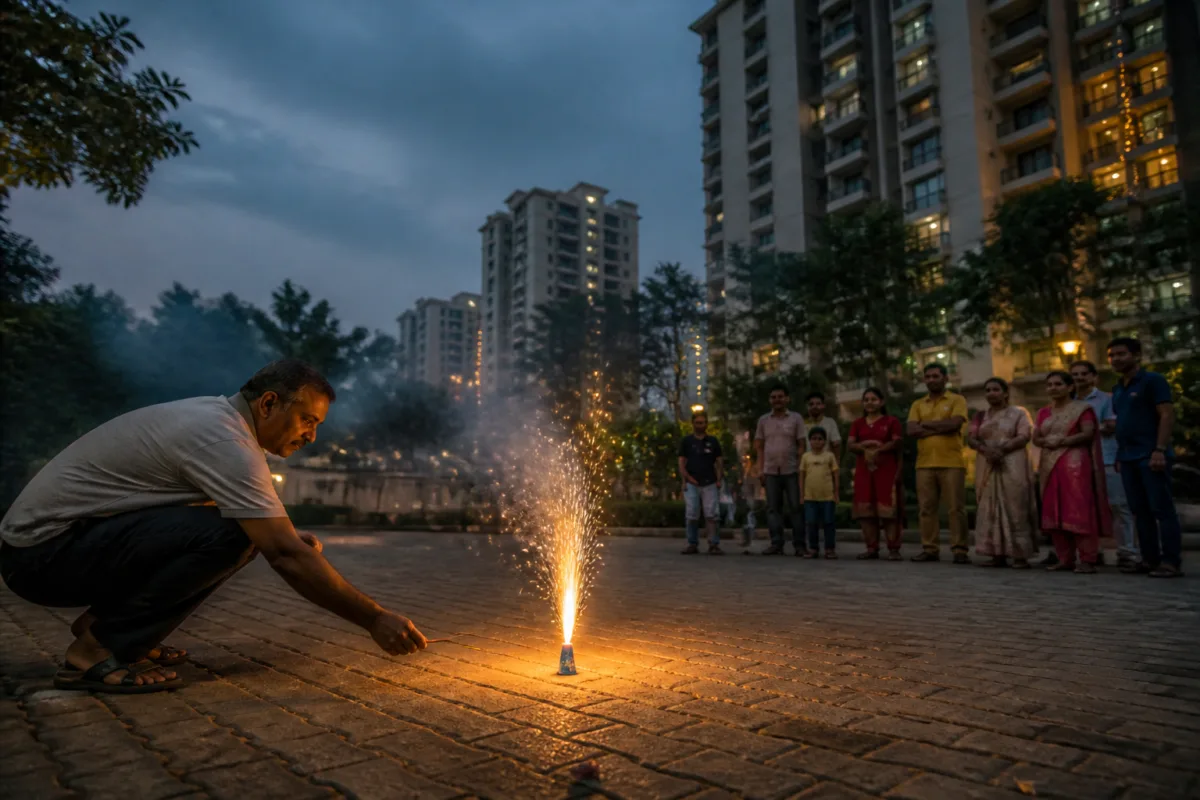
Bengaluru’s green crackers are being presented as a lower-pollution option, but hospital records cited in a report by Prajavani show that they do not remove the risk of serious eye injuries. More than 200 people received treatment for firework-related eye injuries at major eye hospitals in the city during last year’s Diwali period, with children forming a significant share of the cases and bystanders also being injured.
The numbers point to a persistent urban safety problem rather than a one-off festival incident. The Karnataka State Pollution Control Board, non-governmental organisations and medical institutions conduct awareness campaigns around green crackers every year. Authorities also issue guidelines limiting the period during which fireworks may be used. Yet the report says cases continue to rise year after year, suggesting that the existence of rules and public messaging has not translated into consistent safety behaviour at street level.
That gap matters because firework injuries are shaped not only by the product being used, but also by where, how and around whom it is used. In a dense city such as Bengaluru, fireworks are often experienced by more people than those who light them. Hospital records cited in the report show that spectators accounted for a considerable share of injuries, making the issue one of collective urban safety rather than an individual choice alone.
The report identifies Lakshmi bombs, bijli crackers and flower pots among the products associated with many of the injuries. It also cites ophthalmologists warning that products sold in the market as green crackers may not always provide consumers with confidence about their actual composition. Doctors advise buyers to use licensed shops and confirm that products carry the ISI mark and are genuinely certified as green crackers.
Green crackers are described by the experts quoted in the report as using a lower quantity of chemicals. That may reduce pollution, but it does not make the explosion harmless. The intensity of the blast can remain comparable to that of ordinary fireworks. The distinction is important because public discussion often treats the term “green” as a broad safety label, even though the medical risk to the eye remains when sparks, fragments or smoke reach a person at close range.
The city’s healthcare data illustrates the consequences. Minto Eye Hospital treated 56 people for firework-related injuries during last year’s Diwali period. Narayana Nethralaya recorded more than 100 cases, while the combined number treated at Nethradhama and Shankar Eye Hospital, along with the other institutions mentioned in the report, crossed 200. Some patients suffered serious damage and required surgery.
The figures are not presented as a consolidated citywide surveillance system. They are records from individual hospitals cited in the report. Even so, they reveal the scale of demand placed on specialised eye-care facilities during the festival period. They also show why prevention cannot be limited to general advice issued before Diwali. When multiple hospitals receive dozens or hundreds of cases in a short period, emergency preparedness and rapid access to treatment become part of the city’s seasonal public-safety response.
Children are especially exposed. According to the Minto hospital data cited by Prajavani, children below 14 years accounted for 40 per cent of the cases analysed by doctors. Of the 56 patients recorded at the hospital last year, five were below five years old, eight were between six and 10, and 18 were between 11 and 18. The remaining patients were adults.
These figures establish two points. First, the risk is not confined to very young children who may be directly handling fireworks. Second, adolescents form a large part of the affected group, which is relevant because older children may be more likely to light crackers or remain close to an active firework. The data does not identify the exact circumstances of every injury, but it makes clear that children require specific supervision rather than generic festival messaging.
The bystander dimension is equally significant. At Minto, 31 of the cases reported last year involved people who had injured themselves while lighting fireworks, while 25 were spectators watching fireworks being set off. Narayana Nethralaya recorded 32 cases involving people who were watching. These numbers show how an unsafe setting can extend the risk beyond the person handling the cracker.
For city authorities and communities, that changes the practical question. It is not enough to tell people who light fireworks to be careful. Spectators also need distance from the firing area, and the location itself must reduce the chance that a malfunctioning firework will strike nearby people. The advice from Minto Eye Hospital director Dr Suresh Babu, as quoted in the report, is that both users and viewers should follow safety measures even when the crackers are classified as green.
The recommended precautions are straightforward: maintain a distance of at least two to three feet when lighting a cracker, use a long stick, restrict fireworks to open and vacant spaces, and avoid using glass bottles as supports. Glass can break and send fragments towards the eyes. The guidance also highlights the need for protective eyewear and immediate medical attention after an injury.
The instruction not to rub the eye when a spark enters it is particularly important in the context of emergency response. The report warns that delayed treatment can result in permanent loss of vision. This makes the first response after an injury a critical part of the safety chain. Awareness campaigns therefore need to communicate not only how to light fireworks, but also what to do in the first moments after an accident and where specialised care is available.
The institutional arrangement around the issue is already spread across several actors. The pollution control board is involved in awareness and regulation related to green crackers and pollution. Medical institutions provide injury data and emergency treatment. Non-governmental organisations participate in public education, while households, retailers and local communities influence how products are purchased and used. The recurring injuries suggest that responsibility is distributed, but the system lacks a sufficiently effective link between these separate activities.
Retail verification is one such link. Doctors quoted in the report advise consumers to purchase green crackers only from licensed outlets and to check their certification. That places part of the burden on buyers, but it also highlights the importance of reliable market enforcement. If products are being sold under a green label without consumers being able to establish their authenticity, awareness alone cannot resolve the problem. The report does not provide figures on inspections, seizures or prosecutions, so the extent of enforcement remains unclear.
The same limitation applies to the reported year-on-year increase in injuries. The article states that eye-injury cases have continued to rise, but the supplied hospital figures cover last year’s Diwali period and do not provide a complete multi-year series. The available evidence therefore establishes a recurring and substantial injury burden, while the precise rate of increase across Bengaluru cannot be calculated from the figures provided.
What the evidence does establish is that the city’s firework risk is concentrated around three failures: inadequate distance, insufficient protection for spectators and delayed treatment. The presence of green crackers does not eliminate any of these risks. Nor does an awareness campaign automatically change behaviour in crowded or informal settings where people may light fireworks close to homes, roads, groups of spectators or other structures.
The larger urban question is how Bengaluru treats predictable seasonal hazards. Firework injuries occur during a known period, involve identifiable products and repeatedly affect a documented group of hospitals. That makes them different from unforeseeable emergencies. The city has an opportunity to connect regulation, retail checks, neighbourhood-level communication, safe-use spaces and hospital preparedness into one coordinated response.
For now, the available hospital records show that the burden remains significant and that children and spectators cannot be treated as secondary groups. Green crackers may reduce the quantity of chemicals used, according to the experts cited, but they do not make fireworks safe for the eyes. The next meaningful test for Bengaluru’s safety framework is whether official guidance reaches the places where fireworks are actually purchased, lit and watched—and whether people with injuries receive immediate specialist care.

