


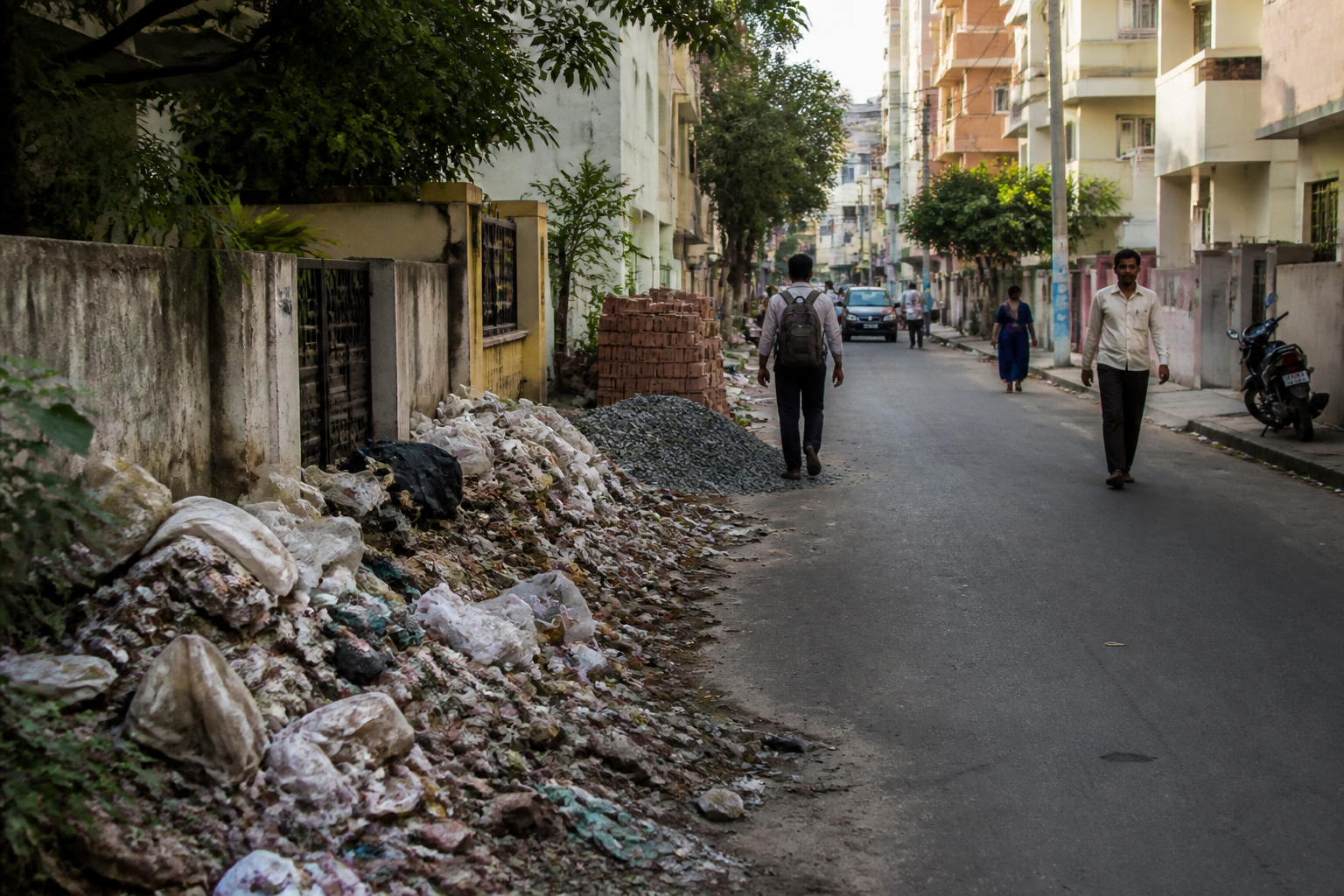
A complaint from Binny Crescent in Bengaluru’s Benson Town has remained unresolved months after residents flagged irregular waste collection, accumulated garbage, foul odours and construction debris on a residential road. The episode, reported by Bangalore Mirror, is a small but revealing account of how routine sanitation failures can persist even after they are formally brought to the attention of the civic administration.
The complaint was submitted on May 28 to the Assistant Executive Engineer and Health Inspector of the Bruhat Bengaluru Mahanagara Palike (BBMP). It concerned a road near 16/5 Binny Crescent in Jayamahal Ward, where residents said regular cleaning had stopped for several days and sanitation workers were not visiting the area as required. According to the report, residents continued to find the stretch unclean months later.
The immediate problem is visible: garbage has accumulated along the road, residents have reported an unpleasant smell and pedestrians and households are facing inconvenience. But the more important issue is the gap between reporting a civic problem and securing a sustained service response. The complaint did not simply identify waste on a road. It also asked the BBMP to ensure regular sweeping, garbage clearance, sanitation and monitoring so that the condition would not recur.
That distinction matters. A one-time cleaning operation may remove the waste that is visible on a particular day, but it does not establish whether the responsible service is operating regularly. In Binny Crescent, residents’ account suggests that the concern was not limited to an isolated missed collection. They described an ongoing absence of routine upkeep and said that repeated observations had not produced a lasting change.
The report also points to the interaction between different forms of urban neglect. Alongside household garbage, residents said cement bricks, jelly and other construction materials had allegedly been dumped on the road. These materials obstructed the stretch and worsened its condition. The complaint therefore concerns both sanitation and the management of construction-related material in a residential public space.
This is significant because waste, debris and access problems can reinforce one another. When a road is not swept or cleared regularly, additional material can accumulate. When construction debris is left on the carriageway or roadside, it can reduce usable space and make cleaning more difficult. The supplied report does not establish who placed the construction materials or whether the BBMP or another agency was responsible for their removal. It does establish that residents experienced the combined effect as a deteriorating public road.
The complaint’s language also reveals what residents expect from municipal administration. They sought immediate cleaning, but they also asked for continued sweeping, garbage clearance and sanitation. In other words, the demand was for service reliability rather than a single intervention. They further requested better monitoring, indicating that residents viewed the problem as one of supervision as well as field-level execution.
What the Bengaluru waste collection complaint establishes and what it does not
The available account establishes several specific facts. A resident complaint was submitted on May 28 to BBMP officials. The location was identified as a road near 16/5 Binny Crescent in Benson Town’s Jayamahal Ward. Residents alleged that cleaning had not taken place regularly for several days, that sanitation workers were not visiting as required and that the condition remained unchanged months later. They also reported accumulated garbage, foul smells and construction materials on the road.
The account does not provide a BBMP inspection report, a written response from the civic body, a service roster, a work order, photographs with dates or an independent assessment of the site. It also does not specify the number of missed collections, the quantity of accumulated waste or the precise date on which the condition was last inspected. Those gaps limit what can be concluded about the scale of the failure.
They do not, however, erase the administrative question raised by the complaint. A sanitation service is experienced by residents through its regularity and visibility. If workers are scheduled to visit but do not appear, residents need a mechanism to record the failure and obtain a response. If the service was interrupted for another reason, the responsible agency needs to communicate that reason and establish when normal operations will resume. The report provides no evidence that either process worked effectively in this case.
The reported health concerns should also be understood carefully. Resident Saorj Bagaria said accumulated waste could attract stray animals and mosquitoes. That is a statement of concern about possible consequences, not evidence in the supplied material of a confirmed disease outbreak or measured health impact. The distinction is important: civic reporting should identify the risk residents are raising without presenting an unverified risk as an established outcome.
The same caution applies to responsibility for the construction debris. The complaint alleges that cement bricks, jelly and other materials were dumped on the road, but the report does not identify the party that placed them. This leaves an enforcement question unresolved. A municipal response would need to distinguish between failure to collect ordinary waste, illegal or unauthorised dumping, and obstruction caused by building activity. Each may involve a different responsible party or administrative process.
The case also illustrates why ward-level civic complaints are important sources of information about the built environment. Large infrastructure announcements and citywide cleanliness campaigns are easy to document, but everyday urban conditions are often determined by smaller systems: scheduled sweeping, local inspections, waste clearance, obstruction removal and follow-up after complaints. The Binny Crescent account brings those systems into view without claiming that one residential road represents every neighbourhood in Bengaluru.
There is no evidence in the supplied report to assess how Jayamahal Ward compares with other wards, whether the problem is common across Benson Town or whether staffing or contract changes affected the service. There are also no figures for BBMP’s sanitation workforce, collection frequency, ward budgets or complaint-resolution rates. Those are necessary questions for a broader assessment, but they cannot be answered from this report alone.
What can be examined is the chain of accountability implied by the facts. Residents identified a location and described a continuing condition. They addressed the complaint to named BBMP officials. They requested both immediate action and monitoring. The report says that months later the situation remained the same, according to the resident. If accurate, that suggests the complaint-to-resolution chain did not deliver a visible and durable result.
For residents, this chain is not an abstract administrative process. It affects whether a road can be used comfortably, whether waste remains in a public area and whether construction material narrows or obstructs the passage. The report specifically refers to inconvenience for pedestrians and people living in the neighbourhood. That places the issue within the daily functioning of a residential street, where sanitation and access are connected rather than separate concerns.
The episode also raises a question about how municipal agencies verify completion. If a road is marked as cleaned, what evidence confirms that the work occurred? If waste is cleared once, who checks whether it accumulates again? The complaint’s request for better monitoring suggests that residents do not see the initial intervention as sufficient. The supplied material does not reveal whether BBMP has a documented inspection or escalation process for this location.
The next administrative step is therefore central to the story. A durable response would require the civic authority to establish the current condition of the road, identify the source and responsibility for the construction debris, restore regular cleaning and communicate how future complaints will be monitored. The report records residents’ request for prompt intervention, but it does not include a response from BBMP or a confirmed timeline for action.
The larger urban question is how cities convert routine obligations into dependable neighbourhood services. Waste collection and road cleaning are not occasional projects; they are recurring functions that residents judge through what happens outside their homes each day. When a complaint remains unresolved, the failure is not only the presence of garbage. It is also the absence of a clear, observable path from reporting to remedy.
The Binny Crescent case does not establish the scale of Bengaluru’s sanitation problem, nor does it provide enough evidence to evaluate BBMP’s wider performance. It does show why local service complaints deserve follow-up: they reveal where formal responsibility, on-ground delivery and public accountability may be separating. What remains to be established is whether the BBMP inspected the site, acted on the complaint and put in place the regular monitoring residents requested.
