


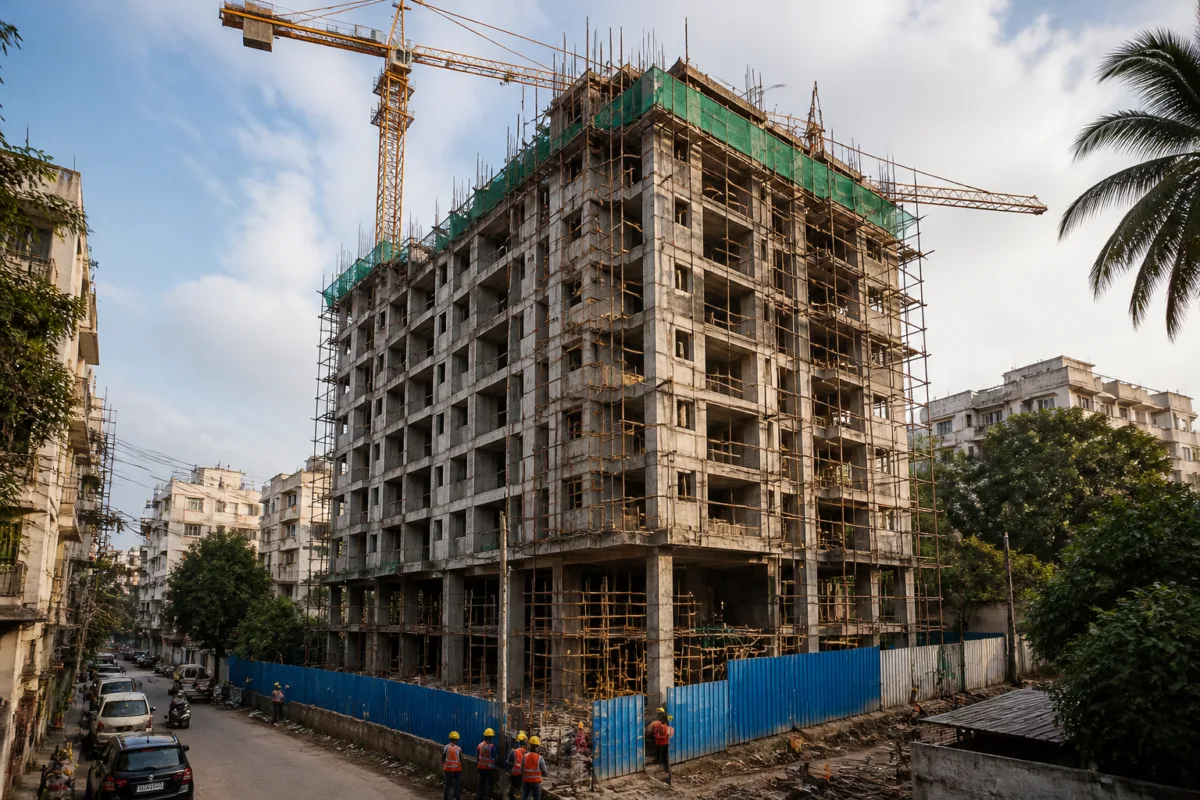
Karnataka’s decision to raise the high-rise threshold from 21 metres to 24 metres is being presented as a fire-safety rationalisation measure, but its immediate urban consequence could be felt in Bengaluru’s development economics. The change gives some buildings in the seven- to eight-floor range more room to remain below the revised threshold, potentially allowing developers to use premium floor area ratio (FAR) that was previously difficult to utilise under the state’s building rules.
The urban development department issued the order early this week, according to the report, stating that the revised definition followed recommendations from the Centre and the adoption of global best practices in building fire safety. Bengaluru development minister Krishna Byre Gowda said the relaxation would reduce the compliance burden and improve ease of doing business.
The important point is that the notification does not simply alter a technical measurement. The definition of a high-rise determines which buildings enter a more demanding regulatory category. Once a project crosses the applicable threshold, its approval and safety requirements can become more complex, particularly where fire-safety evaluation, certificates, renewals and other documentation are involved. Moving the threshold by three metres changes which projects are treated as high-rise buildings, although the precise effect will depend on each building’s design and the applicable zonal regulations.
That distinction matters in Bengaluru because developers have been purchasing premium FAR without always being able to use the full development potential associated with it. FAR determines the amount of built-up floor area that can be constructed on a plot. Premium FAR allows additional floor area beyond the base entitlement, subject to payment and regulatory conditions. The report quoted former Credai president Suresh Hari as saying that the government had been issuing premium FAR but there was insufficient space to use it effectively.
Hari said the revised rule could help developers use the available FAR more efficiently. He also said the change could spread the area over a building in a way that improves cost management. His explanation points to a gap between what planning rules permit on paper and what a project can practically deliver after setbacks, fire-safety requirements, access conditions and building-height restrictions are taken into account.
That gap is at the centre of the policy change. A developer may have additional development rights but still be unable to translate them into usable floor space if the project crosses a regulatory threshold or cannot satisfy the physical requirements attached to the extra height. The result is a form of under-utilisation: development capacity exists, but the building’s design, approvals and compliance obligations prevent it from being realised.
The new threshold therefore appears to address two connected concerns. One is administrative, involving the amount of documentation and repeated compliance required from applicants. The other is economic, involving the ability of a developer to make use of FAR already made available through the planning system. The government’s stated position is that rules should be rationalised without imposing uniform requirements on buildings whose actual risk profiles may differ.
Byre Gowda said rigid and outdated requirements were being re-evaluated. He also referred to fire-certificate renewal as a recurring administrative burden identified by the central government. According to the minister, imposing the same requirements regardless of the specific risks presented by a building can create repeated costs and additional documentation for applicants.
This introduces a risk-based logic into the debate, at least in the government’s explanation of the reform. The argument is not that fire safety should be reduced, but that regulatory requirements should reflect the characteristics and risks of individual buildings. The report said the minister identified industries, schools and hospitals as high-risk categories that are approved on the basis of fire-safety evaluation.
The distinction between regulatory simplification and safety dilution will depend on how the revised rule is implemented. The supplied report does not provide the full text of the notification, the detailed technical conditions attached to the new threshold, or any project-level data showing how many buildings will be affected. It also does not establish whether other requirements, such as access for emergency vehicles, fire-fighting systems, evacuation arrangements or setbacks, have changed. Those details will determine whether the reform mainly removes avoidable procedural duplication or materially alters safety obligations.
The fire and emergency services department appears to have supported the possibility of changing the height reference, subject to adoption in the applicable zonal regulations. That qualification is important. A statewide change in the definition does not automatically resolve every approval question in Bengaluru. The revised threshold still has to operate alongside local planning rules, zoning provisions and the conditions under which individual projects are sanctioned.
In practical terms, this creates an implementation chain involving the urban development department, local planning authorities, the fire and emergency services department and project applicants. The revised threshold may reduce the number of buildings that are categorised as high-rise for a particular approval purpose, but project-level compliance will continue to depend on the applicable regulations. The report does not specify how quickly zonal regulations will be amended or how pending applications will be treated.
That question is especially relevant for projects already in the approval pipeline. Developers who had designed buildings around the earlier 21-metre threshold may seek to revise plans, while projects that have already received approvals may fall under different rules depending on their stage of construction and the terms of the notification. The supplied material does not indicate whether the order applies retrospectively, prospectively or to specific categories of applications.
The reform also exposes a broader feature of Bengaluru’s urban governance: development capacity is shaped not only by the amount of land available, but by the interaction of FAR, setbacks, building height, fire-safety classification and approval procedures. A change to one threshold can affect the viability of floor space across a project without changing the underlying land parcel. It can also alter the balance between what is legally permitted and what is practically buildable.
The available evidence does not establish how much additional floor area will be created across Bengaluru, whether housing supply will increase, or whether the change will affect property prices. No figures on the number of eligible buildings, the volume of premium FAR sold, the value of unused FAR or the expected revenue impact were provided in the report. Those are the measurements that would be needed to assess the reform beyond its stated administrative objective.
For residents, the immediate significance will depend less on the headline change in metres than on what developers and authorities do with it. If the rule allows projects to use already-available FAR without weakening project-specific fire-safety evaluation, it could reduce approval friction and improve the use of permitted development capacity. If the change is implemented without clear technical guidance, it could instead create uncertainty over how different authorities interpret the revised threshold.
The notification consequently has two tests to pass. The first is whether it makes the approval system more proportionate by removing repeated or uniform requirements that do not reflect actual building risks. The second is whether the new threshold is supported by clear, enforceable safety conditions across the projects that benefit from it. The report confirms the government’s stated rationale and the real estate sector’s support, but it does not yet provide enough evidence to measure the reform’s citywide effects.
The next stage will be the adoption of the revised height reference in the applicable zonal regulations and its application to individual building approvals. The treatment of pending projects, the technical conditions attached to the new threshold and the fire-safety evaluation required for different building categories will determine whether Karnataka’s change becomes a genuine regulatory simplification or remains a limited adjustment to the approval process.

