


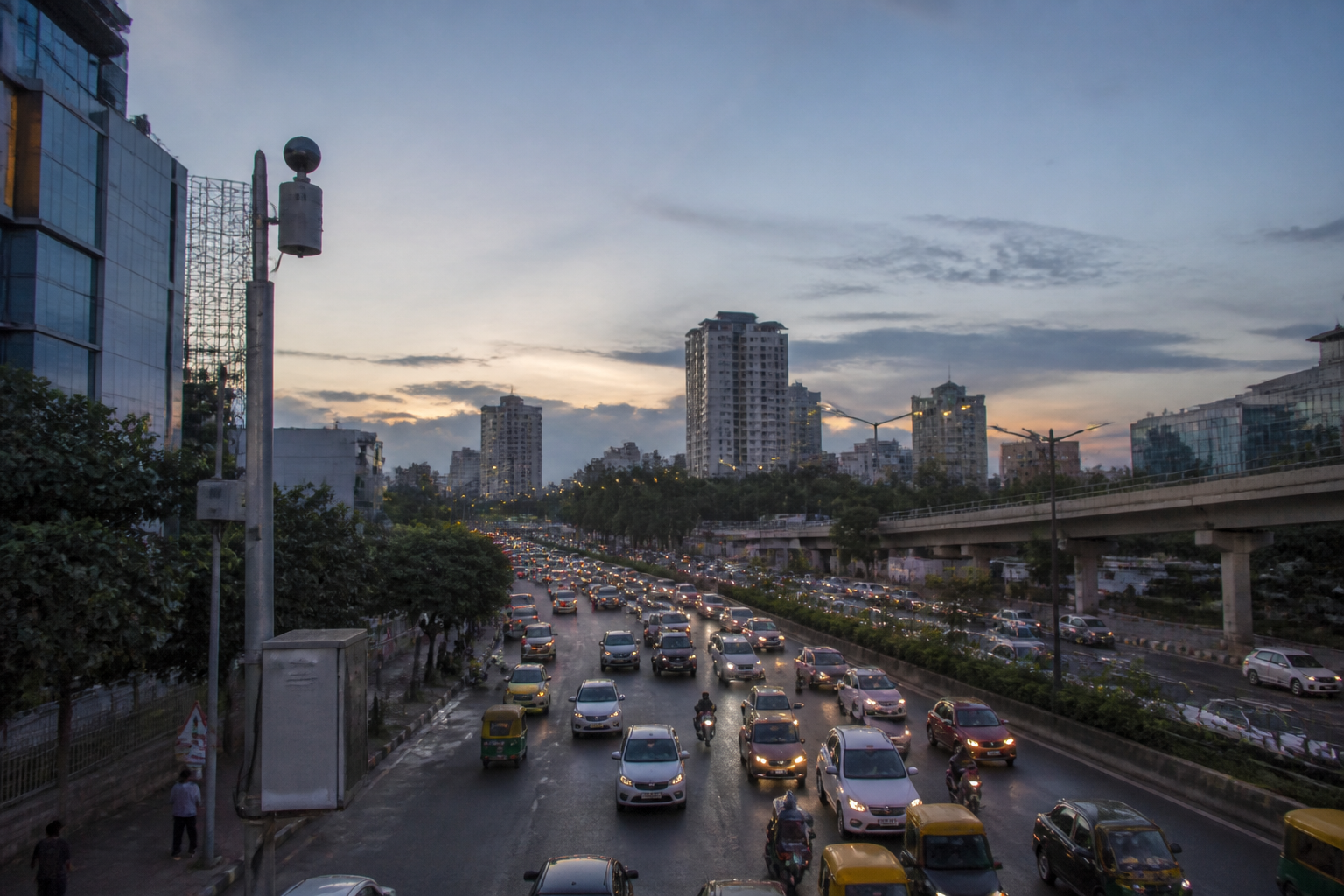
Karnataka State Pollution Control Board data indicates that noise levels at several Bengaluru monitoring locations are lower than they were in 2018. Yet the same readings show that noise remains above permissible limits at multiple sites, particularly at night. The contrast raises a larger question about how effectively the city measures an urban pollutant that changes with traffic, construction, land use and the placement of monitoring stations.
The recent data, as reported by Bangalore Mirror, shows that areas near NIMHANS and RV College of Engineering continue to record significant exceedances. Near NIMHANS, noise levels were 14.2% above the permissible limit during the day and 45% higher at night. Near RVCE on Mysore Road, the exceedance stood at 24.4% during the day and 55.3% at night.
Residential locations also remained above the applicable limits. In Domlur, the average noise level was 16.9% above the limit during the day and 30.7% higher at night. In BTM Layout, the corresponding figures were 17.6% during the day and 34.9% at night. These numbers do not describe a city free of noise pollution. They describe a city where recorded noise has declined at some established sites but remains materially high.
The comparison with 2018 makes the picture more complicated. At the monitoring station near NIMHANS, the monthly average was more than 38% above the permissible limit during the day and nearly 62% higher at night in that period. In Domlur, noise levels were around 20% above the limit during the day and 36% higher at night. BTM Layout recorded levels roughly 23% above the limit during the day and nearly 50% higher at night.
On those comparisons, the newer readings suggest an improvement. But a reduction against an earlier baseline does not automatically establish that Bengaluru as a whole has become quieter. It only establishes that measurements at particular locations were lower than earlier measurements. The distinction matters in a city whose built-up area, traffic patterns and activity centres have changed significantly.
The evidence reported by Bangalore Mirror points to a possible gap between the city being measured and the city being experienced. Anti-noise pollution campaigners argue that the number and location of monitoring stations have remained unchanged even as Bengaluru has expanded and its traffic patterns have shifted. If stations do not reflect newer high-activity or high-traffic areas, citywide conclusions drawn from them may be incomplete.
Raja Kannan, a resident of Begur Kopa Road in Hulimavu and an anti-noise pollution campaigner, said newer areas should be monitored and that the noisiest locations should be used as benchmarks. His argument is not that existing measurements are necessarily inaccurate. It is that a limited network may fail to capture the full distribution of noise across a changing metropolitan area.
Prajna Dutt, founder of the citizen collective Noisewatchers and a resident of JP Nagar, questioned the placement of some existing stations. She cited the Church Street station, which is classified as being in a commercial zone even though vehicular movement is banned there. She also questioned whether the BTM Layout station remains representative. Her broader point was that the city has grown beyond the assumptions underlying the current monitoring network.
This is the central analytical problem in interpreting Bengaluru’s noise data: a monitoring station measures conditions at its location, while policy decisions often require an understanding of conditions across a wider urban system. A reading from a relatively quiet or atypical site can be technically valid and still provide a poor picture of the exposure faced by residents elsewhere.
The issue also concerns how urban land use and transport interact. The source material identifies infrastructure projects as contributors to higher noise pollution, but experts cited in the report point to vehicular noise, including shrill and unnecessary honking, as the biggest contributor. That assessment places transport behaviour and vehicle regulation at the centre of the noise question rather than treating noise only as a temporary construction nuisance.
The distinction between daytime and nighttime readings is especially significant in the available data. Every location cited in the report recorded a larger exceedance at night than during the day. Near NIMHANS, the difference was 14.2% above the limit during the day compared with 45% at night. Near RVCE, it was 24.4% during the day compared with 55.3% at night. The same pattern appeared in Domlur and BTM Layout.
These figures show that the problem cannot be understood solely through average city activity. Noise may be lower in aggregate than it was in 2018 while still producing substantial nighttime exceedances at particular locations. That makes the time and place of monitoring as important as the headline trend. A citywide claim of improvement needs to account for both dimensions.
The supplied material does not establish whether the recent figures represent a continuous trend, a specific month’s results or a longer monitoring period. It also does not provide the absolute decibel readings, the applicable limits by land-use category, or a complete list of monitoring locations. Those gaps limit the conclusions that can be drawn. The data supports a comparison between cited locations and 2018, but not a definitive finding that Bengaluru’s overall noise pollution has significantly declined.
That limitation has implications for governance. The Karnataka State Pollution Control Board’s monitoring network is the foundation on which official assessments are made. If station locations remain fixed while the urban footprint changes, the board may need to explain how representativeness is maintained. The campaigners quoted in the report are effectively calling for monitoring to follow the city’s growth rather than remain tied to an older geography.
The policy response discussed in the report focuses on transport. Dutt said authorities had been asked to reduce and standardise decibel levels across vehicles and to penalise unnecessary honking more strictly. Such measures would address a source that is dispersed across the road network and difficult to capture through a small number of fixed stations. However, the source material does not establish whether these requests have been adopted or how enforcement currently operates.
The result is a two-part urban challenge. Bengaluru needs reliable measurements that reflect its present-day geography, and it needs effective action against the sources identified by experts. Better monitoring without enforcement would leave residents exposed. Enforcement without representative data would make it difficult to determine where intervention is most urgent or whether it is working.
The available evidence therefore supports a cautious conclusion. Noise levels at several monitored locations appear lower than in 2018, but many readings remain above permissible limits, especially at night. At the same time, the unchanged monitoring network and concerns about station placement make it difficult to treat the decline as a complete account of Bengaluru’s noise environment.
The developments that deserve attention are whether KSPCB expands or relocates monitoring stations, publishes fuller location-level and time-specific readings, and responds to concerns about newer high-noise areas. Until then, Bengaluru’s quieter readings should be understood as a partial measurement of the city, not a final verdict on whether the city has become quiet.

