


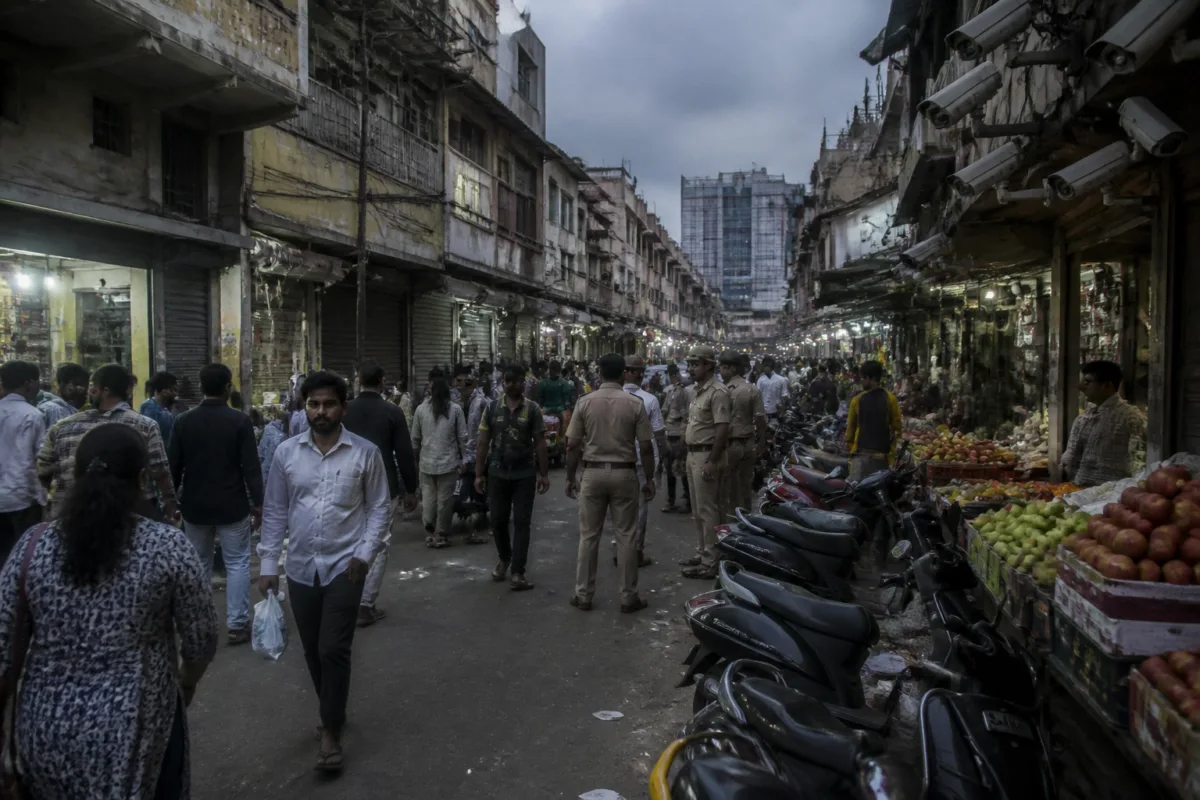
The reported assault of a 19-year-old fruit vendor in Bengaluru’s Chickpet after passersby allegedly mistook him for a phone thief is more than an account of a street confrontation. It shows how quickly an urban public-space incident can move from confusion to collective violence when suspicion replaces verification and bystanders assume the role of investigators and enforcers.
According to the Times of India report, Shahid Khan was riding a two-wheeler from Majestic towards RT Street with his friend Fardeen Pasha, also known as Kaalu, around 7pm on October 19. The vehicle allegedly brushed against an unidentified man, causing the man’s mobile phone to fall. When Pasha picked up the phone to return it, passersby allegedly mistook the two men for phone thieves.
A group of eight to 10 people then allegedly abused the pair and attacked Khan. The complaint said some members of the group punched him near the eyes while others struck him on the head with their phones. Khan suffered injuries to his head and face and was left bleeding. The account, as reported, is based on the complaint filed by the injured vendor; the identities and individual roles of the alleged attackers had not been established in the supplied material.
City Market police registered a case under Sections 115, 118, 119 and 352 of the Bharatiya Nyaya Sanhita. The provisions cited by police relate to voluntarily causing hurt, causing hurt or grievous hurt by dangerous weapons or means, liability of members of an unlawful assembly for offences committed in pursuit of a common object, and intentional insult intended to provoke a breach of peace.
The police response is significant because it places the incident within a formal evidentiary process rather than leaving the accusation to the crowd that initiated the assault. A senior officer told the Times of India that investigators had verified CCTV footage from surrounding buildings and were making efforts to trace the alleged assaulters. The officer also said Khan was out of danger and had no criminal background.
That sequence—an object falls, a person picks it up, bystanders interpret the action as theft, and a group attacks before the facts are established—illustrates the vulnerability of crowded commercial streets. Chickpet is a dense market area connected to major movement corridors, including the Majestic side of central Bengaluru. In such settings, many people may witness an incident for only a few seconds, while noise, congestion and rapid movement can make an event difficult to interpret accurately. The supplied report does not establish whether anyone verified ownership of the phone or contacted the police before the alleged assault.
This distinction matters. A suspicion in public space is not evidence, and the presence of several people does not turn an accusation into a verified fact. The police case and CCTV review indicate that the responsibility for establishing what happened has shifted to investigators. Until that process is completed, the central allegation remains that Khan was wrongly identified as a thief and assaulted. The available account does not identify the alleged attackers or report any finding that Khan or Pasha stole the phone.
The episode also exposes an institutional question for busy urban districts: how should immediate disputes be handled when the first witnesses are not trained to preserve evidence or assess competing accounts? In the reported case, the police are relying on CCTV from surrounding buildings to trace those involved. That makes surveillance footage an important part of the investigation, but it also underlines a limitation of camera-based enforcement: footage can help reconstruct conduct after an incident, yet it cannot undo injuries caused before the facts are established.
The report provides no information about the coverage, ownership or technical quality of the CCTV cameras used in the review. It also does not say whether the footage captured the initial contact, the phone being picked up, the alleged assault, or the identities of all participants. Those details will determine how effectively the evidence can distinguish between the original mishap and the later violence. At this stage, police have said they are making efforts to trace the alleged assaulters, not that they have completed the identification process.
The legal sections invoked by City Market police are another reminder that collective action in a public place does not remove individual accountability. Section 119, as cited in the report, addresses the liability of every member of an unlawful assembly for an offence committed in pursuit of its common object. The case therefore concerns not only the person or persons who may have physically struck Khan, but also the conduct of the wider group, subject to the evidence gathered by investigators and the eventual findings of the legal process.
The account also has a livelihood dimension. Khan is described as a fruit vendor working in Chickpet, and the reported assault occurred while he was travelling for work. An injury to the head and face can affect a worker’s ability to move, sell goods and earn, although the supplied report does not provide details about his treatment, income loss or the duration of recovery. The incident therefore sits at the intersection of public safety and the everyday risks faced by people whose work takes place on crowded streets rather than inside controlled premises.
For informal workers, street-level interactions are unavoidable. Vendors, delivery workers, transport users and pedestrians routinely share tight public spaces where minor collisions and misunderstandings can occur. The supplied material does not establish that such incidents are common in Bengaluru, nor does it provide citywide data on mob assaults or mistaken theft accusations. What it does document is a specific failure of restraint: a disputed event was followed by alleged collective punishment before the facts were resolved.
The police investigation will determine the next stage of the case. The immediate milestones identified in the report are the review of CCTV footage, efforts to trace the alleged attackers and the legal process arising from the registered complaint. The report does not include a statement from the unidentified man whose phone fell, from the alleged attackers, or from an independent witness. Those accounts could become relevant to establishing what happened before the assault.
The broader urban lesson is limited but clear. Public safety depends not only on police presence or surveillance infrastructure, but also on whether people defer accusation and punishment to due process. In this Chickpet case, the available evidence describes a minor road-side mishap becoming a serious assault after a phone was mistaken for proof of theft. What remains to be established is who participated, what the CCTV shows and how the courts assess the competing facts. Until then, the registered case and the police investigation are the formal route for determining responsibility.

